Dash Cam Audio Recording Laws by State: Consent Guide
Use this state-by-state planning guide to decide when to notify passengers, request consent, or switch off dash cam audio.
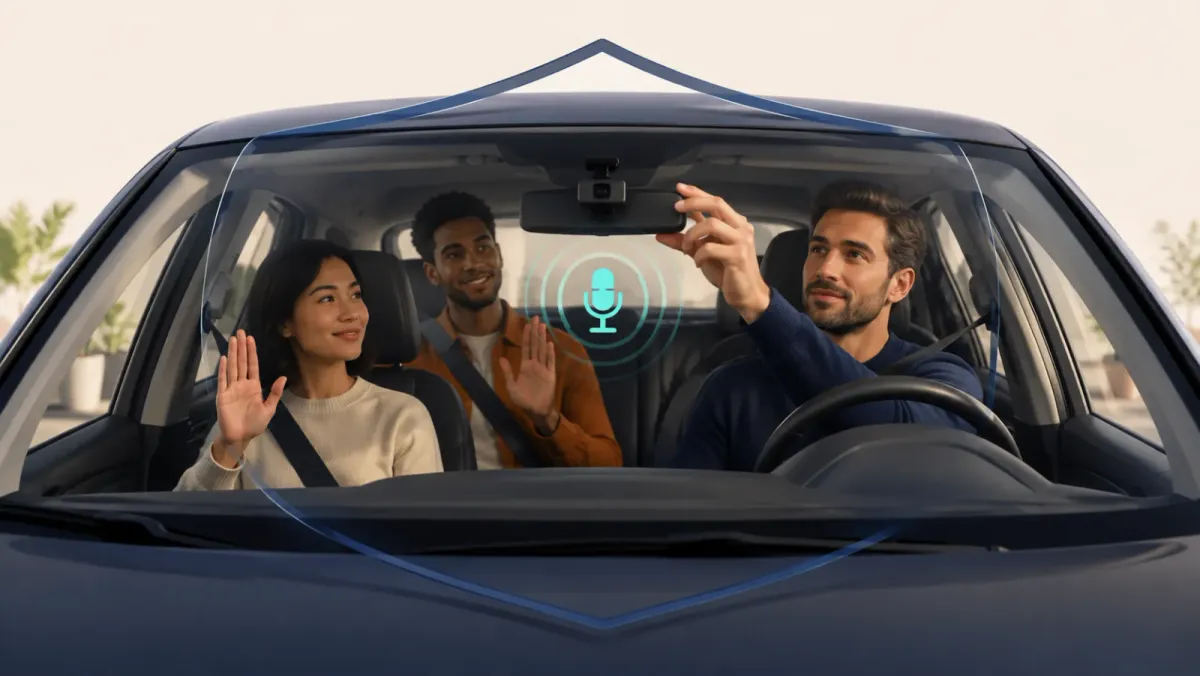
Dash cam audio may record private conversations, even when the lens faces the road. The safest nationwide approach is simple. Tell every occupant, obtain clear consent, or switch the microphone off. State labels help with planning, but privacy expectations and vehicle use still affect the answer.
This guide was checked on September 7, 2026. It provides general US information, not legal advice about a specific recording.
What does federal law require for dash cam audio?
Federal law generally uses a one-party consent rule. The recorder must participate or obtain prior consent from one participant.
The relevant exception appears in 18 U.S.C. section 2511(2)(d). It does not protect recording for a criminal or tortious purpose.
One-party consent does not mean anybody may record nearby speech. A dash cam is not a person and cannot provide consent.
If the driver participates in a conversation, the driver may supply the required federal consent. A stricter state rule may still require everyone.
Federal law also protects an oral communication when someone has a justified expectation against interception. Section 2510 defines that protected category.
Which state rule should a driver use?
Use the table as a conservative planning tool for in-person vehicle conversations. It does not cover every exception, court ruling, or telephone call.
The categories follow the Reporters Committee's state recording guide. That guide also warns that privacy and consent depend on circumstances.
| State | Planning category | Safer dash cam setting |
|---|---|---|
| Alabama | One-party baseline | Driver participates, or microphone off |
| Alaska | One-party baseline | Driver participates, or microphone off |
| Arizona | One-party baseline | Driver participates, or microphone off |
| Arkansas | One-party baseline | Driver participates, or microphone off |
| California | All parties for confidential speech | Announce and obtain consent |
| Colorado | One-party baseline | Driver participates, or microphone off |
| Connecticut | One-party for in-person speech | Confirm vehicle context |
| Delaware | Conflicting rules | Use all-party consent |
| Florida | All parties for private speech | Announce and obtain consent |
| Georgia | One-party baseline | Driver participates, or microphone off |
| Hawaii | Stricter in private places | Use all-party consent in vehicles |
| Idaho | One-party baseline | Driver participates, or microphone off |
| Illinois | All parties for private speech | Announce and obtain consent |
| Indiana | One-party baseline | Driver participates, or microphone off |
| Iowa | One-party baseline | Driver participates, or microphone off |
| Kansas | One-party baseline | Driver participates, or microphone off |
| Kentucky | One-party baseline | Driver participates, or microphone off |
| Louisiana | One-party baseline | Driver participates, or microphone off |
| Maine | Stricter in private places | Use all-party consent in vehicles |
| Maryland | All parties for private speech | Announce and obtain consent |
| Massachusetts | Secret recording restricted | Give notice and obtain consent |
| Michigan | Participant rule remains disputed | Use all-party consent |
| Minnesota | One-party baseline | Driver participates, or microphone off |
| Mississippi | One-party baseline | Driver participates, or microphone off |
| Missouri | All parties for private in-person speech | Announce and obtain consent |
| Montana | Knowledge of all parties | Give a clear recorded warning |
| Nebraska | One-party baseline | Driver participates, or microphone off |
| Nevada | One-party for in-person speech | Confirm vehicle context |
| New Hampshire | All parties for private speech | Announce and obtain consent |
| New Jersey | One-party baseline | Driver participates, or microphone off |
| New Mexico | One-party baseline | Driver participates, or microphone off |
| New York | One-party baseline | Driver participates, or microphone off |
| North Carolina | One-party baseline | Driver participates, or microphone off |
| North Dakota | One-party baseline | Driver participates, or microphone off |
| Ohio | One-party baseline | Driver participates, or microphone off |
| Oklahoma | One-party baseline | Driver participates, or microphone off |
| Oregon | Public recording rule changed | Review private vehicle context |
| Pennsylvania | All parties for private speech | Announce and obtain consent |
| Rhode Island | One-party baseline | Driver participates, or microphone off |
| South Carolina | One-party baseline | Driver participates, or microphone off |
| South Dakota | One-party baseline | Driver participates, or microphone off |
| Tennessee | One-party baseline | Driver participates, or microphone off |
| Texas | One-party baseline | Driver participates, or microphone off |
| Utah | One-party baseline | Driver participates, or microphone off |
| Vermont | Federal baseline | Driver participates, or microphone off |
| Virginia | One-party baseline | Driver participates, or microphone off |
| Washington | All parties for private speech | Record the announcement and consent |
| West Virginia | One-party baseline | Driver participates, or microphone off |
| Wisconsin | One-party baseline | Driver participates, or microphone off |
| Wyoming | One-party baseline | Driver participates, or microphone off |
The District of Columbia generally follows a one-party rule. Treat it like the one-party rows above.
Why are several states marked as mixed or uncertain?
Some states apply different rules by communication type, location, or recorder involvement. A single color-coded map hides those distinctions.
Connecticut and Nevada are generally one-party jurisdictions for in-person conversations. Their telephone rules are stricter, so broad summaries may label them differently.
Michigan courts disagree about recordings made by a participant. The safer operational rule is to obtain everyone's consent.
Missouri takes a stricter approach to private in-person conversations. Oregon's former public notice rule was struck down in 2023.
Oregon's public ruling does not settle every private vehicle recording. Hawaii and Maine also add protections for particularly private places.
Massachusetts focuses on secret interception. Its statute defines interception through secret recording without prior authority.
Is a conversation inside a vehicle private?
A vehicle cabin is not automatically public or private. Courts examine the entire situation and the speaker's justified expectations.
Relevant details can include these factors:
- Whether the camera and microphone were disclosed
- Whether the driver joined the conversation
- Whether strangers could naturally hear the speech
- Whether the subject matter was personal
- Whether the vehicle served passengers or employees
- Whether the camera kept recording after everyone left
California protects confidential communications while excluding some openly overheard speech. Penal Code section 632 defines those boundaries.
Florida similarly connects oral-communication protection with a justified privacy expectation. Its consent rule applies to protected private speech.
Practical rule: never assume a small windshield camera gives meaningful notice. Explain that audio is active before private conversation begins.
Does one-party consent cover parking-mode audio?
Usually not when no consenting participant is present. An unattended device may record a conversation involving strangers or returning passengers.
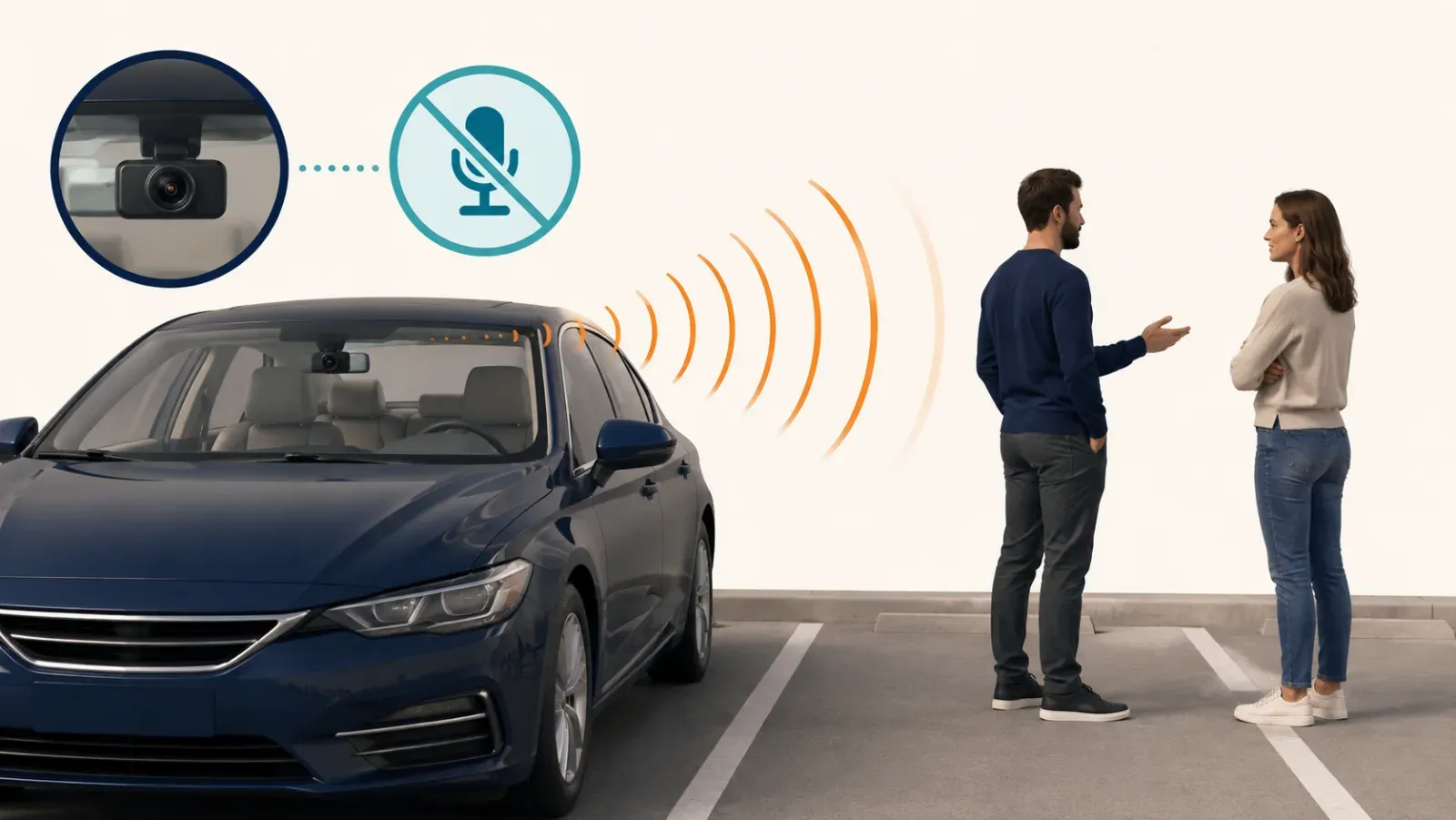
The one-party exception requires the recorder to participate or obtain a participant's consent. Background speech does not become recordable because the microphone belongs to the vehicle owner.
Parking audio creates a separate risk from exterior video. The microphone may capture nearby people while the driver is absent.
Disable parking-mode audio unless qualified advice confirms the specific use. Confirm the setting after firmware updates or factory resets.
How should passengers receive notice and give consent?
Give notice before recording and capture an affirmative response. A recorded exchange provides clearer evidence than an unnoticed sticker.
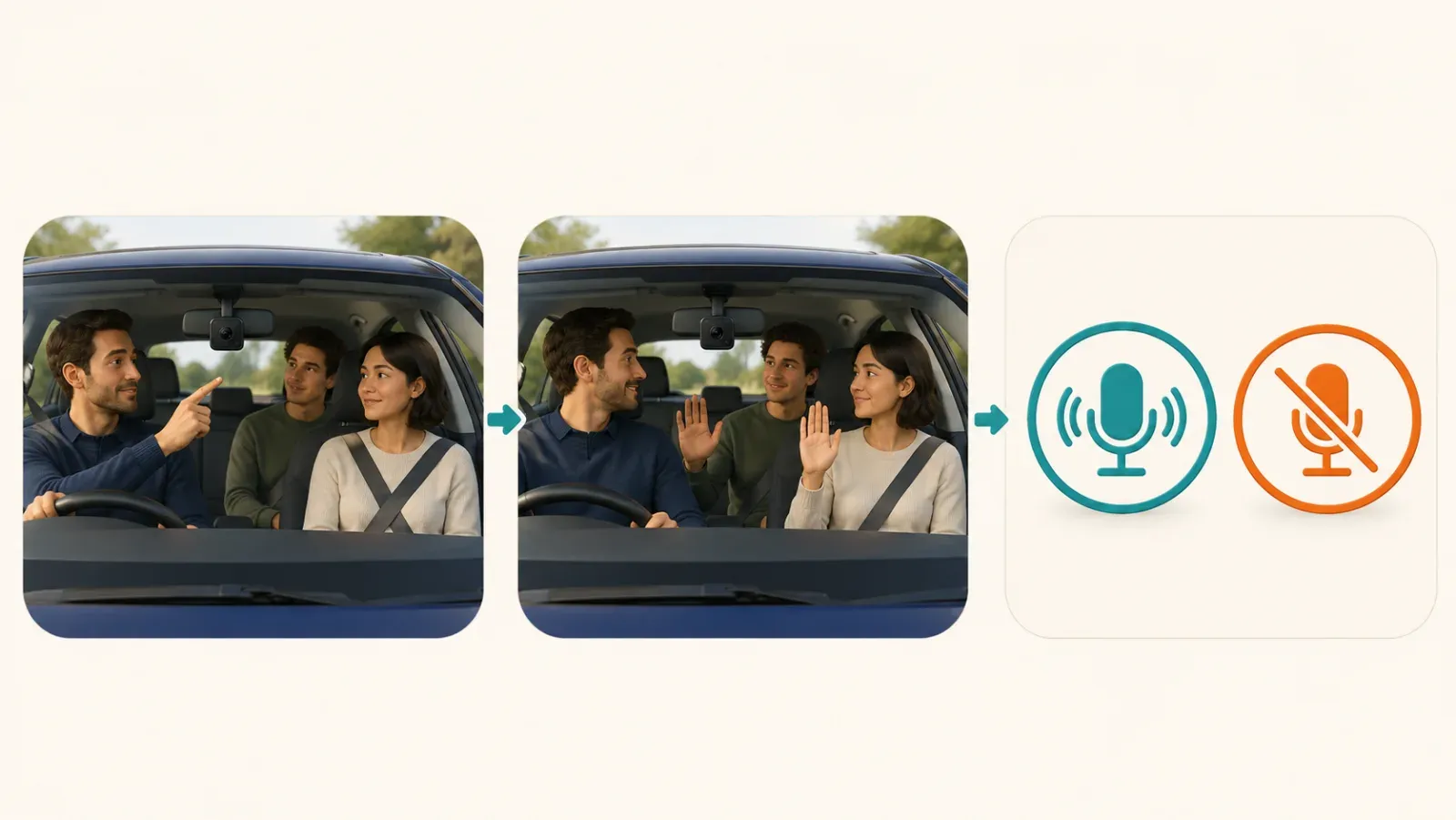
A simple process works for many personal trips:
- State that the dash cam records audio.
- Identify when recording starts and stops.
- Ask whether every occupant agrees.
- Record each clear response.
- Disable audio when anyone declines.
Washington specifically recognizes a reasonably effective announcement when the announcement is also recorded. RCW 9.73.030 states that method.
Do not pressure a passenger to agree. A child or dependent passenger may require additional legal and practical consideration.
What changes for rideshare, taxi, and fleet vehicles?
Professional passenger transport needs a written process, not an improvised warning. Local law, platform rules, employment duties, and retention policies may overlap.
Uber says local rules may require disclosure and consent. Its current guidance also prohibits public posting of rider recordings.
A business process should answer these questions:
- Who receives notice before entering?
- How can a passenger decline?
- Does declining disable audio or cancel service?
- Who may access recordings?
- How long are ordinary recordings retained?
- How are incident files separated and protected?
Platform notification may help, but it does not replace applicable law. Employer permission also does not automatically create passenger consent.
What rule applies during interstate travel?
Follow the stricter rule when a journey crosses jurisdictions. Courts may disagree about which state's law controls.
The Reporters Committee recommends the stricter approach for interstate conversations. A nationwide driver policy can avoid repeated legal guesses.
Use one of these two policies:
- Obtain every occupant's consent before audio starts.
- Keep audio disabled throughout the trip.
Recheck the policy before moving, changing routes, or starting passenger work. Laws and platform requirements can change.
Can a dash cam record audio during a traffic stop?
Recording officials performing public duties is often constitutionally protected. The recording must not interfere with their work.
Several federal appellate courts recognize that right. The Supreme Court has not issued one nationwide recording rule for every circumstance.
Keep the device mounted and avoid handling it while driving. Follow lawful safety directions without secretly changing settings during the encounter.
This public-duty principle does not authorize unrelated private recording. Passenger conversations still require their own consent analysis.
How should I configure the microphone?
Choose the audio policy first, then make the camera match it. Do not rely on a factory default.
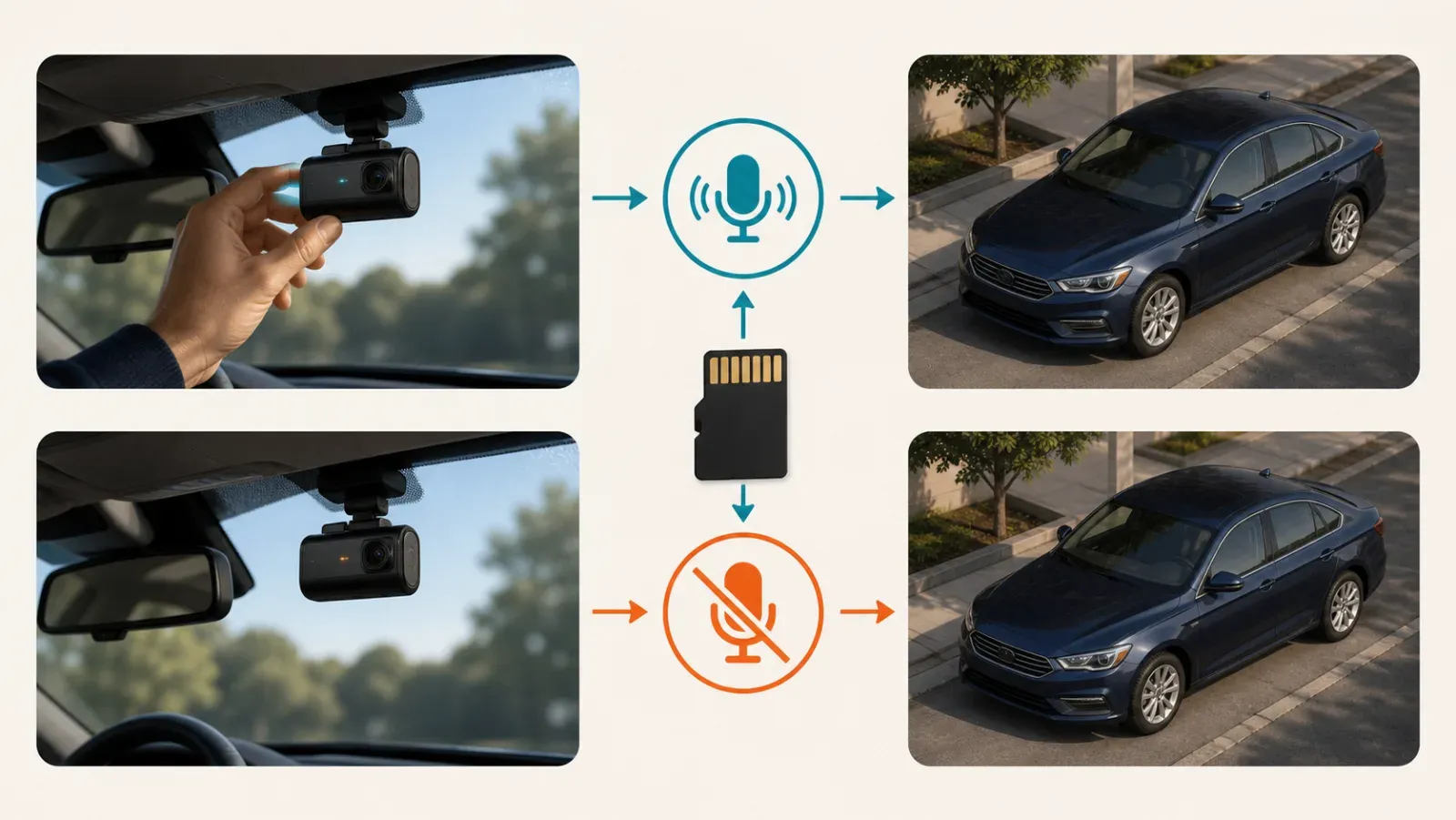
Garmin warns that some jurisdictions require passenger knowledge and consent. Its manual also confirms that audio can be switched off.
Use this setup checklist while parked:
- Find the camera's microphone control.
- Set the normal-driving audio choice.
- Check any separate parking-mode choice.
- Record a short test with consent.
- Play the file and confirm its audio state.
- Recheck after updates, resets, or profile changes.
If a lawful recording becomes evidence, keep the untouched original. Create separate copies for redaction, trimming, or limited sharing.
What is the safest nationwide policy?
Use all-party consent as the operational default. Disable audio whenever clear consent is missing or cannot be documented.
That policy does not resolve every workplace, privacy, or disclosure question. It does reduce dependence on simplified state labels.
Before an unusual use, check the current statute and relevant court decisions. Ask a qualified local attorney about disputes or commercial recording programs.