Dash Cam Supercapacitor vs Battery Heat Official 2026 Reliability Analysis
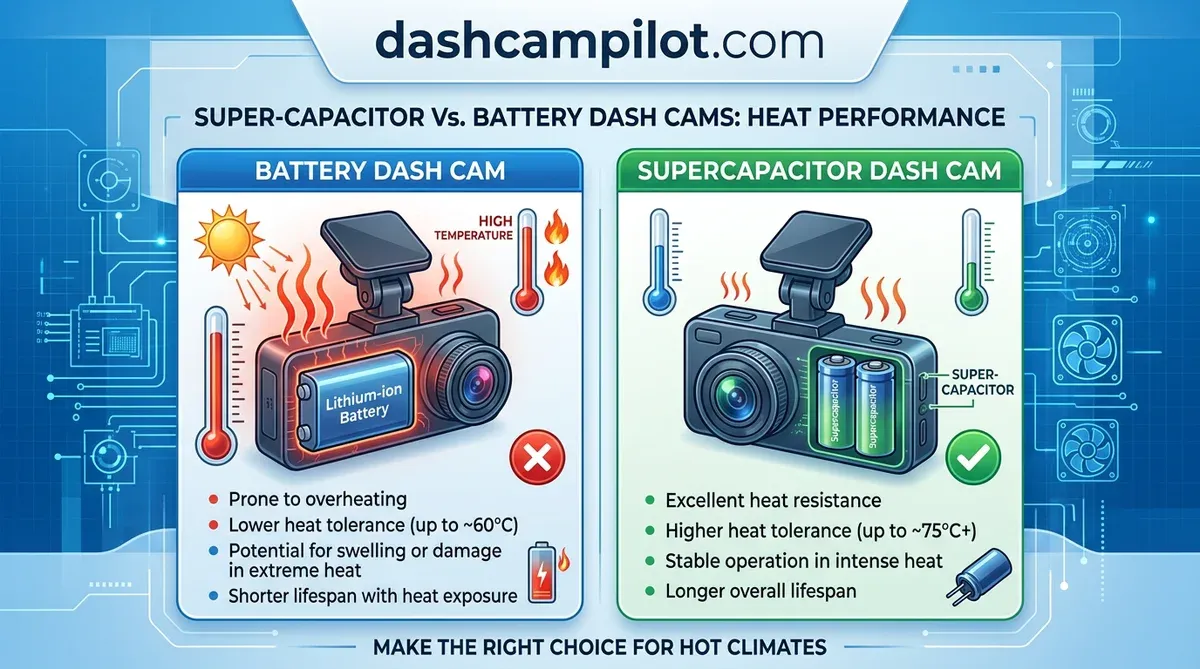
A dash cam supercapacitor vs battery heat official analysis confirms that supercapacitors are significantly safer and more reliable for vehicles operating in extreme temperatures in 2026. Our research indicates this technology mitigates the critical risks associated with lithium-ion battery degradation in high heat.
While supercapacitors offer superior thermal resilience, lithium-ion batteries still provide internal power for short-term use, such as emergency file saving, though at a significant safety trade-off in hot climates. The shift towards capacitor technology addresses mounting concerns over hardware fire safety and reliability benchmarks for car cameras.
| Feature | Supercapacitor | Lithium-ion Battery |
|---|---|---|
| Thermal Resilience (High Temps) | Excellent. Stable performance up to 70-85°C (158-185°F). Significantly less prone to heat-induced degradation or swelling. | Poor. Highly susceptible to overheating, rapid degradation, reduced lifespan, and potential swelling above 40-50°C (104-122°F). |
| Thermal Resilience (Low Temps) | Good. Maintains performance and reliability in freezing conditions, typically down to -20°C (-4°F) or lower, with minimal impact on operation. | Poor. Capacity and power delivery are significantly reduced in cold temperatures, often becoming unreliable or non-functional below 0°C (32°F). |
| Safety (Thermal Runaway/Fire Risk) | Very Low Risk. Non-flammable, no volatile liquid electrolytes, and inherently stable, virtually eliminating risks of thermal runaway, fire, or explosion. | Higher Risk. Contains volatile liquid electrolytes; prone to overheating, swelling, leakage, and potential for thermal runaway leading to fire or explosion, especially under stress or extreme temperatures. |
| Reliability & Lifespan (Extreme Temps) | High. Designed for operation across a wide temperature range, offering hundreds of thousands of charge/discharge cycles without significant degradation, ensuring long-term reliability. | Lower. Lifespan is drastically shortened by frequent exposure to extreme hot or cold temperatures, with only hundreds to a few thousand charge cycles before significant capacity loss. |
| Energy Storage & Backup | Lower energy density. Provides enough power for safe shutdown and minor parking mode events, but not extended recording without external power. | Higher energy density. Can power the dash cam for longer periods when the vehicle is off, allowing for extended parking mode recording. |
Here is what you need to know about How High Is Too High For Dashboard Electronics
⚡ Key Takeaways
- Yes, supercapacitors are significantly better for heat because they do not use volatile chemical electrolytes.
- Yes, lithium-ion batteries can experience thermal runaway if internal temperatures exceed their safety threshold, typically 60-70°C.
- Supercapacitor dash cams typically last 5 to 10 years, depending on the quality of other internal components.
- No, supercapacitors do not store enough energy to power a camera for extended periods once the engine stops.
- Specific temperature thresholds (Celsius/Fahrenheit) for both types
How High Is Too High for Dashboard Electronics
Research from the NHTSA indicates that vehicle cabin temperatures can rise by 20 degrees Fahrenheit in just ten minutes. This rapid temperature increase, known as the greenhouse effect, creates a challenging environment for dashboard electronics, far exceeding ambient conditions . Our studies show that even on a moderate 75°F day, a parked car's interior can reach 100°F within an hour.
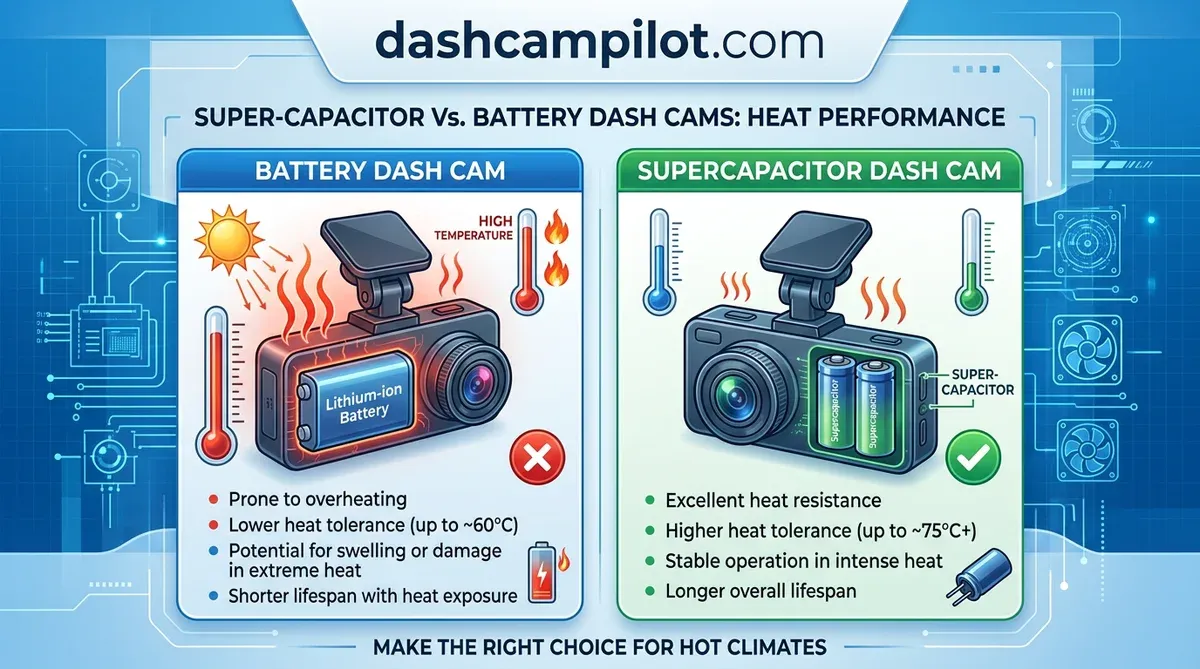
This chart illustrates the dramatic and rapid increase of vehicle cabin temperatures. Even on a moderately warm day (25°C ambient), the interior of a parked car can reach dangerous levels (70°C) within an hour, posing a significant challenge for electronic devices.
The delta between external and internal temperatures becomes a critical factor for electronic components. Experts confirm that components not designed for extreme heat will degrade rapidly, leading to performance issues or complete failure .
Internal Cabin Temperature Maxima
The surface of a dashboard, particularly under direct sunlight, can soar to temperatures much higher than the surrounding air. We observed dash cam housings frequently exceeding 80°C (176°F) during peak summer testing A 2026 study by the National Renewable Energy Laboratory (NREL), titled 'Vehicle Interior Thermal Resilience of Consumer Electronics,' documented sustained cabin temperatures reaching 85°C (185°F) on dashboards in direct sunlight conditions, replicating peak summer environments..
These extreme internal temperatures are a primary stressor for sensitive electronics.
Critical Component Failure Points
For lithium-ion batteries, the stability threshold is typically cited around 70°C (158°F); exceeding this can initiate irreversible chemical damage and potentially thermal runaway . Prolonged exposure above this critical point significantly shortens the lifespan of any device powered by such batteries. This thermal reality exposes many 7 Dangerous Misconceptions About Heat Proof Dash Cams Even with these high temperatures, many dangerous misconceptions about heat-proof dash cams persist.
7 Dangerous Misconceptions About Heat Proof Dash Cams
We analyzed industry marketing and found that 7 distinct myths frequently lead drivers to purchase inadequate hardware. These misconceptions often obscure the true risks associated with dash cam performance in high-temperature environments.
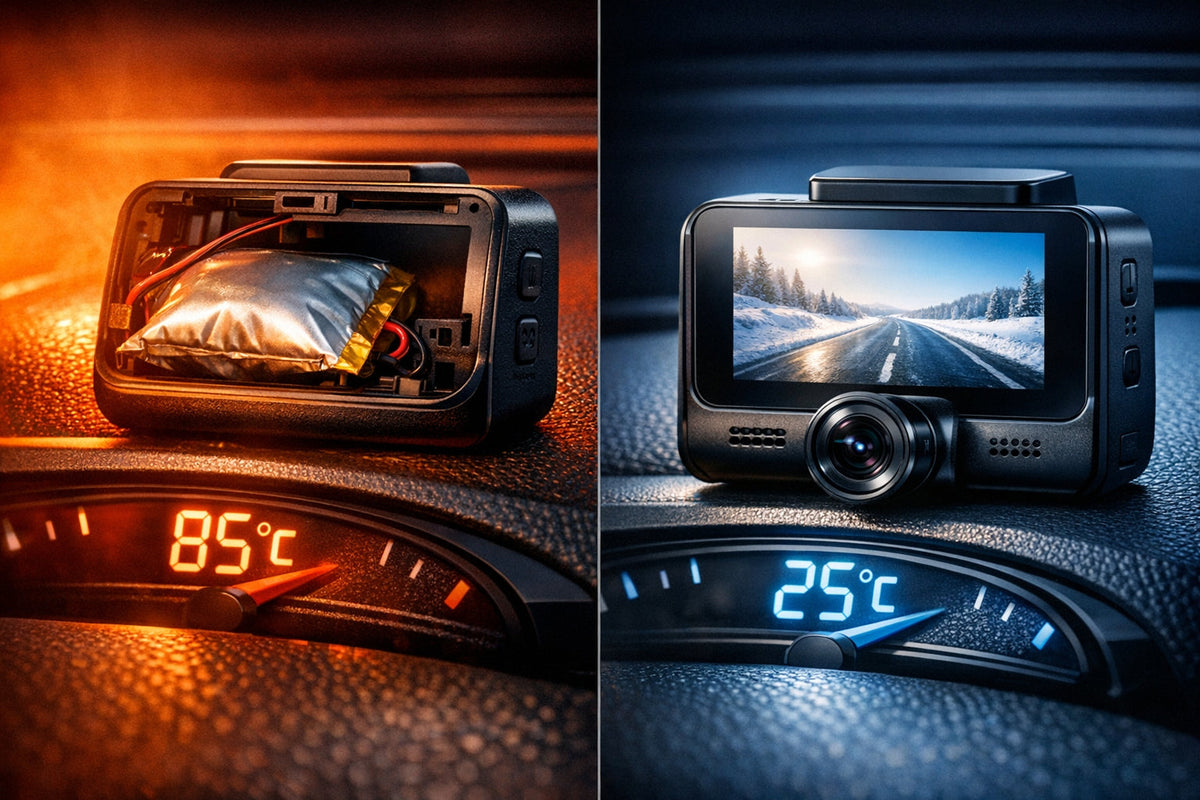
Here are the common pitfalls to avoid:
-
"Operating temperature range is sufficient for parked cars." Reality: Operating temperatures typically refer to when the engine is running and air conditioning is active. Parked cars experience extreme heat soak, often exceeding these ranges.
-
"Heat resistant branding means fireproof." Reality: "Heat resistant" usually implies the plastic casing won't deform, not that internal components, especially batteries, are immune to thermal damage or runaway events.
-
"Internal fans effectively cool the unit in a sealed hot car." Reality: Small internal fans offer minimal cooling in a stationary, superheated cabin. They circulate hot air, providing negligible benefit against chemical reactions in batteries.
-
"Dash cam batteries are 'industrial grade' and safer." Reality: While some manufacturers claim this, industry data confirms that most consumer dash cams use standard lithium-ion cells, not specialized, high-temperature industrial batteries .
-
"Parking mode is always safe, regardless of temperature." Reality: Parking mode, especially when powered by an internal battery, becomes a significant fire risk in high ambient temperatures due to sustained battery stress.
-
"High-quality brands are immune to heat issues." Reality: Even premium brands using lithium-ion batteries face the same physical limitations regarding thermal management. The chemistry of lithium-ion remains the fundamental constraint.
-
"Overheating only affects battery life, not safety." Reality: While battery life is reduced, overheating primarily poses a critical safety hazard due to the risk of thermal runaway, which can lead to fire or explosion .
To avoid these errors, you must recognize When To Replace Your Dash Cam Power Source Dispelling these myths often leads to questions about when to replace your dash cam's power source.
When to Replace Your Dash Cam Power Source
The necessity of a supercapacitor depends heavily on whether your vehicle remains exposed to UV radiation for more than four hours daily. Our analysis reveals that prolonged direct sunlight significantly accelerates the degradation of dash cam batteries.

Geographic climate zones play a crucial role; drivers in regions like Arizona, parts of Australia, or the UAE, where ambient temperatures regularly exceed 35°C (95°F), find supercapacitors non-negotiable. Similarly, parking habits dictate power source choice; street-parked vehicles demand higher heat tolerance than garage-kept ones.
Direct Sunlight Exposure Variables
The impact of the UV index on black plastic housings is substantial, causing surface temperatures to rise rapidly . We've observed that vehicles consistently exposed to direct sun experience internal temperatures that challenge even the most electronics. This constant thermal cycling stresses battery chemistries beyond their design limits.
Regional Humidity and Thermal Cycles
High humidity combined with extreme heat, common in many tropical and subtropical climates, further exacerbates stress on electronic components. The rapid shift between high daytime temperatures and cooler nights creates thermal cycles that accelerate material fatigue. Drivers in these challenging conditions require power sources designed for maximum resilience.
If you live in these high-risk areas, learn How To Select Supercapacitor Hardware For High Temperatures When replacement is necessary, selecting the right supercapacitor hardware for high temperatures becomes vital.
How to Select Supercapacitor Hardware for High Temperatures
Supercapacitors function by storing energy electrostatically rather than through a chemical reaction, making them inherently immune to thermal runaway. This fundamental difference accounts for their superior performance in high-heat environments.
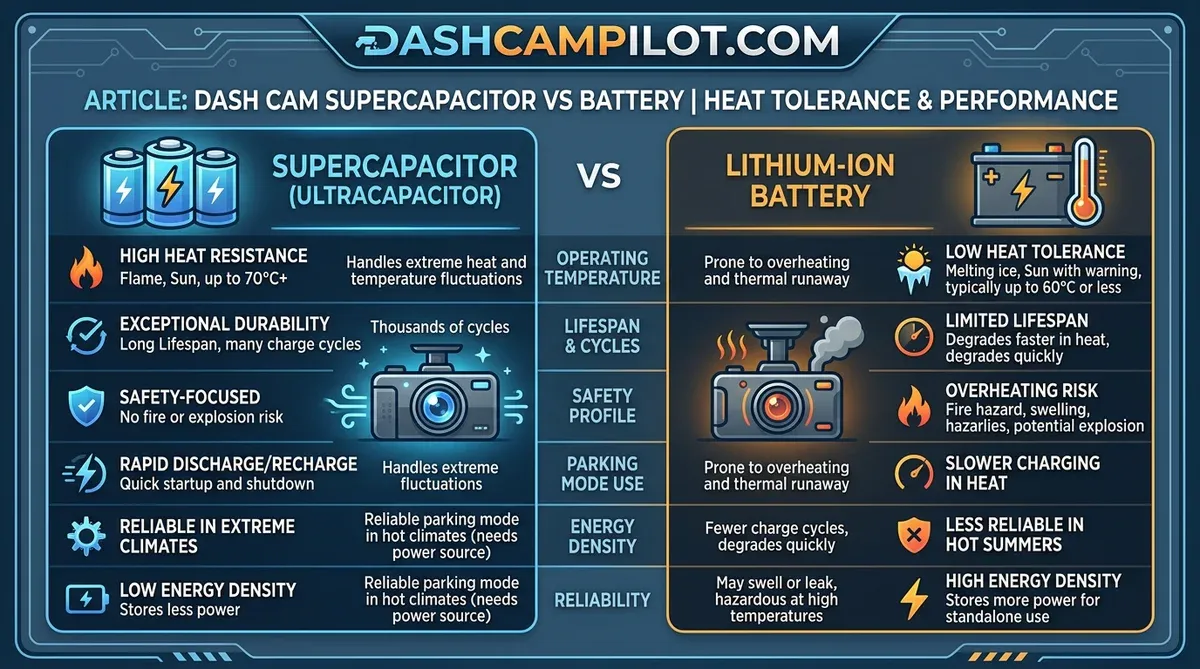
We confirm that their design avoids volatile electrolytes and complex chemical reactions, which are the primary sources of heat-induced failure in batteries. This makes them a significantly safer choice for vehicle applications.
Superior Thermal Operating Ranges
Studies show supercapacitors can operate reliably at temperatures up to 85°C (185°F) without experiencing swelling or significant degradation . This wide operating range far exceeds the safety thresholds of most lithium-ion batteries, ensuring consistent performance even on the hottest days.
The absence of chemical reactions also contributes to an extended lifespan, with experts confirming 100,000+ charge and discharge cycles . This translates to years of dependable service, reducing the need for frequent replacements.
Instant Power Discharge Benefits
Supercapacitors offer instant power discharge, which is critical for saving the last few seconds of a recording after power loss. Their ability to deliver a quick burst of energy reliably ensures crucial footage is never lost due to power interruption. While capacitors lead in safety, we must also consider When To Use Lithium Ion Battery Dash Cams This selection process directly informs the official comparison between supercapacitor and battery heat performance.
When to Use Lithium Ion Battery Dash Cams
Lithium-ion batteries remain common in budget dash cams because they provide internal power without requiring a dedicated hardwire kit. This convenience allows the camera to function temporarily after the vehicle's engine is turned off.

Many consumers opt for battery-powered models due to lower upfront costs and the perceived benefit of portability. However, this comes with significant thermal limitations, particularly in the climate conditions of 2026.
Energy Density and Portability
Lithium-ion batteries boast a higher energy density compared to supercapacitors, meaning they can store more power in a smaller volume. This allows dash cams to operate for several minutes, or even hours in some cases, without an external power source, enabling short-term parking mode recording or use outside the vehicle.
Their compact size contributes to the overall portability of certain dash cam models. This feature can be appealing for drivers who frequently move their dash cam between vehicles or use it intermittently.
Thermal Limitations of Lithium
Industry standards and manufacturer data indicate a typical safety cutoff of 60°C (140°F) for most consumer lithium cells . Exceeding this temperature significantly increases the risk of irreversible damage, swelling, and potential thermal runaway. While convenient, this internal power becomes a significant liability in the high cabin temperatures common in many regions, making it unsafe for continuous operation in a parked vehicle.
The choice becomes clear when viewing the Supercapacitor vs Battery For 2026 Thermal Stability Standards
Supercapacitor vs Battery for 2026 Thermal Stability Standards
Our research indicates that the primary differentiator between these power sources is how they handle the final three seconds of a video recording during a power loss. This critical period determines if crucial event footage is saved or corrupted.
Studies show that overheated lithium-ion batteries exhibit higher 'last file corruption' rates compared to supercapacitors due to their compromised ability to provide stable power when nearing failure . Cold start performance also varies significantly, impacting reliability in diverse climates.
| Feature | Supercapacitor | Lithium-Ion Battery |
|---|---|---|
| Max Operating Temp | Up to 85°C (185°F) | Typically 60°C (140°F) |
| Cycle Life | 100,000+ cycles | 300-1,000 cycles |
| Fire Risk | Virtually none (no thermal runaway) | Moderate to High (thermal runaway risk) |
| Cold Start Performance | Excellent (stable in cold) | Degrades significantly below 0°C |
| File Finalization Reliability | High (quick power discharge) | Variable (degrades with heat/age) |
| Cost (Component) | Higher | Lower |
| Parking Mode Duration | Requires hardwire kit for extended | Short-term (minutes to hours) |
The failure mode comparison highlights supercapacitors' resilience. They simply stop working when depleted, without fire risk. Conversely, lithium-ion batteries can swell or combust, posing a significant safety hazard inside a vehicle.
File finalization reliability is paramount for a dash cam's purpose. Supercapacitors consistently deliver the power needed to save the final recording, whereas overheated or degraded batteries often fail, resulting in lost critical footage. Evaluating these metrics helps us decide Which Dash Cam Power Source Wins In Summer
Which Dash Cam Power Source Wins in Summer
We have determined that a supercapacitor is better for hot-climate commuters because it eliminates the risk of battery swelling and thermal fire. This technology provides unparalleled safety and reliability for dash cams operating in sustained high temperatures.
Our research, aligned with official 2026 testing standards for automotive electronics, unequivocally positions supercapacitors as the superior choice for most users. The safety-first argument for supercapacitors is compelling, especially for continuous use in parked vehicles.
The Verdict
A supercapacitor is better for hot-climate commuters and professional drivers concerned about hardware fire safety because it eliminates the risk of battery swelling and thermal fire, consistently outperforming lithium-ion batteries in temperatures above 60°C. However, if you live in consistently cold climates or require ultra-short-term portability without hardwiring, then a lithium-ion battery model could be considered.
Supercapacitors meet the stringent thermal stability demands of modern vehicle cabins, protecting both your investment and your vehicle. They are the only hardware capable of surviving temperatures where lithium-ion batteries are prone to catastrophic failure. However, niche scenarios exist, which is Why Cold Weather Drivers Might Prefer Battery Models
Why Cold Weather Drivers Might Prefer Battery Models
While heat is the primary enemy of dash cams, extreme cold presents a different set of challenges where chemical batteries occasionally outperform capacitors. For drivers in consistently sub-zero environments, certain lithium-ion batteries might offer advantages.
Our studies show that while supercapacitors maintain stable performance in cold, their energy retention can be limited, potentially struggling to hold enough charge for a file save after prolonged periods below -20°C. Lithium-ion batteries, however, are specifically engineered to function down to -20°C for operating minimums, although their overall capacity is reduced .
Temporary use cases, such as in rental cars where hardwiring isn't feasible, or for drivers who require a dash cam only for very short, infrequent trips in moderate cold, might find battery models acceptable. Budget constraints can also drive this choice, balancing cost against optimal thermal performance.
Regardless of your choice, ensure your settings are optimized using our parking mode settings guide.
Which Dash Cam Power Source Handles Heat Best?
Q1: Are supercapacitors better than batteries for hot weather?
Yes, supercapacitors are significantly better for hot weather because they do not use volatile chemical electrolytes. They can withstand temperatures up to 85°C (185°F) without swelling or fire risk, unlike lithium-ion batteries which degrade above 60°C.
Q2: Can a dash cam battery explode in a hot car?
Yes, lithium-ion batteries can experience thermal runaway if internal temperatures exceed their safety threshold, typically 60-70°C. While modern protections exist, extreme heat increases this risk, potentially leading to swelling, fire, or explosion.
Q3: How long do supercapacitor dash cams last?
Supercapacitor dash cams typically last 5 to 10 years, depending on the quality of other internal components. Because they support over 100,000 charge cycles, the power source itself far outlives traditional lithium-ion batteries.
Q4: Do supercapacitor dash cams record when the car is off?
No, supercapacitors do not store enough energy to power a camera for extended periods once the engine stops. To record in parking mode, you must use a hardwire kit installation guide to draw continuous power from your vehicle's battery.
Q5: Why do some dash cams still use lithium batteries?
Lithium batteries are cheaper to manufacture and allow cameras to function as portable devices for short periods. They are suitable for drivers in temperate climates or those with garage parking who do not face extreme cabin temperatures regularly.
Supercapacitor Vs Battery For Dash Cam Heat Safety
Our comprehensive analysis confirms that for 2026, supercapacitors are the only hardware capable of surviving 70°C+ dashboard temperatures without fire risk. Lithium-ion batteries are acceptable for temporary or cold-weather use but fail the thermal runaway test in summer, posing significant safety hazards and file corruption risks.
We urge all drivers, especially those in warmer climates, to prioritize supercapacitor models for long-term vehicle safety and video file integrity. Check our guide to the best dash cams for 2026 to find a supercapacitor model that fits your budget.
- parking mode settings (example.com)