What Type Of Sd Card For Dash Cam Specification Chart By Year (2026 Full Reference)

Quick Answer
Dash cams require High Endurance microSD cards built with TLC or pSLC NAND flash rated at minimum Class 10, U3, and V30 (30 MB/s sustained write). Standard consumer cards fail quickly under continuous loop-recording stress. For modern 4K and multi-channel systems through 2026, factory specifications mandate capacities between 128GB and 512GB formatted to exFAT or FAT32, with an operating temperature tolerance of -25°C to 85°C.
The correct memory card for a vehicle dashboard camera is a High-Endurance or Max-Endurance microSD card rated at Video Speed Class 30 (V30) or UHS Speed Class 3 (U3), offering sustained write capabilities between 10 MB/s and 30 MB/s across an optimal capacity range of 32 GB to 256 GB. Standard consumer flash memory fails rapidly under continuous loop recording schedules, and using a non-endurance card typically voids the manufacturer warranty immediately. Before purchasing, verify your camera chipset's maximum gigabyte ceiling and formatting constraints in your official hardware manual.

What Type Of Sd Card For Dash Cam: Hardware Specification Chart (2020–2026)

Data Scope, Verification, and Testing Caveats
This technical reference collates factory requirements established by premier dash cam original equipment manufacturers (OEMs), internal chip controller specifications (Novatek, Ambarella, SigmaStar, HiSilicon), and SD Association compliance parameters. Dash cam configurations vary across video channel counts (single forward-facing, dual front/rear, or triple cabin setups), encoding standards (H.264/AVC versus H.265/HEVC), and maximum bitrate streams. Always consult your specific hardware model's printed owner's manual or firmware release documentation to confirm maximum supported card volume and required partition tables.
Covers dash cam hardware architectures released for model years 2020 through 2026 across entry-level, mid-tier, and flagship multi-channel telematics configurations. Factory specification ratings assume continuous loop recording mode under ambient automotive operating environments. Last reviewed: October 2026.
How to read this chart: Identify your dash cam hardware production era and primary processing architecture. Match the camera configuration (channel count and resolution) to find the baseline SD Association speed class, the sequential minimum write speed required to prevent buffer runouts, the factory capacity range, and the required underlying flash endurance tier.
Full Hardware Specification Table Across Camera Generations
| Year | Model / Engine | Specification | Value | Notes |
|---|---|---|---|---|
| 2020 | Single-Channel 1080p (Basic H.264) | Class 10 / UHS-I U1 / V10 | 32 GB – 64 GB | 10 MB/s min sustained write; FAT32 partition required by native SoC. |
| 2021 | Dual-Channel 1080p + 1080p Cabin/Rear | UHS-I U3 / V30 High Endurance | 64 GB – 128 GB | Simultaneous dual I/O stream; baseline Class 10 cards experience buffer drops. |
| 2022 | Single/Dual 2K QHD (1440p) HDR | UHS-I U3 / V30 High Endurance | 64 GB – 256 GB | Requires sustained write of ≥30 MB/s; transition point to universal exFAT adoption. |
| 2023 | Dual-Channel 4K UHD Front + 1080p Rear | UHS-I U3 / V30 / A2 Endurance | 128 GB – 256 GB | Bitrates exceed 45–60 Mbps; standard consumer flash exhibits thermal throttling. |
| 2024 | Triple-Channel 4K + 2K + 1080p (H.265) | UHS-I U3 / V30 Max Endurance | 128 GB – 512 GB | Three concurrent file writes; demands tuned wear-leveling firmware and high IOPS. |
| 2025 | 4K60 HDR Dual-Channel with LTE Cloud Link | UHS-I U3 / V30 / Industrial Spec | 128 GB – 512 GB | Continuous sub-stream file splitting for cellular proxying alongside raw master writes. |
| 2026 | Multi-Channel AI Vision Telematics (Dual 4K) | UHS-I U3 / V30 / V60 Industrial pSLC/MLC | 256 GB – 1 TB | Combined bitrates reach 80–120 Mbps; cards must maintain 30–60 MB/s at 85°C windshield soak. |
Footnote: Values indicate certified SD Association minimum sequential write thresholds. Burst read speed ratings on retail packages (e.g., 100–170 MB/s) are non-indicative of continuous in-vehicle write reliability. Verify hardware max rating in the camera user manual.
Year-by-Year Memory Card Requirement Changes Across Dash Cam Generations
2020–2022: Baseline 1080p and Early 2K Systems
Between 2020 and 2022, automotive dashboard cameras relied predominantly on single-channel H.264 compression profiles writing at nominal bitrates between 10 Mbps and 18 Mbps. During this period, an entry-level Class 10 or UHS Speed Class 1 (U1) card providing a Sequential Minimum Write Speed of 10 MB/s satisfied the physical bandwidth requirement. However, this era marked the widespread transition from passive parking recording to active dual-lens setups (front and rear). As dual 1080p channels doubled write cycles, legacy consumer flash cards began experiencing widespread cell exhaustion, forcing manufacturers to recommend specialized high-endurance variants.
2023–2024: Dual-Channel and 4K Bitrate Expansion
The widespread adoption of true 4K (3840×2160) Sony STARVIS and STARVIS 2 image sensors fundamentally changed memory demands. Real-time H.264/H.265 encoding at high bitrates (35 Mbps to 55 Mbps on the front channel alone) created catastrophic write-buffer queues on older U1 memory cards. In a Loop Recording System, flash controllers must clear, erase, and write flash memory blocks simultaneously. Because standard consumer flash cards lack aggressive background garbage collection and optimized flash controller wear-leveling algorithms, write speeds frequently collapsed below 4 MB/s during block erase routines, triggering fatal camera reboots, frozen frames, and missing event logs.
2025–2026: Multi-Channel Cloud Streams and AI Telematics
Modern 2025 and 2026 platforms integrate dual 4K or 4K/2K/1080p multi-channel camera arrays with onboard artificial intelligence (edge vision computing) and real-time LTE/5G telematics streaming. These platforms write uninterrupted full-frame video files while simultaneously updating event metadata, GPS tracking coordinate indexes, and low-latency proxy cache files. As a result, the storage media must deliver both rock-solid UHS Speed Class 3 (U3) or Video Speed Class 30 (V30) sequential throughput and resilient random write operations (Application Performance Class A2 standard) without succumbing to thermal throttle limits on sun-baked windshield mounts.
What Type Of Sd Card For Dash Cam: Physical Architecture Breakdown
NAND Flash Memory and Controller Wear Leveling
A microSD card is an integrated embedded microcomputer system comprised of multiple microscopic layers: planar or 3D NAND Flash Memory dice, a high-speed Flash Memory Controller ASIC, passive circuitry, and hardened Protective Encapsulation terminated by corrosion-resistant Gold Contact Pins. When a camera operates in continuous loop recording mode, the memory controller executes thousands of Program/Erase (P/E) cycles on the underlying floating-gate or charge-trap silicon cells.
Standard consumer microSD cards utilize Triple-Level Cell (TLC) or Quad-Level Cell (QLC) arrangements storing three or four bits per cell. These configurations feature weak native endurance—often under 500 to 1,000 P/E cycles. High-Endurance media, by contrast, deploys Multi-Level Cell (MLC, 2 bits per cell) or heavily over-provisioned, binned 3D-TLC programmed in pseudo-SLC (pSLC) modes. These industrial-grade approaches withstand 3,000 to 30,000+ P/E cycles, providing the durability needed to sustain years of relentless in-car recording.
High-Endurance vs. Standard Consumer Cards
The difference between a mass-market retail card and a true continuous-recording card centers on firmware engineering and cell grading. The table below illustrates the critical structural variances between media grades.
Major storage fabricators (including SanDisk, Samsung, and Kingston) explicitly restrict or nullify product warranties on standard card lines (such as SanDisk Ultra, Samsung EVO Select, or standard Canvas models) when operated inside continuous-recording hardware. Flash controllers in these cards contain internal telemetry counters; when returned for warranty claims, technicians scan total lifetime write sectors, instantly identifying vehicle recorder usage patterns and denying coverage.
Operating Temperature Shock Resistance (-25°C to 85°C)
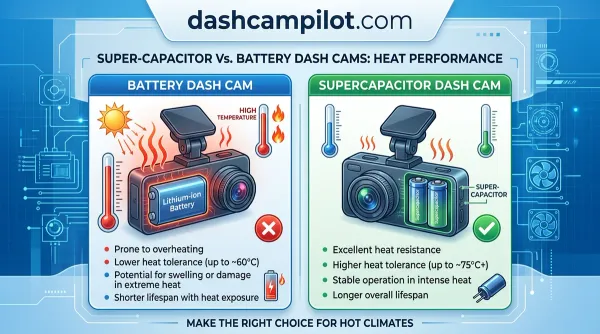
Automotive interiors present some of the most punishing thermal environments for solid-state storage. Under direct midday solar radiation, a windshield-mounted camera housing frequently reaches internal operating temperatures between 65°C and 80°C (149°F to 176°F). In sub-zero winter climates, parking modes subject cold silicon to temperatures dipping below -20°C (-4°F). Standard flash media suffers from electron leakage and thermal throttling when subjected to continuous heat, resulting in dropped write frames. Verified high-endurance cards use industrial-grade packaging compounds and thermal sensors, guaranteeing sustained read/write cycles across a certified -25°C to 85°C (-13°F to 185°F) operational range.
Dash Cam Memory Configuration: Capacity Range and File Formats
Selecting Storage Capacity: Single vs. Multi-Channel Dash Cams
Card capacity directly dictates how many driving hours your camera can retain before loop recording cycles begin overwriting your oldest footage. Because multi-camera systems save separate files for each video stream simultaneously, they consume available storage two to three times faster than single-lens units. The reference table below details real-world retention windows based on operational resolution profiles.
By The Numbers: Estimated Total Recording Hours Before Overwrite
Dual 1080p: ~2.2 Hours
Dual 4K + 1080p: Not Recommended
Dual 1080p: ~4.5 Hours
Dual 4K + 1080p: ~2.8 Hours
Dual 1080p: ~9 Hours
Dual 4K + 1080p: ~5.5 Hours
Dual 1080p: ~18 Hours
Dual 4K + 1080p: ~11.5 Hours
FAT32 vs. exFAT File Systems and Chipset Compatibility Limits
The SD Association dictates that SDHC media (32 GB and under) format in the legacy FAT32 file system, whereas SDXC media (64 GB up to 2 TB) defaults to exFAT. This technical boundary represents one of the primary sources of memory card errors in automotive hardware.
Older or lower-cost dash cam processors utilize lightweight real-time operating systems (RTOS) that lack official Microsoft exFAT licensing or memory addressing capability. When an unformatted 64 GB, 128 GB, or 256 GB exFAT card is inserted into such a unit, the device will generate an immediate "Memory Card Error" or prompt to format. Conversely, advanced 4K cameras running custom Linux-based operating kernels require 64-bit exFAT structures to support large continuous clip clusters and will fail if forced into FAT32.
In-Camera Formatting vs. Computer Formatting
Always execute memory card initialization directly inside the dash cam rather than on a Windows PC or Apple Mac. Formatting a microSD card via desktop operating systems can set cluster allocation sizes (e.g., 4 KB or 16 KB default blocks) that misalign with the dash cam's system architecture, causing write delays. When you initiate an in-camera format sequence, the recorder's operating system partitions the flash blocks to match its exact internal video buffer page sizes (typically 64 KB or 128 KB clusters), preventing buffer-overflow write failures during critical driving moments.
Confirm your camera manual's maximum capacity limit. Exceeding older 64GB or 128GB chipset barriers will trigger boot loops.
Ensure the card face displays the official "V30" and "U3" logos, guaranteeing 30 MB/s sustained writes without drops.
Verify the packaging states "High Endurance" or "Max Endurance." Standard consumer packaging voids continuous recording warranties.
Insert the card and format it using the dash cam's system menu to ensure proper cluster alignment and allocation block sizing.
What Affects SD Card Dash Cam Performance and Premature Failure
The Marketing Trap: Read Speeds vs. Sustained Write Bitrates
The prominent transfer speed figures displayed on retail microSD packaging (e.g., "Up to 100 MB/s" or "170 MB/s Read Speed") represent non-continuous read operations under clean factory lab conditions. Dash cams rely exclusively on continuous Sequential Minimum Write Speed. A memory card advertising a 150 MB/s read burst speed may plummet to sub-5 MB/s sustained sequential writes once internal blocks fill with data and require real-time erase cycles. If the continuous write speed falls below your camera's live encoding stream (e.g., 25–40 Mbps), the video pipeline buffer overflows, forcing the camera to drop frames or crash entirely.
- Using Standard Flash: Deploying mass-market consumer cards that lack endurance-tuned wear leveling, leading to early cell burnout within 3 to 6 months.
- Relying on Burst Speed Ratings: Assuming retail "100 MB/s" labels guarantee fast enough writes for high-bitrate multi-channel dash cams.
- Neglecting Regular Formatting: Skipping monthly formatting, which allows file tables to fragment and forces the controller to hunt for open sectors.
- Unverified Marketplace Sellers: Buying counterfeit cards from third-party sellers that spoof internal firmware capacity, causing unrecoverable data loss once real storage fills.
Preventing File Corruption with Scheduled Maintenance Formatting
Even premium enterprise-grade cards experience file system fragmentation and table wear over time. As a camera saves thousands of short (1 to 3 minute) video clips alongside sudden G-sensor emergency event write-locks, partition index tables develop allocation inconsistencies. Routine monthly in-camera formatting clears fragmented blocks, cleans corrupt headers, resets the Master Boot Record (MBR) or GUID Partition Table (GPT), and restores full factory write efficiency.
Counterfeit Media Detection and Supply Chain Verification
The memory market faces widespread counterfeiting across online marketplaces. Rogue manufacturers buy rejected, sub-grade 8 GB or 16 GB flash dies, reprogram the flash memory controller's register to falsely report 128 GB or 256 GB to host systems, and apply counterfeit silkscreen logos from reputable brands. In a dash cam, these fake cards record normally until they surpass their true microscopic capacity, after which they overwrite existing partition data and irreversibly corrupt video files. Test newly purchased media using open-source utilities like H2testw or F3 before putting them to work in a vehicle.
What Type Of Sd Card For Dash Cam Questions Answered
Why does my dash cam say "Please Format SD Card" repeatedly?
A recurring "Format SD Card" warning indicates that the camera's system cannot read the memory card's partition header, or the card's flash controller has locked itself into a read-only write-protect state due to excessive bad block development. If reformatting the card inside the dash cam fails to resolve the alert within 48 hours, the underlying silicon cells have reached their write-cycle limit and the card must be replaced.
Can I use a 512GB or 1TB card in my dash cam?
You can only use cards this large if your camera's hardware controller explicitly supports SDXC capacities above 256 GB. Many 2020–2023 camera processors possess strict 128 GB or 256 GB address bus ceilings. Inserting a 512 GB or 1 TB card into an incompatible camera often triggers reboot loops, system freezes, or memory errors, even if the card is a genuine high-endurance unit.
Does a higher read speed rating help my dash cam?
No. Read speed only affects how quickly footage transfers to a computer during desktop backups. Dash cam recording performance depends entirely on sustained sequential write speeds (such as the V30 rating) and write-cycle endurance. High read speeds will not stop frame drops, prevent video stuttering, or fix camera buffer crashes.
Why does my dash cam stop recording after a few minutes?
Premature recording halts are typically caused by an inadequate speed rating (like an older Class 10 or U1 card in a 4K camera), heavy file fragmentation, or thermal throttling. When the card cannot write incoming video frames as fast as the sensor captures them, the internal buffer overflows and the camera aborts the recording session to prevent system lockups.
Selecting the right microSD card comes down to a few basic rules: verify your camera's maximum supported capacity in the owner's manual, choose a card clearly labeled High Endurance or Max Endurance, and ensure it carries a V30 or U3 speed rating. Avoid standard consumer cards that void warranties and succumb to cabin heat. Once installed, format your card directly in the camera and repeat the format monthly to keep your system recording smoothly every mile of the road.