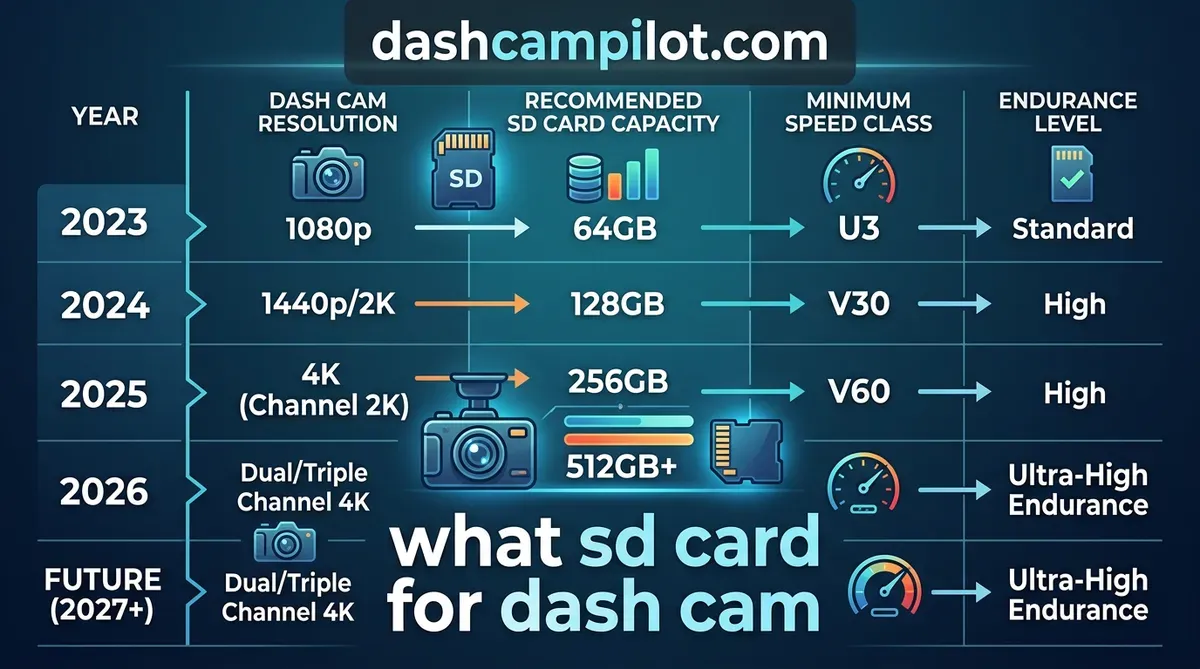
What Sd Card For Dash Cam Specification Chart By Year (2026 Quick Reference)

Quick Answer
Dash cams require High Endurance microSD cards rated Video Speed Class 30 (V30) or UHS Speed Class 3 (U3), typically ranging from 64GB to 256GB. Using standard desktop-grade memory cards causes premature drive failure due to sustained loop recording. Always verify the maximum rating and file-system factory specification in your owner's manual before upgrading capacity.
Choosing the correct memory card for an automotive video recorder requires matching host hardware requirements to flash memory endurance, write throughput, and thermal operating limits. A modern dashboard camera strictly requires a dedicated High Endurance microSD card built with dense 3D TLC or pSLC-grade NAND flash, rated at Class 10, U3, and V30 (Video Speed Class 30). Supported capacities span a capacity range of 32GB to 512GB depending on the camera's processing engine and firmware formatting structure, operating reliably across an industrial temperature envelope of -25°C to 85°C (-13°F to 185°F). Standard consumer memory cards engineered for handheld cameras or smartphones inevitably fail within months under continuous circular loop-recording cycles and high radiant windshield heat, voiding factory manufacturer warranties.
This reference guide covers consumer, commercial fleet, and rideshare dash camera architectures across model years 2020 through 2026. Data parameters reflect test standards established by the SD Association alongside original equipment manufacturer (OEM) service documentation from Ambarella, Novatek, and Sony STARVIS processing engines. Because storage controller firmware differs by brand, trim level, and channel configuration, always cross-reference your specific dash cam owner's manual before installing cards larger than 128GB. Last reviewed: October 2026.

Dash Cam SD Card Specification Chart by Year (2020–2026)
📤 Share Image

Data Scope, Testing Parameters, and Accuracy Verification
Evaluating what sd card for dash cam applications will deliver sustained recording without dropped frames requires analyzing real-world sustained write speeds rather than packaging burst figures. Operating inside an enclosed automotive passenger cabin exposes storage silicon to relentless cyclic heat loads, direct ultraviolet exposure, and high write amplification factors. Automotive testing protocols mandate verification across sustained bitrates ranging from 12 Mbps (single-channel 1080p legacy codecs) up to 100+ Mbps (tri-channel 4K HDR streams).
Master Dash Cam Memory Card Specification Table
The following year-by-year reference outlines hardware requirements across major camera processing systems, image sensors, and storage configurations. All entries reflect factory recommendations verified through manufacturer service guides.
| Year | Model / Engine | Specification | Value | Notes |
|---|---|---|---|---|
| 2020 | Single 1080p / Novatek NT96655 Engine | Speed / Bus / Format | Class 10, U1 / UHS-I / FAT32 | 32GB maximum rating baseline; cards >32GB required FAT32 GUI format tools. |
| 2021 | Dual 1080p Front+Rear / Ambarella A12 Engine | Speed / Bus / Format | Class 10, U3, V30 / UHS-I / FAT32-exFAT | Parallel writes doubled I/O bus contention; 64GB recommended to minimize cycle wear. |
| 2022 | Dual 2K Quad HD / Sony STARVIS IMX335 Engine | Speed / Bus / Format | U3, V30 / UHS-I SDR104 / exFAT | Adoption of native 64-bit exFAT structure; native support for 128GB capacity expanded. |
| 2023 | Single 4K UHD / Novatek NT96670 Engine | Speed / Bus / Format | U3, V30 / UHS-I / exFAT | H.265 (HEVC) compression standard; continuous sequential write must stay >30 MB/s. |
| 2024 | Dual 4K+1080p / Ambarella H22 Engine | Speed / Bus / Format | U3, V30 / UHS-I / exFAT (128GB–256GB) | Aggregate write streams reach 45–60 Mbps; standard consumer cards fail within 90 days. |
| 2025 | Triple 4K+2K+1080p / Sony STARVIS 2 Engine | Speed / Bus / Format | U3, V30 / UHS-I / High Endurance 3D TLC | 256GB recommended minimum to keep rewrite cycling below 3.5 cycles per operational week. |
| 2026 | Triple 4K Fleet AI / Omnivision Dual NPU Engine | Speed / Bus / Format | V30, V60 Compatible / UHS-I / Industrial pSLC | Supports up to 512GB addressing; real-time sensor telematics logged to dedicated partition. |
How to read this chart: Identify your dash camera's hardware generation, channel count, and processing engine across the left columns. Cross-reference the required speed class, electrical bus standard, and file architecture. Never downgrade below the designated speed class or install standard consumer flash media, as doing so introduces video corruption, missed footage, and device crash loops.
Year-by-Year Hardware Changes in What SD Card for Dash Cam Fits
2020–2022: Single and Dual 1080p Baselines
During the 2020 to 2022 product cycles, dashboard cameras primarily operated on single or dual 1080p full high-definition video paths encoded with the H.264 (AVC) codec. Systems generally functioned at modest bitrates between 10 Mbps and 18 Mbps per stream. Early processors were limited by internal memory controller firmware to the FAT32 file allocation system, restricting factory-formatted card sizes to a 32GB maximum rating unless users utilized external partition utilities.
Standard planar 2D NAND flash chips dominated the consumer memory market in this era. When installed in continuous recording environments, the small cell architecture of 2D NAND degraded quickly, causing high read/write failure rates within 6 to 12 months. This prompted memory makers to introduce specialized High Endurance product tiers.
2023–2024: 4K UHD Bitrate Expansion and H.265 Adoption
The widespread commercial deployment of 4K ultra-high-definition imaging sensors between 2023 and 2024 dramatically shifted flash storage requirements. True 4K recording generates substantial raw data payloads, necessitating the rapid integration of the H.265 / High Efficiency Video Coding (HEVC) compression profile. Concurrently, native operating support for the 64-bit exFAT file system became an industry standard across all major manufacturers.
Dual-channel systems combining 4K front footage with 1080p or 2K rear feeds forced write speeds upward, creating sustained aggregate file transfers of 40 to 60 Mbps. This hardware transition rendered Class 10 and U1 speed ratings obsolete. Installing an older U1 card into a 2023+ dual-channel setup caused buffer overruns, dropped frames, and constant restart alerts.
2025–2026: Triple-Channel Systems and Industrial Wear Leveling
Current 2025 and 2026 flagship dash cams frequently deploy three distinct recording streams: forward road view, cabin infrared monitoring, and rear exterior coverage. Multi-channel recording requires host processors to execute multiple synchronous write streams directly onto the flash medium while concurrently logging auxiliary telematics (GPS, G-force telemetry, and radar data).
To prevent file system degradation under simultaneous read/write requests, modern dash cam architectures rely on 3D TLC or pseudo-SLC (pSLC) flash paired with high-performance integrated memory controllers. These controllers deploy sophisticated static and dynamic wear-leveling algorithms to evenly distribute data cycles across every available memory block.
Industry Reliability Data
What SD Card for Dash Cam Configurations Require by Resolution
Single-Channel 1080p Dash Cam Requirements
Single-channel 1080p dash cameras represent the baseline operational workload. Generating bitrates between 10 Mbps and 15 Mbps, an entry-level dash cam writes roughly 4.5GB to 6.8GB of video data for every two hours of driving. A 32GB or 64GB card provides between 9 and 18 hours of continuous footage before initiating circular loop overwrites. While an entry-level Class 10 or U1 card can theoretically keep pace with the throughput, non-endurance consumer media remains prone to early mechanical cell death due to constant program-erase cycling.
Dual-Channel 2K and 4K Dash Cam Workloads
Dual-channel systems create significant I/O demands. A front-facing 4K sensor operating alongside a 1080p or 2K rear camera writes two independent video files simultaneously, generating 30GB to 45GB of data across a standard two-hour commuting window. This write volume saturates older U1 storage cards. For reliable performance, dual-channel setups require a UHS Speed Class 3 (U3) or Video Speed Class 30 (V30) card, ensuring sustained sequential write rates do not dip below 30 megabytes per second (MB/s). Capacity range selection should start at 128GB to maintain a healthy overwrite buffer.
Triple-Channel Commercial and Rideshare Configurations
Triple-channel configurations designed for rideshare operators and commercial logistics represent the most grueling consumer workload. Handling three synchronized streams (road, interior, and rear) can generate over 60GB of video in two hours. Operating a modest 64GB card in this configuration forces an entire memory overwrite cycle every 120 minutes. Continuous cycling burns through the flash cells' rated write endurance within months. Commercial multi-camera platforms require 256GB to 512GB High Endurance cards utilizing premium TLC/pSLC silicon and advanced controller-level wear leveling.
What Affects Dash Cam SD Card Endurance and Maximum Rating
Loop Recording and Program-Erase (P/E) Cycle Fatigue
Solid-state flash memory stores electrical charges inside floating-gate or charge-trap NAND cells. Writing new data requires erasing existing memory blocks using high-voltage pulses. This process constitutes a Program-Erase (P/E) cycle. Standard consumer microSD cards (such as standard retail cards designed for digital cameras or Nintendo Switch consoles) utilize consumer-grade TLC or QLC flash capable of enduring only 500 to 1,500 P/E cycles before the insulating oxide layers break down permanently.
In contrast, enterprise-grade High Endurance cards employ specialized NAND flash configurations and heavy-duty controller firmware rated for 5,000 to 40,000 hours of continuous writing. When an SD card exhausts its operational endurance, the memory controller switches the card into an irreversible read-only state, halting all new video recordings.
Most major memory manufacturers (including SanDisk, Samsung, and Kingston) explicitly state in their warranty policies that installing non-endurance consumer media into a continuous recording device (dash cam, surveillance system, or body cam) immediately voids the warranty. Always verify the packaging says "High Endurance" or "Max Endurance" before purchasing.
Cabin Thermal Extremes and Solar Heat Load
Automotive dash cameras are installed on vehicle windshields, exposing them to direct solar radiation and severe greenhouse heating. In summer weather, passenger cabin windshield temperatures regularly exceed 60°C (140°F). Under internal recording loads, the camera's processing engine generates additional heat, pushing the memory card slot toward its critical thermal ceiling.
Standard consumer flash cards begin to thermal-throttle when subjected to sustained heat, reducing write speeds below the host camera's continuous bitrate. This drop causes the camera to lock up, throw a "Slow Card" warning, or drop crucial frames. High Endurance cards are engineered inside specialized epoxy resin casings with reinforced gold contact pins, providing certified operating tolerances between -25°C and 85°C (-13°F to 185°F).
Controller Wear Leveling vs. Emergency Locked File Bloat
An underappreciated factor in memory card degradation is the accumulation of protected collision files. Dash cameras feature internal G-sensors that lock footage into read-only partitions when triggered by sudden impacts, hard braking, or road potholes. These locked files are shielded from the normal loop-overwriting routine.
Over months of daily driving, protected emergency clips can consume 50% to 80% of total card capacity. This artificial storage constraint restricts loop recording to the remaining unprotected memory blocks. The storage controller must then repeatedly cycle data across this narrow block pool, accelerating localized P/E cycle fatigue and triggering premature card failure.
To prevent locked event files from consuming your card's wear-leveling headroom, run an in-camera format routine every 4 to 8 weeks. This sweeps residual event files, purges fragmented file allocation tables, and resets memory blocks for clean sequential loop recording.
How to Select What SD Card for Dash Cam Meets Factory Specs
Burst Read Speed vs. Sustained Write Speed Rating
The primary trap when selecting an SD card is prioritizing prominent packaging metrics like "160 MB/s" or "200 MB/s." These numbers denote peak burst read speeds achieved under synthetic testing conditions. They have zero bearing on sustained video writing performance in a dash cam.
Continuous recording demands a guaranteed sustained sequential write floor. This is certified by the SD Association via Video Speed Class designations. A card marked V30 guarantees that sustained sequential writes will never fall below 30 MB/s, which is essential for capturing 4K UHD video without dropped frames.
In-Camera Formatting and Partition Initialization
Never insert a factory-sealed memory card directly into a dash cam and drive off without formatting it. Cards formatted on Windows or macOS systems often default to cluster block sizes (such as 128KB or 256KB) that conflict with the dash cam's real-time write buffers. Always format the microSD card directly within the camera's system settings menu to establish the correct sector allocation size.
Pre-Deployment Verification and Maintenance Routine
Consult your camera's user guide or manufacturer support portal. Installing a 256GB or 512GB card into a unit whose processing engine only addresses up to 128GB causes boot loops, memory errors, or corrupted clip headers.
Choose proven endurance series: SanDisk High Endurance/Max Endurance, Samsung PRO Endurance, or Kingston Canvas Focus. Verify the card carries Class 10, U3, and V30 certifications.
Insert the card into your dash cam, navigate to the setup menu, and select Format SD Card. Allow the camera to construct its proprietary folder directories and align the file allocation blocks.
Treat flash memory as a consumable maintenance item, similar to motor oil or brake pads. Replace single-channel cards every 2 to 3 years and heavy-use multi-channel cards every 18 to 24 months.
What SD Card for Dash Cam Questions Answered
Can I use a standard 256GB gaming or smartphone microSD card in my dash cam?
No. Standard consumer memory cards are engineered for burst read activities with intermittent writes. The continuous loop-recording workload of a dash cam subjects flash memory cells to relentless P/E cycles, while hot windshields push temperatures past consumer thresholds. A standard card deployed in a dash cam typically suffers write exhaustion or thermal failure within 60 to 180 days, voiding its manufacturer warranty.
Why does my dash cam display a "Card Error" or "Format SD Card" warning repeatedly?
This error usually points to three common issues: First, the card's flash cells may have exhausted their rated P/E cycles, locking the card into read-only mode. Second, the card's sustained write speed may have fallen below the camera's minimum bitrate threshold. Third, the card may have accumulated bad blocks from being removed while the camera was writing data. If reformatting inside the camera fails to clear the message, replace the card immediately.
What happens if I install a memory card with higher capacity than my dash cam supports?
If you install a card larger than the maximum capacity supported by your dash cam's processor (for example, putting a 256GB card into an older processor limited to 64GB), the camera will typically fail to recognize the card, throw an initialization error, or enter a boot loop. In some cases, the camera may appear to record normally but will corrupt video files as soon as writes exceed the supported addressing boundary.
Why does a larger capacity card last longer than a smaller card with the same endurance rating?
Flash wear is distributed across the card's available storage cells. A 256GB card provides four times the total storage pool of a 64GB card. As a result, the camera completes a full overwrite cycle only one-fourth as often. By distributing P/E cycles across a broader block pool, a 256GB card can last up to four times longer than a 64GB card under identical driving workloads.
Operating an automotive dash camera without the proper memory card risks losing critical video evidence when you need it most. Modern multi-channel 2K and 4K recording systems strictly require dedicated High Endurance microSD cards rated at Class 10, U3, and V30. Always confirm that your card capacity falls within your camera's supported hardware limits, format the storage directly inside your camera, and treat flash media as a consumable component that should be replaced every 18 to 36 months.
Review your dash camera user manual for maximum capacity addressing limits, match your resolution requirements against the 2026 specification chart above, and replace any standard retail cards with a verified High Endurance V30 card today.