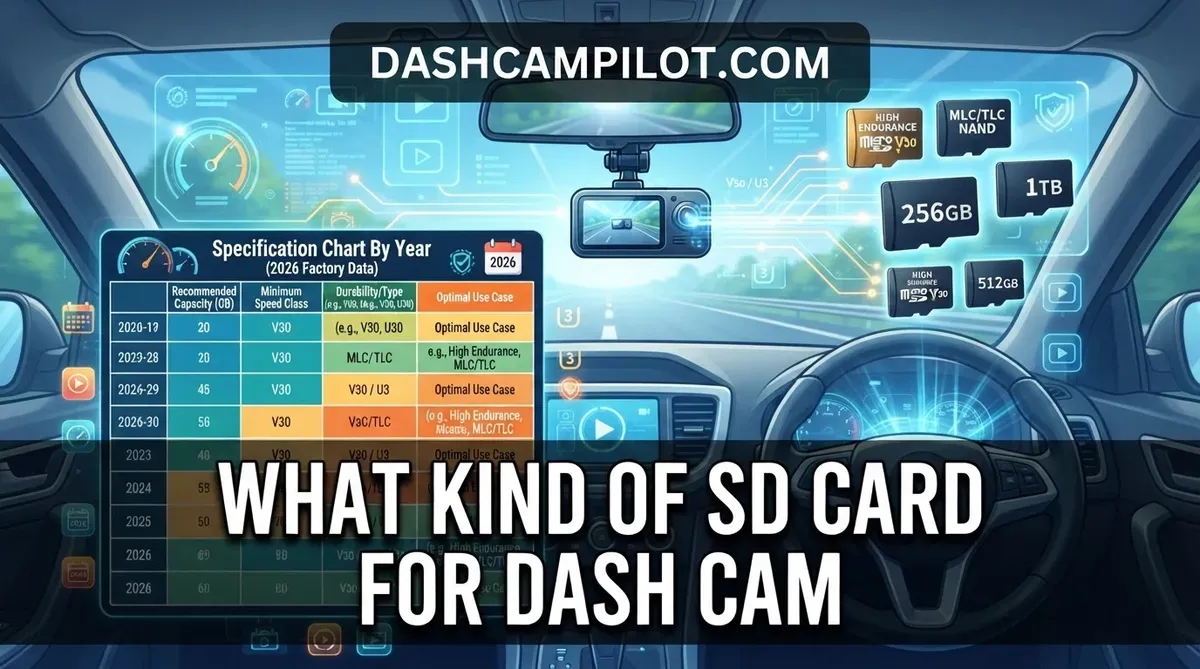
What Kind Of Sd Card For Dash Cam Specification Chart By Year (2026 Factory Data)

Quick Answer
Dash cams require a dedicated High Endurance microSD card featuring U3, V30, and Class 10 speed ratings, built with high-write-cycle TLC or MLC NAND flash memory. Standard consumer cards fail rapidly under continuous loop recording. Supported capacities range from 32GB to 512GB depending on dash cam firmware, with 128GB to 256GB serving as the industry sweet spot. Always verify factory specifications in your dash cam or vehicle owner's manual.
For any dashboard camera, the required memory card is a dedicated high-endurance microSD card engineered with UHS Speed Class 3 (U3) or Video Speed Class 30 (V30) ratings, delivering a minimum sustained sequential write speed of 30 MB/s across a factory specification capacity range of 32GB to 512GB. Standard consumer memory cards—regardless of advertised maximum read speeds up to 200 MB/s—will catastrophically fail under continuous loop recording workloads and extreme windshield greenhouse temperatures up to 85°C, immediately voiding both card and camera manufacturer warranties.

What Kind of SD Card for Dash Cam Models: 2020–2026 Specification Chart
Understanding how memory requirements scale across camera architectures requires examining hardware controller generations. Over the past seven model years, image signal processors (ISPs) have transitioned from basic single-channel 1080p encoders to complex AI-assisted quad-channel recording suites executing multiple simultaneous bitstreams.
📤 Share Image
This reference covers factory specifications across dash cam hardware releases spanning 2020 through 2026 production cycles. Specifications are compiled from OEM engineering standards, SD Association physical compliance criteria, and dash camera chipset datasheets (including Ambarella, Novatek, and SigmaStar processing platforms). Always cross-reference the camera’s official manual, as hardware controller firmware limits dictate absolute maximum card volume ceilings. Last reviewed: October 2026.

Data Scope, Generation Coverage, and Manual Verification
The table below organizes memory specifications by model year and camera processor configuration. In dash camera architecture, the processing system acts as the “engine option” that defines maximum bitrates and throughput limits, while the multi-channel sensor package represents the operational “trim level.”
| Year | Model / Engine | Specification | Value | Notes |
|---|---|---|---|---|
| 2020 | Single 1080p (Novatek NT96655/Ambarella A12) | Class 10 / U1 / High-Endurance | 32GB – 128GB (10 MB/s floor) | Standard FAT32 filesystem; 32GB maximum limit on select entry-tier controllers. |
| 2021 | Dual-Channel 2K QHD (Novatek NT96675 / HiSilicon) | UHS-I U3 / V30 High-Endurance | 64GB – 256GB (30 MB/s floor) | exFAT transitions emerge; dual sequential streams overwhelm basic U1 cards. |
| 2022 | Dual-Channel 4K UHD (Ambarella H22 / STARVIS) | UHS-I U3 / V30 / 3D TLC | 128GB – 256GB (30 MB/s floor) | H.265 (HEVC) compression standard; continuous 35–45 Mbps combined bitrates. |
| 2023 | Triple-Channel 4K+FHD+FHD (Front/Interior/Rear) | UHS-I U3 / V30 / Industrial TLC | 128GB – 512GB (30 MB/s floor) | Simultaneous 3-stream muxing requires optimized controller wear leveling. |
| 2024 | Dual 4K HDR STARVIS 2 (SigmaStar / Novatek NT98529) | UHS-I U3 / V30 / Automotive Spec | 128GB – 512GB (30 MB/s floor) | High dynamic range write spikes; minimum 20,000-hour endurance threshold. |
| 2025 | AI Multi-Stream LTE Cloud (Quad-Core NPU Engines) | UHS-I U3 / V30 / A2 Application Class | 256GB – 512GB (30 MB/s floor) | Local telemetry log caching requires higher random 4K write IOPS (A2 minimum). |
| 2026 | Next-Gen 4K 60fps Quad-Channel Array Platforms | UHS-I/II U3 / V30 / V60 Industrial | 256GB – 1TB (30–60 MB/s floor) | Factory specifications mandate up to 40,000 continuous operating hours. |
Footnote: Maximum rating ceilings are governed by controller addressing limits. Formatting a 512GB or 1TB card in a system engineered with a 128GB controller ceiling will result in initialization failure or corrupted allocation tables. Always verify your device's exact trim level specifications.
Key Endurance and Speed Thresholds (Visual Data Summary)
To evaluate what kind of SD card for dash cam deployment will survive real-world conditions, contrast the core hardware tolerances outlined below. The critical performance indicators are sustained sequential write speed (not burst read speed) and cell longevity under continuous Program/Erase (P/E) cycling.
Sustained Sequential Write Speed Floors by SD Association Speed Class
Dash cams rely exclusively on sustained write minimums to prevent dropped video frames during buffer flushes.
How to read this chart: Identify your dash cam’s model year and sensor configuration. If you operate a multi-channel or 4K resolution camera platform, cross the table horizontally to verify the baseline write speed class and maximum supported storage limit. Selecting a card below the specified write floor results in fatal buffer underruns, truncated video files, and random reboot loops.
What Kind of SD Card for Dash Cam Loop Recording Is Required?
Unlike action cameras or digital DSLRs that record footage intermittently, a dashboard camera engages in relentless loop recording. The moment ignition power activates, the camera writes video files continuously in 1-, 3-, or 5-minute increments. Once storage capacity fills, the memory controller erases the oldest non-protected file block to record the new incoming stream. This creates thousands of cumulative Program/Erase (P/E) cycles, inflicting immense physical wear on the microscopic silicone gates of the NAND flash memory chip.
NAND Flash Architecture: MLC vs. 3D TLC Under Continuous Write Cycles
The physical endurance of any microSD card depends entirely on its underlying silicon gate architecture. Consumer storage media is built down to a price point, using architectures unsuited for automotive stress:
- Triple-Level Cell (3D TLC) – High-Endurance Grade: Stores 3 bits of data per floating-gate transistor cell. When combined with vertical stacking (3D NAND) and specialized firmware tuning, high-endurance 3D TLC cards deliver between 10,000 and 30,000 continuous recording hours at an accessible price-to-performance ratio.
- Multi-Level Cell (MLC): Stores 2 bits per cell. MLC silicon exhibits dramatically lower electrical degradation during writes, historically providing the gold standard of 10,000 to 40,000 continuous hours. While more expensive and increasingly rare due to 3D TLC advancements, planar or 3D MLC remains exceptional for high-duty cycle dash cams.
- Quad-Level Cell (QLC) – Consumer/Gaming Grade: Stores 4 bits per cell. QLC cards (often sold as “ultra-fast” phone or handheld gaming cards) support as few as 100 to 500 P/E cycles before the silicon oxide layer degrades. In a dual-channel 4K dash cam driven daily, a consumer QLC card can suffer complete sector burnout in as little as 90 to 120 days.
Major flash memory manufacturers (including SanDisk, Samsung, and Kingston) explicitly exclude automotive dash cams, security systems, and CCTV surveillance from the standard multi-year or “lifetime” warranties of their consumer product lines (such as SanDisk Ultra/Extreme or Samsung EVO Select). Installing these cards in a dash cam immediately voids warranty replacement claims. Only designated “High Endurance,” “Max Endurance,” or “Industrial” lines carry valid warranty coverage for continuous loop recording.
Memory Controller Wear Leveling and Terabytes Written (TBW)
The unsung hero of a resilient memory card is the integrated memory controller. In an industrial or high-endurance card, the controller runs proprietary firmware running advanced dynamic and static wear leveling algorithms. Instead of rewriting footage across the same physical NAND blocks repeatedly, the wear-leveling engine evenly maps write cycles across all available physical blocks on the silicon substrate.
Furthermore, automotive-grade controllers deploy hardware-level Error Correction Code (ECC) (such as Low-Density Parity-Check / LDPC) to detect and correct single-bit data corruptions before they compromise the file allocation table. The card's operational lifespan is measured in total Terabytes Written (TBW). A premium 256GB high-endurance card typically boasts ratings surpassing 120 to 240 TBW, whereas a consumer-grade 64GB card may succumb to unrecoverable read/write errors after accumulating fewer than 20 TBW.
Speed Class and Storage Capacity Range Across Dash Cam Configurations
When shopping for dash camera media, marketing numbers printed prominently across product packaging often mislead buyers. Prominently advertised read ratings (e.g., “Up to 160 MB/s”) represent non-continuous read bursts useful for offloading vacation photos to a PC, but they offer zero utility for recording performance inside your vehicle.
Single vs. Multi-Channel Bandwidth: Why V30 and U3 Ratings Matter
In video capture, the singular critical performance metric is sustained minimum sequential write speed. The SD Association codifies these baselines into Speed Class, UHS Speed Class, and Video Speed Class designations:
Acceptable only for legacy single-channel 1080p cameras running modest bitrates (12–18 Mbps). Deficient for 4K.
The universal factory standard. Guarantees 30 MB/s continuous throughput, required for 4K single, dual, and triple channels.
Engineered for 4K 60fps multi-cam suites and quad-channel commercial fleet setups capturing uncompressed telemetry.
Consider a modern 2024–2026 dual-channel dash cam package: the front sensor records in native 4K (3840×2160) at 30 fps using an H.264/H.265 stream at 28 Mbps, while the rear camera streams 1080p at 12 Mbps, combined with stereo audio and GPS metadata streams. While the nominal data rate translates to roughly 5 to 6 megabytes per second (MB/s), video encoding data streams are not linear. Complex driving scenes—such as navigating high-speed freeway traffic through tree canopies in rain—generate massive I-frame bitrate surges that immediately choke cards restricted to a 10 MB/s (Class 10/U1) write floor, corrupting the video segment.
How Higher Storage Capacity Directly Extends Card Lifespan
A core engineering reality of flash memory is that a larger storage capacity card of the exact same product line will last significantly longer in calendar lifespan than a lower-capacity equivalent. This occurs directly because loop recording wear is distributed over a broader physical array of NAND cells.
For example, assume a driver commutes two hours daily in a vehicle with a dual-channel dash cam generating 10GB of video per hour (20GB daily):
- 32GB MicroSD Card: Overwrites its entire storage volume every 1.6 days of operation (~228 complete P/E overwrite cycles per calendar year).
- 128GB MicroSD Card: Overwrites its entire volume every 6.4 days of driving (~57 complete P/E overwrite cycles per calendar year).
- 256GB MicroSD Card: Overwrites its volume every 12.8 days of driving (~28 complete P/E overwrite cycles per calendar year).
By opting for a 256GB card over a 32GB or 64GB card, you effectively reduce the silicon wear-rate by up to 800 percent. Provided your dash cam's hardware controller natively supports 256GB addressing, investing in the larger card volume guarantees years of trouble-free service life while retaining critical footage from prior days before overwrites occur.
For single-channel 1080p setups, a 64GB high-endurance card provides adequate retention. For 2K QHD or 4K dual-channel setups, deploy a 128GB or 256GB card. For triple-channel systems (front, cabin, rear) or continuous 24/7 parking mode recording, 256GB is the baseline recommendation to avoid continuous overwriting every few hours.
Factory Specification Survival in Extreme Cabin Thermal Environments
Dash cameras occupy the harshest operating environment of any consumer electronics device: affixed directly against the vehicle windshield glass in direct sun exposure. Inside this optical greenhouse, thermal radiation causes interior dashboard and windshield contact temperatures to reach astonishing extremes.
Windshield Greenhouse Temperatures vs. Operating Range (-25°C to 85°C)
When outdoor ambient temperatures hover at a moderate 32°C (90°F), sunlight radiating through laminated automotive windshield glass heats the vehicle interior cabin to 60°C (140°F) within an hour. The forward-facing dash camera housing—absorbing direct solar radiation while running high-load video encoding processors internally—regularly experiences localized temperatures ranging from 70°C to 80°C (158°F to 176°F).
Consumer-grade SD cards are factory-rated for an operating range of only 0°C to 70°C (32°F to 158°F). When subjected to the cabin greenhouse threshold, non-endurance consumer media experiences thermal throttling. The memory card's internal controller aggressively throttles write speeds down to 1–2 MB/s to protect internal circuits from melting. This instant speed drop triggers a catastrophic buffer overrun in the dash cam, causing the recording engine to freeze, emit repeated error chimes, or write corrupt video headers that render accident clips unplayable.
Conversely, certified High-Endurance and Automotive-Grade microSD cards feature a rigorous operating specification of -25°C to 85°C (-13°F to 185°F). Their structural packaging employs specialized epoxy molding compounds and thermal dispersion layers that insulate the silicon die, maintaining sustained 30 MB/s write capability without data loss even under desert summer conditions or sub-zero winter overnight parking.
Automotive cabin thermal cycling expands and contracts memory card socket components. Standard cards feature thin contact flash plating that can oxidize or micro-arc under heavy road vibration and pothole impacts. Automotive and industrial-grade cards utilize thickened 30-microinch gold plating across their contact pins to eliminate contact fretting, prevent read disconnects, and ensure continuous electrical coupling over years of driving.
Industrial-Grade pSLC Cards vs. High-Endurance Consumer Lines
For extreme-duty commercial fleets or hot desert climates, industrial memory manufacturers engineer cards utilizing pseudo-SLC (pSLC) mode. In this configuration, the memory controller configures multi-level 3D TLC flash cells to store only a single bit of data per cell. This yields near-SLC endurance levels—providing up to 20,000 to 50,000 P/E cycles, an expanded thermal tolerance of -40°C to 85°C, and complete immunity to write-disturb errors—though at a substantially higher cost per gigabyte compared to standard high-endurance retail lines.
What Kind of SD Card for Dash Cam Setup Prevents Write Errors?
Selecting the correct card hardware addresses only half the equation; configuration and maintenance dictate whether the card functions when an incident occurs. Misaligned file systems, unpurged event partitions, and counterfeit marketplace media represent the three leading causes of dash cam card failures.
Formatting in the Dash Cam Menu: FAT32 vs. exFAT File Systems
MicroSD cards adhere to standard SD Association formatting defaults based on card storage capacity:
- SDHC (32GB and under): Factory formatted in legacy FAT32. FAT32 has an absolute single-file size ceiling of 4GB.
- SDXC (64GB to 2TB): Factory formatted in Microsoft exFAT (Extended File Allocation Table), supporting massive individual file sizes and optimized for flash memory block structures.
Formatting an SDXC card on a Windows PC using generic default settings can assign incorrect allocation unit cluster sizes (such as 4KB NTFS). When inserted into a dash cam, the camera's RTOS (real-time operating system) struggles to process sequential block writes, causing dropped frames and write-abort errors.
📋 Mandatory In-Camera Card Commissioning Routine
Never hot-plug or eject a microSD card while the dash camera is powered or recording. Hot-swapping causes immediate voltage arcs that corrupt the card's master boot record (MBR) and trigger controller lockouts.
Power up the camera and navigate to Settings > Format SD Card. Formatting in-device enables the camera's native firmware controller to align memory allocation clusters (typically 64KB or 128KB clusters) directly to its specific video block buffers.
G-sensor impacts (potholes, sudden braking, railroad crossings) lock video files into protected folders that loop recording cannot overwrite. Over time, these locked orphan files fill up the card, reducing available space for loop recording to zero. Format the card in-camera every 30 to 60 days to clear file fragmentation and purge protected folders.
Detecting Counterfeit Cards and Spoofed Storage Capacities
The open online marketplace is saturated with fraudulent memory cards. Unscrupulous third-party vendors modify the firmware on cheap, reject 8GB or 16GB memory chips to spoof the host operating system into reporting 256GB or 512GB of available space. The card prints legitimate-looking branding from reputable manufacturers.
When inserted into a dash cam, a spoofed counterfeit card records normally until written data exceeds its true 8GB silicon capacity. At that point, the defective controller either silently loops back and writes over previously recorded data or quietly drops all new footage without throwing an error code. You will only discover the deception after a collision occurs, finding zero saved footage of the accident.
Always purchase memory cards directly from authorized retailers or manufacturer-direct storefronts. Before placing any new card into service, connect it to a PC and run full-surface sector verification tools such as H2testw (Windows) or F3 (Mac/Linux). These utilities write and verify random data across 100 percent of the card's addressable sectors, confirming true storage capacity and verifying that sustained sequential write speeds remain well above the 30 MB/s V30 floor.
Frequently Asked Questions: What Kind of SD Card for Dash Cam Systems
Can I use a SanDisk Ultra or Samsung EVO card in my dash cam?
No. Standard consumer cards like the SanDisk Ultra or Samsung EVO Select utilize low-cost TLC/QLC flash silicon engineered for smartphones and cameras. Under continuous dash cam overwrite cycles and cabin heat, these consumer cards fail within months. Crucially, manufacturer warranties on these lines explicitly exclude dash cam use, voiding replacement coverage upon failure.
Why does my dash cam display “Memory Error” or format prompts repeatedly?
This error stems from three primary issues: using a non-endurance card whose NAND cells have exhausted their write cycles, severe file fragmentation from protected G-sensor event files filling the volume, or an incompatible allocation cluster size caused by formatting the card on a computer rather than inside the dash cam menu.
Will a 512GB microSD card work in any dash cam?
No. Dash camera hardware controllers feature strict addressing ceilings (typically 128GB or 256GB on older or budget platforms). Inserting a card that exceeds the controller's factory maximum specification will cause initialization failures, boot loops, or corrupted video files. Always check your dash cam manual for the maximum supported card capacity.
What is the difference between U1 and U3 microSD cards for dash cams?
U1 cards guarantee a minimum sustained sequential write speed of 10 MB/s, which is insufficient for multi-channel 2K or 4K dash cams. U3 (equivalent to V30) guarantees a minimum sustained write speed of 30 MB/s. Modern dual and triple-channel dash cams require U3/V30 cards to prevent buffer overflows and dropped video frames.
Final Recommendations on Dash Cam Factory Specification Compliance
Selecting the right microSD card is just as crucial as choosing the dash cam hardware itself. To guarantee your camera captures every critical incident without corruption or premature hardware failure, ensure your setup meets these core factory specifications:
Select dedicated High-Endurance or Industrial microSD cards built with 3D TLC or MLC NAND flash, rated for at least 10,000 to 40,000 recording hours.
Insist on UHS Speed Class 3 (U3) or Video Speed Class 30 (V30), ensuring a continuous 30 MB/s write floor to support multi-stream 4K bitrates without buffering.
Deploy the highest capacity supported by your camera's controller to spread wear-leveling cycles across more physical blocks, multiplying card lifespan.
Format the card exclusively via the dash cam's system menu upon initial installation and repeat every 30 to 60 days to purge orphan files and maintain flash health.
Take a moment today to check the user manual for your dash cam's maximum supported capacity, swap out any generic consumer cards for a certified high-endurance V30 drive, and perform an in-camera format. This simple maintenance routine guarantees that when the unexpected happens on the road, your dash cam reliably saves every critical frame.