Electrostatic Sticker for Dash Cam: Cling Film & 3M Setup
Scraping stubborn, melted adhesive tape off your windshield is one of the most frustrating parts of vehicle ownership. Direct mounting often leaves messy residues or risks tearing expensive aftermarket window tints during removal.
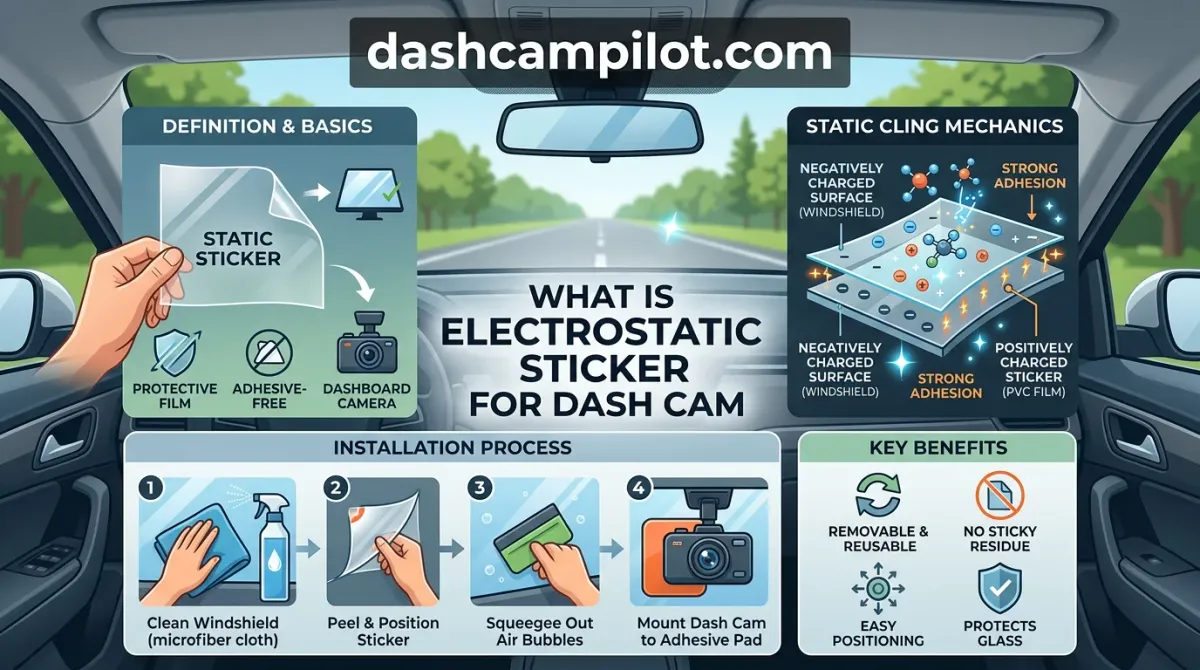
An electrostatic sticker solves this problem. It is a thin, transparent plastic film that bonds tightly to smooth auto glass without any sticky chemical glue. Instead of mounting your camera's permanent adhesive pad directly onto the windshield, you affix the dash cam onto this protective barrier.
This setup allows heavy camera hardware to stay firmly anchored during daily driving, yet peels away cleanly without tools whenever necessary. Below, we examine how this static bond functions, compare it to mechanical suction mounts, and walk through reliable installation methods.
What Is an Electrostatic Sticker for Dash Cams? The Fundamentals
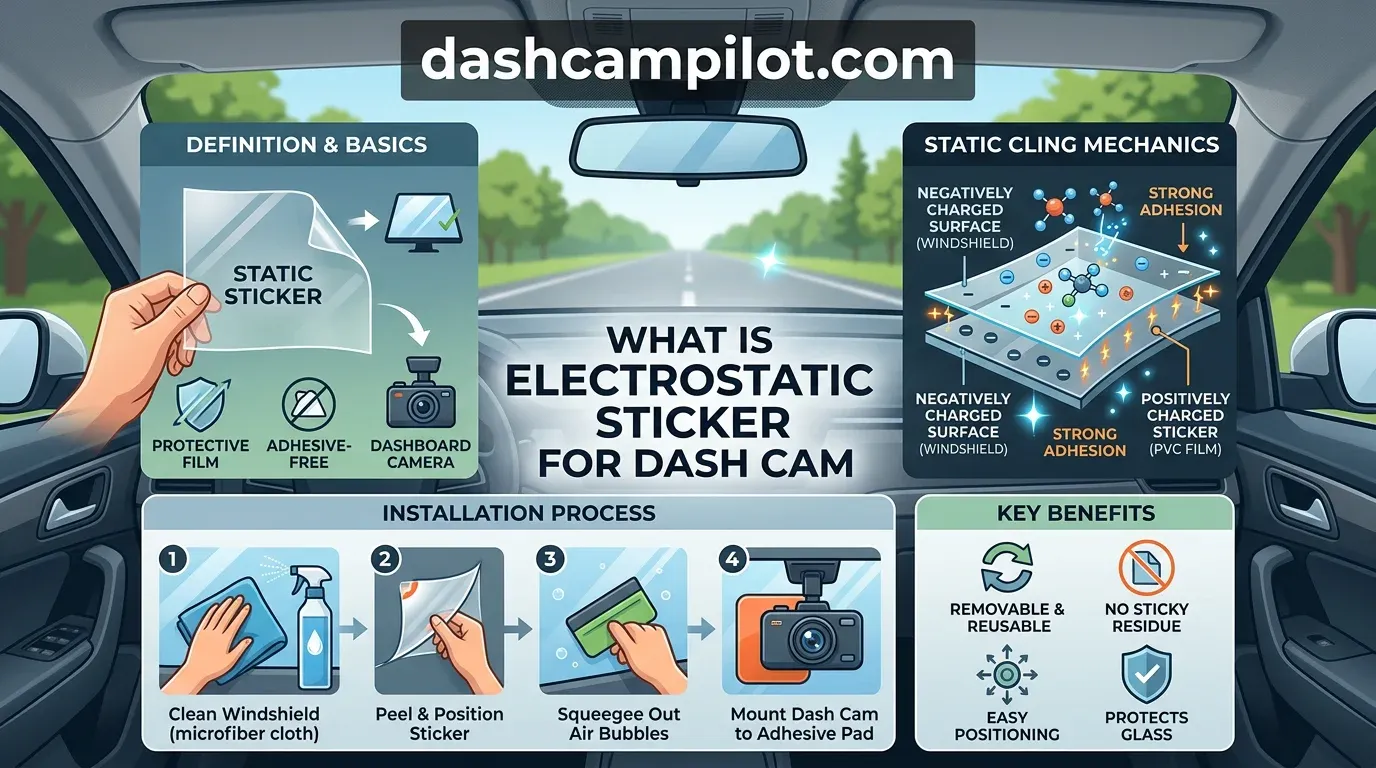
An electrostatic sticker is a transparent, high-clarity plastic film engineered to bond flush against smooth automotive glass without any chemical adhesives. When unboxing a modern dash cam from brands like 70mai, VIOFO, or Thinkware, you will typically find two transparent square film sheets labeled "Electrostatic Sticker" packed alongside the mounting brackets.

The Intermediate Barrier Concept
The sticker acts as a sacrificial intermediate barrier between your car and your recording hardware. Under this layout, the windshield glass directly touches the static film, while the dash cam's industrial 3M VHB adhesive tape bonds to the outer face of the film.

This design replaces direct tape-to-glass contact. By isolating the permanent mounting tape from the vehicle glass, the sticker allows clean, tool-free dash cam removal later without leaving adhesive residue or requiring razor scrapers.
Chemical Adhesives vs. Static Cling
Unlike standard stickers or tape mounts, this film contains no glue or liquid chemical binders. Instead, it relies on ultra-flat molecular contact and natural static charge to stay anchored against non-porous glass surfaces.
Manufacturers now provide these stickers as standard accessories because high-bond tapes can permanently bake onto automotive glass under intense solar heat. The static film handles the structural load of the camera while safeguarding the glass surface completely.
Understanding How Static Cling Dash Cam Film Adheres to Glass
Van der Waals Forces and Surface Contact
Electrostatic dash cam film relies on physics rather than liquid glue. Its specification lists Adhesive Type: None (Static Cling / Van der Waals forces). The film adheres because automotive windshield glass provides an ultra-smooth, non-porous substrate.
When pressed flat against glass, the microscopic distance between the two surfaces drops to mere nanometers. At this proximity, Van der Waals forces—subtle electromagnetic attractions between neighboring molecules—activate to bond the surfaces together.
Once you evacuate air pockets across the sheet, external atmospheric pressure seals the film against the windshield. Ambient air presses evenly across the exterior face, providing a stable, reliable hold capable of bearing the shear weight of a camera bracket.
The cling force operates on the exact same physical principle as smartphone screen protectors and vinyl holiday window clings, but the automotive film is chemically stabilized to resist cabin heat extremes.
Why the Film Does Not Feel Sticky to the Touch
Expecting the sticker itself to feel tacky or sticky to human touch is a common misconception. Because there is zero chemical resin or solvent-based adhesive on the film, it feels like an ordinary, dry piece of flexible plastic in your hands.
Human skin is textured with microscopic ridges, pores, and natural oils that prevent uniform contact. Because fingers cannot make the 100% flush, nanometer-level contact required to trigger molecular attraction, the static sheet remains completely non-tacky until smoothed onto flat glass.
Dash Cam Electrostatic Sticker Anatomy and Material Breakdown
Layer Composition and the Peel Tab
An electrostatic dash cam sticker consists of two primary elements: the active static cling base film and a temporary protective release liner. The liner shields the ultra-smooth bonding face from airborne dust, oils, and particulate contamination during transit and handling.
Integrated edge pull tabs simplify installation. Separating the liner using fingernails often transfers skin sebum or creates static charges that attract dust directly to the bonding face. The pull tab allows you to peel the backing cleanly without touching the cling surface.
Material Specifications: PVC vs. PET Formulations
Manufacturers produce these films using either polyvinyl chloride (PVC) or polyethylene terephthalate (PET). While plasticized PVC offers pliable handling at lower price points, it tends to degrade faster under prolonged UV radiation and can leach plasticizers onto the glass over time.
High-clarity PET formulations deliver superior dimensional stability and optical clarity. Standard industrial thickness ranges between 0.08 to 0.15 mm, providing enough rigidity to prevent bubbling without adding unnecessary bulk between the windshield and the camera mount.
Thermal stability is a vital metric for windshield hardware. For example, examining a 0.10 mm optical-grade PET sheet reveals that it withstands cabin temperatures up to 80 degrees Celsius without yellowing, warping, or losing structural tension under direct sunlight exposure.
Why Use an Electrostatic Sticker for Dash Cam Windshield Mounting
Mounting hardware directly to glass with heavy-duty adhesives presents long-term maintenance headaches. Its primary benefit is facilitating clean, tool-free dash cam removal without scraping glass or tearing interior window tint, acting as a non-destructive mounting base for modern vehicles.
Protecting Interior Window Tint from Delamination
Directly adhering high-tack 3M VHB tape to interior films creates substantial mechanical risk. The structural pull of industrial acrylic foam frequently exceeds the adhesive strength holding aftermarket window tint to the glass. During uninstallation, this tension can tear, bubble, or delaminate aftermarket automotive window tint entirely.
Removing stubborn mounting points manually carries expensive consequences. Scraping baked-on 3M foam tape with a razor blade can sever embedded defroster lines or permanently scratch ceramic window tint costing $200+ to replace. Electrostatic sheets isolate the adhesive, keeping the underlying film intact.
Eliminating Baked-On Adhesive Residue and Razor Scraping
Prolonged solar exposure bakes traditional mounting tape, curing it into a brittle, gummy layer that regular glass cleaners cannot dissolve. The static sticker creates a zero-residue bond that peels off cleanly in seconds, eliminating any need for chemical degreasers or physical scraping tools.
Residue Level Upon Removal: Zero. This complete cleanliness delivers distinct vehicle resale and lease return benefits where windshield glass must remain spotless. Lease inspectors frequently penalize drivers for stubborn adhesive smears, optical distortions, or glass blemishes that require professional reconditioning.
Furthermore, repositioning or transferring the camera to a new vehicle is simplified. Drivers and fleet operators can release the entire camera assembly in one fluid motion, bypassing hours of glass scraping when migrating hardware between windshields.
Electrostatic Film vs. Suction Cups and Direct 3M VHB Mounting
Windshield mounting systems must balance shear retention strength with ease of removal. Drivers typically secure dash cams using direct adhesive tape, vacuum suction cups, rearview mirror stem clamps, or electrostatic film acting as a protective barrier.
Direct tape bonding delivers the highest mechanical grip but creates windshield maintenance issues. Conversely, suction mounts offer flexibility at the cost of stability. Pairing an electrostatic film with 3M Very High Bond (VHB) tape provides the optimal middle ground: maximum shear hold with zero adhesive residue.
Holding Strength Across Temperature Extremes
Suction cups rely on negative vacuum pressure under a flexible silicone or rubber seal. Seasonal temperature swings degrade this seal rapidly; rubber stiffens in freezing conditions and softens in direct sunlight, causing air ingress that drops the assembly.
For example, a standard suction cup frequently loses suction at 10 degrees Fahrenheit as the seal contracts. In contrast, an electrostatic film paired with 3M VHB remains bonded through sub-zero winter conditions and 100-degree summer heat because it relies on molecular surface contact rather than trapped air pressure.
Direct 3M VHB provides maximum shear strength against heavy road vibration. However, applying VHB tape directly to windshield glass presents severe drawbacks. The viscoelastic acrylic adhesive cross-links over time, leaving gummy residue upon removal and frequently tearing aftermarket window tint.
Mounting Profile and Visual Footprint
Mechanical bulk significantly affects driving visibility. Rearview mirror stem clamps eliminate glass adhesion entirely by latching onto the mirror post, but their metal or plastic articulation arms add substantial weight and introduce image-degrading vibration.
Suction mounts require deep structural housings to house release levers, creating an obtrusive footprint that drops the camera lower into the driver's forward sightline.
Electrostatic film sits flush against glass with a profile measured in fractions of a millimeter. When bonded to a slim 3M VHB mounting plate, it minimizes leverage-based shake while concealing the entire mount neatly behind the rearview mirror matrix.
How to Read the Mounting Method Comparison
The table evaluates key trade-offs between dash cam mounting mechanisms under everyday driving and maintenance conditions. Retention mechanism defines the physical principle holding the hardware in place, from air-tight vacuum chambers to adhesive chemical bonds and intermolecular surface contact.
Thermal reliability indicates functional performance thresholds under seasonal automotive cabin temperatures. High heat softens adhesives and expands air seals, while severe sub-zero cold stiffens elastomers, leading to bond failures in non-static mounts. Verify operational limits for your exact dash cam weight configuration.
Tint safety and visual bulk highlight secondary installation risks. "Tint-Safe" denotes whether detachment risks delaminating tinted polyester layers or leaving stubborn chemical polymers that require razor blades to scrape clean. Visual bulk reflects windshield occlusion and structural lever length, where minimal footprints correspond to lower vibration and broader driver visibility.
How to Apply an Electrostatic Sticker for Dash Cam Setup
Installing an electrostatic sticker properly creates a reliable, semi-permanent bond between your vehicle's windshield and the camera mount. Following a strict sequence guarantees that the film holds the dash cam's weight without detaching under cabin heat or road vibration.
Windshield Degreasing and Surface Preparation
Windshield surface preparation is critical; any dust or grease prevents proper cling. Microscopic films from dashboard off-gassing, finger oils, and atmospheric grime break the direct contact area required for static adhesion.
Use a 70% isopropyl alcohol wipe to degrease the glass thoroughly. Avoid conventional ammonia glass cleaners, which leave slick chemical surfactants behind. Wipe the target area twice, finishing with a dry, lint-free microfiber cloth, and allow 60 seconds for the alcohol to flash off completely.
Bubble Elimination and Mount Bracket Attachment
Air bubbles must be pressed out during installation, especially directly beneath where the camera bracket will press. Trapped air pockets under the bracket footprint create stress risers that cause the film to peel away from the glass over time.
📋 Step-by-Step Installation Protocol
Peel protective liner layer number one. Align the sticker on the prepped glass behind the rearview mirror, letting the center make initial contact.
Use a plastic card or squeegee to work from the center outward to clear all micro-bubbles. Verify the central mounting footprint is entirely flat and transparent.
Peel the tape backing from the mount bracket and press it against the sticker center for 30 seconds. Wait 2 to 24 hours before hanging the camera body.
Allowing settling time before attaching the heavy camera unit is vital. The pressure-sensitive adhesive on the bracket pad needs hours to wet out and form a full structural bond against the smooth static film surface without downward shear stress.
Common Dash Cam Electrostatic Film Mistakes That Cause Failure
Inverted Layer Installation Errors
Sticking the dash cam adhesive to the windshield first and trying to use the sticker as an overlay is a critical error. The electrostatic film is engineered to sit directly against the bare glass, serving as a non-adhesive protective barrier beneath the mounting bracket's high-bond adhesive pad.
Reversing this sequence leaves the camera bracket bonded directly to your glass, defeating the film's removal benefits entirely. Additionally, touching the glossy cling side with bare fingers transfers natural oils. These microscopic skin oils ruin electrostatic attraction, preventing the sheet from forming an airtight, uniform grip.
Trapped Air and Temperature Shock at Application
Applying the film to a cold, dusty, or uncleaned windshield leads to premature detachment. For example, applying the sticker on a 20-degree winter morning without running the car defroster first causes moisture condensation under the film, completely blocking static adhesion.
Cold windshield temperatures stiffen flexible electrostatic film, preventing it from flattening seamlessly against the glass. Always clean the surface thoroughly and warm the cabin first; otherwise, microscopic dust particles and localized moisture will prevent the direct contact needed for long-term retention.
Air management during placement is equally vital. Leaving large air bubbles underneath the area where the camera mount applies load causes detachment. The downward shear weight and road vibrations concentrate along these bubble voids, gradually peeling the film away from the windshield.
Residue-Free Removal and Reusing Windshield Static Cling Film
Peeling the Film Without Windshield Scrapers
To remove the mount, lift an outer corner using a fingernail or a thin plastic pry tool. The sheet peels away cleanly without requiring chemical solvents, heat guns, or razor scrapers that risk scratching window glass or damaging defroster grids.
You can easily complete the process by peeling a 2-year-old sticker away in one smooth motion, leaving zero glue on factory windshield glass. Because the film relies on surface contact rather than adhesive, the Residue Level Upon Removal is Zero.
Can You Wash and Reuse an Electrostatic Sticker?
Rinsing surface dust off with clean tap water chemically restores the vinyl's cling capability, but peeling it off almost always stretches or bends the thin plastic. Reusing a wrinkled, creased, or contaminated sticker severely reduces holding capacity by creating persistent air gaps.
When migrating hardware between vehicles, fresh film is strongly recommended. Universal static film multi-packs are widely available online for under five dollars, making low-cost replacement sheets a far safer option than risking equipment drops on compromised film.
- ✓ The fundamental concept relies on static cling physics—no glue, chemical adhesives, or sticky residue touch your windshield glass.
- ✓ Electrostatic film acts as a sacrificial barrier that preserves factory defroster lines and delicate aftermarket window tint from 3M VHB tape damage.
- ✓ Material composition typically features flexible optical-grade polyethylene or PVC engineered to withstand direct UV exposure and cabin thermal cycling.
- ✓ Proper installation requires a pristine, degreased glass surface; trapped dust or micro-bubbles will compromise static vacuum tension.
- ✓ Removal is completely clean and non-destructive: peel an edge to break the static seal, leaving zero adhesive cleanup behind.
❓ Frequently Asked Questions
1 What is an electrostatic sticker for a dash cam?
An electrostatic sticker is a transparent, glue-free static cling sheet applied directly to your windshield before attaching a dash cam mount. It provides a smooth overview surface for strong adhesives like 3M VHB tape, preventing stubborn glue residues, glass pitting, or expensive window tint damage upon device removal.
2 How does static cling dash cam film work?
Static cling film operates on the physics concept of electrostatic attraction and atmospheric pressure. Smooth, non-porous PVC creates molecular contact against flat automotive glass. This creates a tight, glue-less bond that resists vertical shearing forces from road vibrations while remaining effortlessly peelable along its flexible edge.
3 Why is an electrostatic sticker better than direct 3M VHB mounting?
While 3M VHB tape forms an ultra-durable bond, direct windshield mounting leaves stubborn residue and frequently tears aftermarket window tint upon removal. An electrostatic sticker provides the necessary high-tack surface for 3M tape while ensuring your vehicle glass remains pristine and residue-free when upgrading or transferring hardware.
4 Can an electrostatic dash cam sticker withstand extreme summer heat?
Yes, high-grade automotive electrostatic films are engineered for extreme cabin thermal cycling, typically from -20°F to 160°F. Unlike cheap rubber suction cups that harden, deform, and drop cameras in direct summer sunlight, static cling films maintain contact tension without melting, degrading, or sliding down the glass.
5 How do you properly install a dash cam electrostatic sticker?
Begin with the basics: clean glass thoroughly using isopropyl alcohol to eliminate fingerprints. Peel the protective backing, align the film behind your rearview mirror, and smooth it onto the glass from the center outward. Squeegee out all bubbles before firmly pressing your dash cam adhesive bracket onto it.
6 What is the purpose of an electrostatic sticker for a dash cam?
It acts as a sacrificial barrier layer between glass and adhesive tape. The static film adheres to glass via molecular cling, and the dash cam's 3M VHB tape sticks to the film, enabling clean, tool-free removal without scraping or damaging interior window tint.