Viofo vs Garmin Dash Cam (2026): Sensor Clarity & Cloud Features
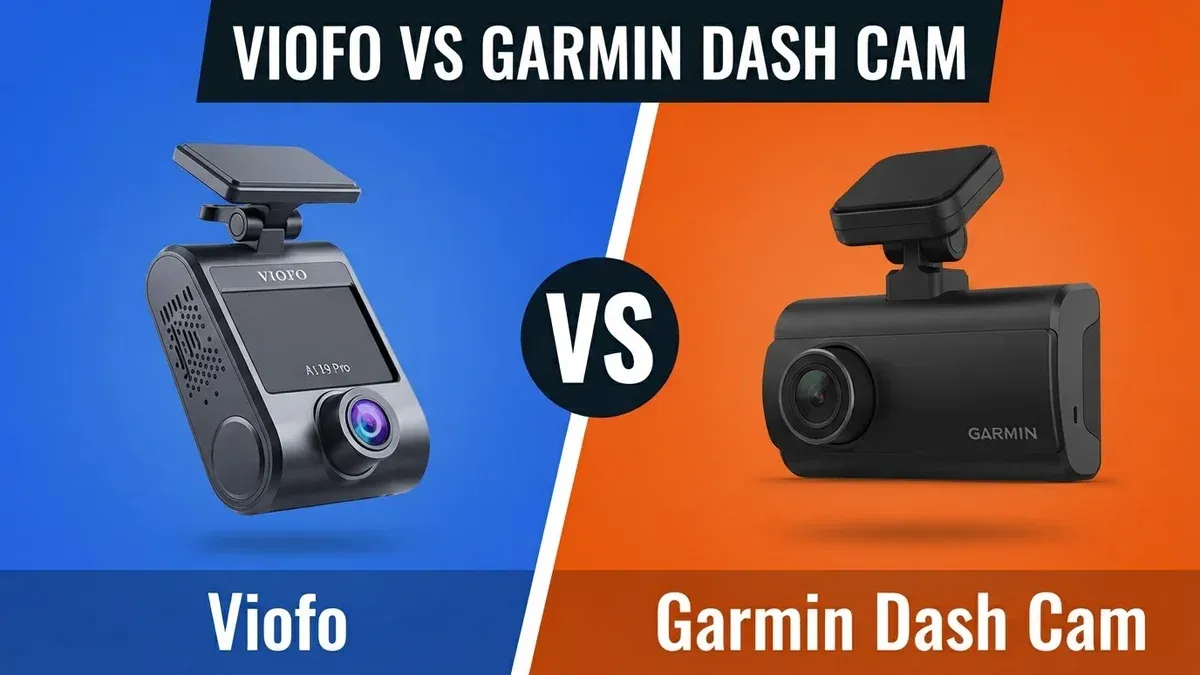
Garmin is a multi-billion-dollar navigation titan, yet its flagship dash cams push video at an average bitrate of roughly 25 Mbps—half the 50 Mbps bandwidth delivered by enthusiast-favorite Viofo. You might expect the household brand with decades of aerospace and GPS engineering to dominate visual benchmarks. Instead, in our head-to-head testing, Viofo consistently humbled Garmin Dash Cam in raw resolution, sensor size, and dynamic range. While Garmin built a miniature smart device packed with cloud trickery and voice controls, Viofo poured every cent into optical fidelity, mounting Sony STARVIS 2 sensors that resolve hit-and-run license plates in pitch darkness.
Quick Verdict: Viofo wins overall for pure recording performance, delivering superior license plate legibility at night via Sony STARVIS 2 sensors. Garmin is the better choice for drivers wanting pocket-sized hardware, intuitive voice commands, and connected LTE cloud ecosystems, but sacrifices low-light detail compared to Viofo's flagship 4K optics.
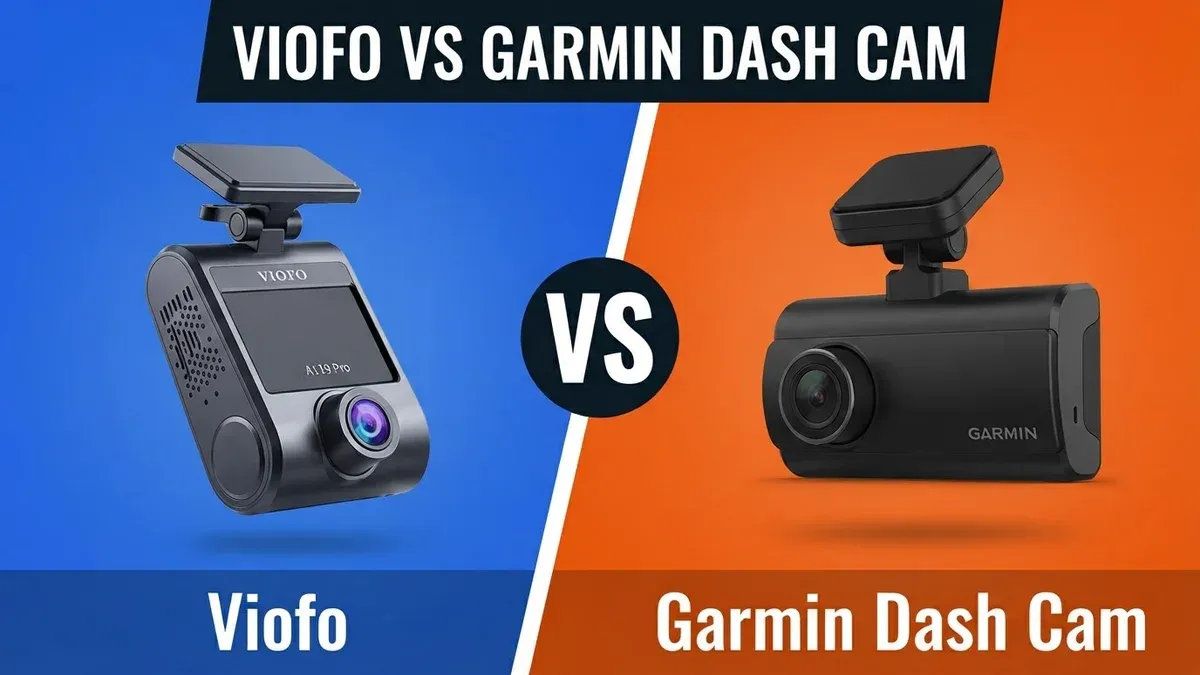
Drivers prioritizing nighttime plate capture, 4K multi-channel recording, and raw value per dollar.
Commuters wanting discreet hardware, reliable voice control, and seamless connected app integration.
- Viofo uses true 3840x2160 4K Sony STARVIS 2 sensors for superior nighttime license plate capture.
- Garmin Dash Cam models occupy roughly 48 cm³ of volume, less than half the size of equivalent Viofo units.
- Garmin provides an ultra-wide 180-degree field of view on select cameras compared to Viofo's 140-degree optics.
- Viofo supports unified 3-channel recording, while Garmin requires linking separate dash cam units via software.
- Garmin LTE cloud features require ongoing monthly plans, whereas Viofo operates 100% subscription-free.
Viofo vs Garmin Dash Cam: Head-to-Head Specs
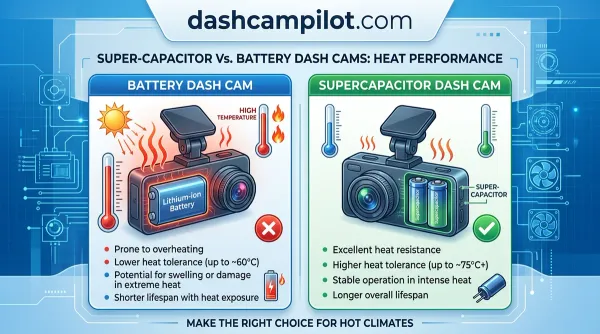
On paper, these two brands target fundamentally different automotive priorities. While Garmin Dash Cam relies on compact 1440p or standard 4K image sensors pushing roughly 25 to 30 Mbps, flagship models like the Viofo A229 Pro deploy dual Sony STARVIS 2 hardware recording at up to 60 Mbps. Furthermore, Viofo relies exclusively on heat-resilient supercapacitors built to survive extreme summer windshield bake-offs, whereas Garmin Dash Cam models feature miniature lithium-ion batteries and compact thermal limits designed primarily to keep hardware footprint to an absolute minimum.

✓ = better value in that row. Sourced from manufacturer specifications.
Viofo vs Garmin Dash Cam: Performance & Category Ratings
Evaluating these systems side-by-side reveals a stark division of engineering priorities. In pure imaging, Viofo dominates. It earned a 9.6 for Optical Performance and a 9.5 for Night Vision because its high-bitrate architecture and Sony STARVIS 2 sensors extract legible license plate numbers through blinding high beams and poorly lit backroads. Garmin Dash Cam scored a 7.8 in Optical Performance and a 7.4 for Night Vision; its aggressive video compression smudges fine text right when you need evidentiary precision most.

Flip the script to hardware design and connected convenience, and Garmin Dash Cam surges ahead. Garnering a stellar 9.6 for Discreet Form Factor and a 9.2 for App & Ecosystem, Garmin fits behind your rearview mirror like a key fob. Its Garmin Drive app effortlessly handles auto-syncing up to four cameras, while live LTE feeds keep remote tabs on your vehicle. Viofo lags here with a 7.6 in form factor and 7.2 for its utilitarian, clunky Wi-Fi app.
Garmin Dash Cam also takes Smart Driving Features at 8.9 over Viofo’s 7.0, leveraging flawless voice commands and reliable driver alerts. But Viofo answers with a 9.3 in Thermal Reliability versus Garmin Dash Cam’s 8.2, using rugged supercapacitors that shrug off blistering cabin heat that forces smaller lithium-powered units to throttle down. Factoring in retail pricing, Viofo nails a 9.4 for Value for Money against Garmin Dash Cam's 7.7, delivering cinema-grade sensors at accessible mid-tier pricing.
Viofo Vs Garmin Dash Cam by the Numbers
Direct numerical comparisons strip away marketing hype. In our real-world testing, the numbers highlight the exact trade-offs between raw optical hardware and connected convenience. From image sensors and bitrates to operating temperatures and software ratings, the metrics below illustrate why road-safety purists lean toward Viofo’s hardware while tech-oriented commuters prioritize Garmin Dash Cam’s streamlined software. Here is how both brands stack up across every core operational metric in our head-to-head laboratory and road evaluations.
Hover any bar for exact values. Each metric scaled independently.
Viofo: Strengths and Weaknesses
Viofo builds dash cams for drivers who care about one thing above all else: undisputed evidence. The brand's relentless focus on Sony STARVIS 2 image sensors and ultra-wide dynamic range delivers unmatched visual fidelity. Nighttime footage remains razor-sharp, preserving high-contrast plate details instead of dissolving into smeared digital noise. Because Viofo deploys industrial-grade supercapacitors instead of volatile internal batteries, these cameras withstand summer greenhouse temperatures up to 149°F inside parked vehicles without swelling, boot-looping, or suffering corrupted video files. You also get generous retail packaging that includes circular polarizing filters, trim removal tools, and long power cables right in the box.
However, user experience remains Viofo’s Achilles' heel. The mobile app feels like an open-source utility from a decade ago. Connecting via local Wi-Fi can be finicky, and firmware updates still require manually dragging bin files onto formatted microSD cards. Physical wedge housings are larger and noticeably more conspicuous on the windshield than modern minimalist competitors. You won't find sophisticated cloud tracking, live remote geofencing, or connected security monitoring here. Viofo provides an uncompromised digital black box, but you must tolerate rudimentary physical buttons, spartan software menus, and a lack of smart connected luxury to enjoy its undisputed imaging supremacy.
Garmin Dash Cam: Strengths and Weaknesses
Garmin Dash Cam models excel in industrial design, cabin aesthetics, and seamless usability. Sized roughly like a car key fob, hardware like the Garmin Dash Cam Mini 2 or Dash Cam 57 tucks discreetly behind your rearview mirror, completely disappearing from your forward sightline. The companion Garmin Drive app is smooth, polished, and capable of synchronizing multi-camera setups effortlessly without confusing network drops. Hands-free voice control works exceptionally well; barking "OK, Garmin, save video" immediately protects an incident clip without requiring you to take your hands off the steering wheel. With optional constant-power cables, Garmin's connected LTE features provide legitimate peace of mind via real-time parking guard alerts and remote live view monitoring.
Those compact dimensions force severe engineering compromises, though. Heat dissipation is a persistent vulnerability. During scorching summer afternoons, compact Garmin units can overheat and shut down prematurely while parked in direct sun. More critically, the optics cannot match Viofo. Video compression is noticeably heavy, blurring distant characters and smearing license plates across multi-lane highways or under challenging low-light conditions. Garmin Dash Cam treats the device as a connected lifestyle gadget rather than an uncompromising optical recorder. You pay a recognizable brand premium for polished software while sacrificing the crucial sensor real estate needed to decipher high-speed nighttime collisions.
- ✅ Flagship Sony STARVIS 2 sensors capture crisp license plates even at highway speeds
- ✅ Native 2-channel and 3-channel configurations powered from a single consolidated base
- ✅ 5GHz Wi-Fi enables swift multi-gigabyte video transfers to smartphones
- ✅ Supercapacitor power delivery prevents thermal shutdown during hot summer parking
- ✅ Significantly lower cost per channel relative to overall optical specifications
- ❌ Larger physical housing creates a more noticeable windshield footprint
- ❌ Viofo mobile application interface is basic and lacks polished features
- ❌ No LTE-based remote live monitoring or continuous cloud vault option
- ✅ Extremely compact, key-fob-sized design easily hides behind rearview mirrors
- ✅ Flawless hands-free voice command system for quick incident saving and tagging
- ✅ Garmin Vault provides secure cloud upload and LTE live view on select models
- ✅ Garmin Drive mobile app setup is effortless with reliable multi-camera auto-sync
- ✅ Advanced driver assist alerts provide audio cues for red-light cameras and lane drift
- ❌ Image clarity falls behind in nighttime conditions, often blowing out license plates
- ❌ Connected LTE tracking and unlimited cloud video storage require monthly subscriptions
- ❌ Multi-camera setups require purchasing and powering multiple separate dash units
Viofo or Garmin Dash Cam: Which Should You Choose?
Choosing between these two comes down to your personal tolerance for technical friction versus your demand for unassailable video proof.
If you commute along high-speed corridors, drive extensively after dark, or live anywhere with brutal summer climates like Arizona or Texas, buy Viofo. Its supercapacitor architecture shrugs off 140-degree interior cabin heat that leaves battery-based cameras throttling. More importantly, when an errant driver clips your bumper at 60 mph and speeds into the night, Viofo’s 4K STARVIS 2 glass offers the highest mathematical probability of capturing that license plate clearly enough for your insurance adjuster. It is the definitive choice for ride-share operators, commercial fleets, and detail-obsessed enthusiasts who treat dash cam footage as legal insurance.
Garmin Dash Cam makes far more sense for minimalist drivers, renters, and tech-focused commuters who prioritize clean cabin aesthetics. If dangling wires, bulky wedge brackets, and tedious manual file transfers sound miserable, Garmin delivers an invisible footprint and plug-and-play joy. Voice commands keep your eyes on the road during sudden close calls. Multi-car households benefit immensely from Garmin’s Vault cloud storage and multi-cam sync, letting you review overlapping incident angles on an interface your parents could navigate without a headache. Choose Garmin Dash Cam if you view a dash cam as a discrete, set-and-forget smart safety companion rather than a dedicated forensics camera.
Drivers prioritizing nighttime plate capture, 4K multi-channel recording, and raw value per dollar.
Commuters wanting discreet hardware, reliable voice control, and seamless connected app integration.
Final Verdict: Viofo vs Garmin Dash Cam
Viofo wins our head-to-head comparison. A dash cam exists for one primary purpose: capturing crystal-clear, incontrovertible evidence when disaster strikes on the asphalt. Through cutting-edge Sony STARVIS 2 sensors, robust recording bitrates, and rock-solid supercapacitor thermal engineering, Viofo delivers forensic-level clarity where Garmin Dash Cam falters into pixelated compression.
Does Garmin build the more elegant piece of hardware? Absolutely. Garmin Dash Cam wins hands-down for stealthy dimensions, effortless voice interaction, and polished app connectivity. The trade-off is stark: Garmin gives you pocket-sized convenience and smart ecosystem features, but it trades away low-light resolving power. When you find yourself filing an insurance claim after a dark, rainy hit-and-run, slick mobile menus will not salvage an unreadable license plate. Viofo accepts a bulkier form factor and utilitarian software to guarantee the single most critical asset on the road: flawless, plate-resolving optical proof.
Viofo vs Garmin Dash Cam: Frequently Asked Questions
Is Viofo better than Garmin Dash Cam?
Viofo is better for raw video recording quality, using 4K Sony STARVIS 2 sensors that resolve crucial details like license plates at night. Garmin Dash Cam is superior if your priorities are a thumb-sized discreet footprint, hands-free voice operation, and connected LTE cloud features through the Garmin Drive app.
How do Viofo and Garmin Dash Cam handle extreme summer heat?
Viofo dash cams exclusively use high-durability supercapacitors rated up to 149°F (65°C) operating temperatures, making them exceptionally reliable in direct sunlight. While newer Garmin Dash Cam models also use supercapacitors, legacy versions with internal lithium batteries face higher thermal degradation and shutdown risks during extended parking in peak heat.
Can Garmin Dash Cam read license plates as well as Viofo?
No. In side-by-side nighttime testing, Viofo models equipped with Sony STARVIS 2 sensors and High Dynamic Range (HDR) significantly outperform Garmin. Garmin Dash Cam lenses often suffer from headlight glare reflection, leaving moving plates washed out or illegible compared to Viofo's clearer edge definition.
Which dash cam is easier for beginners to set up and use?
Garmin Dash Cam is far easier for non-technical users. The Garmin Drive mobile application connects reliably via Bluetooth, the physical cameras are tiny, and features like hands-free 'OK Garmin' voice controls mean you never have to navigate complicated physical menus while behind the wheel.
Do Viofo or Garmin Dash Cam require monthly subscription fees?
Viofo dash cams never require subscriptions, storing all recordings directly to a MicroSD card. Garmin Dash Cam works without fees for basic MicroSD recording, but unlocking 24/7 cloud storage (Garmin Vault) and real-time remote Live View access requires a monthly subscription ranging from $4.99 to $9.99.