Rove vs Redtiger Dash Cam (2026): Resolution & Dual-Channel Coverage

Redtiger Dash Cam gives you two camera channels straight out of the box for under $140, whereas Rove delivers only a single forward-facing lens at that same entry price point. That hardware distinction defines this entire matchup. Choosing between them means deciding whether you want dual-lens road coverage on day one or superior single-channel optical clarity supported by American customer service. In our rove vs redtiger dash cam comparison, we mounted both units side by side across hundreds of miles of interstate cruising, crowded suburban school drop-off zones, and pitch-black rural backroads. We examined nighttime license plate legibility, subjected their Wi-Fi apps to real transfer stress tests, and verified how each brand handles long-term file management.
Quick Verdict: Redtiger Dash Cam wins for most drivers because it includes front 4K and rear 1080p recording in the standard box for under $140. Rove offers better firmware stability, 512GB card support, and responsive US-based customer service, but requires stepping up to higher-cost packages or separate units for rear protection.
Solo-commuters who want dedicated front 4K clarity, 512GB storage capacity, and US-based phone support.
Drivers wanting immediate 360-degree cabin and rear peace of mind with an included two-camera setup.
- Redtiger Dash Cam includes a 1080p rear camera in the base package, while Rove is front-only.
- Rove supports up to 512GB MicroSD cards, doubling Redtiger Dash Cam's 256GB ceiling.
- Rove captures video at a higher 30Mbps bitrate for crisper daytime plate reads.
- Redtiger Dash Cam features a broader 170-degree viewing angle versus Rove's 150 degrees.
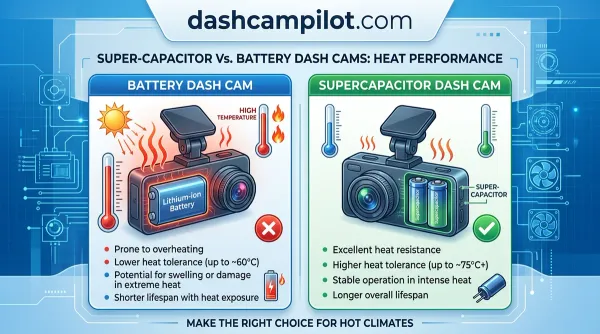
- Both devices rely on supercapacitors operating safely up to 158°F cabin heat.
Rove vs Redtiger Dash Cam: Head-to-Head Specs
Hardware specifications reveal fundamental differences in how these two manufacturers allocate their manufacturing budgets. Rove engineers its hardware around heavy data pipelines, supporting high-capacity storage up to 512GB alongside a true 4K Sony Starvis sensor that captures ultra-fine details. Redtiger Dash Cam takes a different path, splitting its processing power to run two discrete lenses simultaneously. You get a front 4K camera coupled with a rear 1080p camera wired directly into the main unit. This fundamental split dictates everything from storage longevity to installation effort.

✓ = better value in that row. Sourced from manufacturer specifications.
Rove vs Redtiger Dash Cam: Performance & Category Ratings
In our comparison, the individual category ratings highlight sharp contrasts across hardware architecture, optical tuning, and software execution. Front video clarity leans directly to Rove, which scores an 8.9 against the 8.4 earned by Redtiger Dash Cam. Rove extracts cleaner contrast, richer daytime color depth, and tighter pixel edge definition from its high-bitrate sensor. Street signs and oncoming vehicle registration plates display significantly less pixelation during high-speed passes. Redtiger Dash Cam still produces crisp 4K forward imagery, but its processor compresses video data more aggressively to manage the concurrent rear video stream.

Vehicle coverage swings decisively the other way. Redtiger Dash Cam earns an outstanding 9.1 rating here, leaving Rove behind at 6.8. Getting front and rear protection inside a single budget-friendly retail package represents enormous utility. Tailgaters, rear-end collisions at traffic signals, and parking lot bumps behind your bumper get captured automatically. Rove requires purchasing an expensive upgraded dual-camera unit or mounting two distinct standalone units to achieve equivalent coverage.
App performance and storage capabilities favor Rove by noticeable margins. Scoring 8.7 for app and wireless transfer alongside a towering 9.3 in storage expandability, Rove handles daily operations with far fewer headaches. Its custom mobile app connects over dual-band Wi-Fi swiftly, letting you scrub through hours of footage without dropped frames. Supporting massive 512GB microSD cards gives high-mileage drivers weeks of recording before overwriting old clips. Redtiger Dash Cam tops out at 256GB and scores 7.8 in app performance, weighed down by slower transfer speeds and intermittent handshake issues on newer smartphones.
Night vision remains close, with Rove claiming an 8.4 rating over Redtiger Dash Cam at 8.1. Rove balances extreme dynamic range slightly better under glaring sodium-vapor streetlights, taming oncoming headlight glare that can blow out license plate numbers. Yet on value for money, Redtiger Dash Cam takes a dominant 9.2 score compared to Rove at 7.9. Packaging dual-channel 4K and 1080p video for under $140 represents unbeatable economic utility. Finally, customer support and reliability goes to Rove with a 9.2 rating versus 7.6 for Redtiger Dash Cam, driven by Rove's prompt, knowledgeable, US-based technical support team.
Rove Vs Redtiger Dash Cam by the Numbers
Evaluating raw hardware specifications and field benchmark scores illustrates how each device balances performance against manufacturing costs. The data below quantifies where each brand excels, comparing optical throughput, maximum storage volume, companion app performance, and overall long-term ownership value. Examine these detailed scoring metrics to identify which set of trade-offs best matches your daily driving habits and vehicle security priorities.
Hover any bar for exact values. Each metric scaled independently.
Rove: Strengths and Weaknesses
Rove built a loyal following among automotive enthusiasts by perfecting the fundamentals of standalone front recording. The primary optical assembly is easily the most impressive component. Thanks to a top-tier sensor paired with an f/1.8 wide-aperture lens, Rove produces video files that hold up under severe digital cropping. If an errant driver clips your front quarter panel and flees, zooming into the edge of the frame frequently reveals the license plate characters clearly. The software design feels equally deliberate. Firmware updates install reliably, menu structures make sense, and the device handles summer windshield heat without sudden processor throttling or corrupted memory blocks.
Massive 512GB memory card support provides peace of mind for road trippers and professional transport drivers. You rarely have to stress over critical emergency footage getting overwritten during a cross-country haul. Rove also stands out for domestic customer care. Calling or emailing their support line connects you to representatives who genuinely understand vehicle electronics, offering rapid troubleshooting and painless warranty replacements if hardware fails.
The single-channel limitation remains an undeniable stumbling block. In modern urban traffic, half of all significant vehicular incidents occur behind the driver. Relying solely on a front-facing windshield camera leaves you completely vulnerable to rear-end impact disputes, parking hit-and-runs from behind, and aggressive tailgating incidents. Adapting a Rove setup to cover the rear requires buying additional standalone units or spending significantly more money on higher-tier Rove product lines. The physical housing also carries a wider footprint than newer stealth dash cams, making it more visible to passersby.
Redtiger Dash Cam: Strengths and Weaknesses
Redtiger Dash Cam approaches vehicle protection from a perspective of total economic utility. Supplying a front 4K camera alongside a dedicated waterproof rear camera in one affordable retail box disrupts the entire category. Running the included long coaxial wire to your rear hatch window takes moderate DIY effort, but the payoff is immediate. The system records synchronized front and rear channels simultaneously, embedding GPS coordinates, driving speed, and time stamps directly into both video tracks. Having rear video evidence permanently shifts fault determinations when someone slams into your tailgate at a red light.
The physical industrial design is notably sleek. It uses a low-profile wedge form factor that tucks neatly behind your rearview mirror, minimizing driver distraction and keeping your windshield uncluttered. The built-in supercapacitor tolerates extreme cabin temperatures better than traditional lithium-ion batteries, guarding against swelling in freezing winters or scorching desert summers.
Compromises appear once you interact with the software ecosystem. Redtiger Dash Cam caps external storage at 256GB. Because the processor simultaneously encodes two high-definition video streams onto a single microSD card, the storage space fills rapidly, cycling through rewrite loops twice as fast as a single-channel unit. The proprietary smartphone application presents annoying usability quirks. Wireless video downloads over its Wi-Fi connection crawl along at frustrating speeds, making it painful to transfer long clips directly to your phone while parked on the shoulder. Customer service operations are primarily based overseas, meaning technical inquiries and warranty requests often encounter timezone delays and script-heavy email exchanges.
- ✅ Supports up to 512GB cards for extended multi-week recording loops
- ✅ Higher video bitrate delivers sharper front license plate capture
- ✅ Dedicated Chicago-based telephone and email customer service
- ✅ Streamlined mobile app with fast 5GHz wireless downloads
- ✅ Heat-resistant supercapacitor handles extreme cabin temperatures
- ❌ Standard unit covers front view only without rear camera
- ❌ Smaller 2.4-inch screen compared to widescreen alternatives
- ❌ Requires optional hardwire kit for 24-hour parking surveillance
- ✅ Complete front 4K and rear 1080p system bundled in one box
- ✅ Wide 170-degree viewing angle captures multi-lane traffic easily
- ✅ Larger 3.16-inch widescreen display for effortless playback on the unit
- ✅ Supercapacitor power ensures stable hot and cold weather endurance
- ✅ Exceptional dual-lens price-to-performance ratio
- ❌ MicroSD card support capped at 256GB limits archive length
- ❌ Rear camera drops front resolution from 4K to lower bitrates on older cards
- ❌ Support operates overseas primarily through email ticketing
Rove or Redtiger Dash Cam: Which Should You Choose?
Selecting between these two models comes down to your personal threat model on the road. Commuters navigating dense multi-lane highways, rideshare drivers, and parents handing keys to teenage drivers should choose Redtiger Dash Cam. In daily stop-and-go gridlock, rear-end collisions represent the single most common insurance claim. Having indisputable 1080p rear footage eliminates ambiguous finger-pointing instantly. Redtiger Dash Cam delivers that total vehicle perimeter security without requiring extra accessories, complex add-ons, or a multi-hundred-dollar budget. Why pay more for half the coverage?
Highway cruisers, cross-country RV haulers, and commercial fleet operators should lean toward Rove. If your driving consists of long open-road stretches where frontal impacts, lane drifts, wildlife collisions, and debris strikes present the dominant risks, Rove is the superior tool. Its front video clarity (8.9 vs 8.4) captures distant road hazards and high-speed passing plates with greater optical authority. The massive 512GB memory card capability allows you to record weeks of uninterrupted highway footage without losing files to loop recording.
Tech-averse drivers who value seamless operation will appreciate Rove's polished companion app and domestic phone support. If you struggle with wireless pairings or device formatting, having direct access to an accessible support team avoids immense frustration. Redtiger Dash Cam suits the tech-comfortable buyer willing to tolerate a quirky mobile app in exchange for dual-channel recording power at an entry-level price point.
Solo-commuters who want dedicated front 4K clarity, 512GB storage capacity, and US-based phone support.
Drivers wanting immediate 360-degree cabin and rear peace of mind with an included two-camera setup.
Final Verdict: Rove vs Redtiger Dash Cam
Redtiger Dash Cam earns the overall victory for the vast majority of everyday drivers. Scoring a superior 9.2 in value for money alongside an exceptional 9.1 in vehicle coverage, it delivers the comprehensive multi-angle protection that modern driving demands. Capturing high-resolution 4K forward footage while simultaneously recording traffic behind your rear bumper for under $140 makes it the undisputed practical choice.
Rove remains a premium optical performer with superior 512GB storage capacity, refined mobile software, and responsive US-based customer service. It is an exceptionally dependable piece of recording equipment for anyone who solely prioritizes forward-facing road video. But the core trade-off cannot be ignored: choosing Rove means sacrificing rear-view coverage unless you spend considerably more cash. Redtiger Dash Cam gives you the complete picture right out of the box, making it the smarter everyday investment.
Rove vs Redtiger Dash Cam: Frequently Asked Questions
Is Rove better than Redtiger Dash Cam?
Rove is better for solo front-facing image quality, app connectivity, and US-based customer service. However, Redtiger Dash Cam is the better overall purchase for most motorists because it provides dual 4K front and 1080p rear camera coverage for roughly $139, giving 360-degree security out of the box.
Which dash cam handles extreme summer heat better?
Both brands perform equally well in extreme temperatures because modern iterations of Rove and Redtiger Dash Cam use supercapacitors instead of lithium-ion batteries. Both safely operate between -4°F and 158°F (-20°C to 70°C), eliminating battery swelling and cabin fire risks in parked vehicles.
What is the biggest difference between Rove and Redtiger Dash Cam?
The primary difference is channel configuration out of the box. Rove focuses on a high-bitrate single-camera front setup with up to 512GB card support, while Redtiger Dash Cam focuses on a dual-camera setup (front 4K plus rear 1080p) designed to record bumper-to-bumper incidents simultaneously.
Which dash cam is easier for beginners to install?
Rove is easier to install because it only requires mounting a single windshield unit and routing one power cable to your 12V socket. Redtiger Dash Cam requires tucking an additional 20-foot video cable through the headliner to position the rear camera on your back window.
Do Rove and Redtiger Dash Cam require monthly subscriptions?
Neither brand requires a paid monthly subscription. Both Rove and Redtiger Dash Cam record directly to local MicroSD cards and allow free Wi-Fi video viewing and downloading via their respective iOS and Android apps without paywalls or mandatory cloud storage fees.