How Long Does A 128Gb Sd Card Last In A Dash Cam Specification Chart By Year (2026 Verified Specs)

Quick Answer
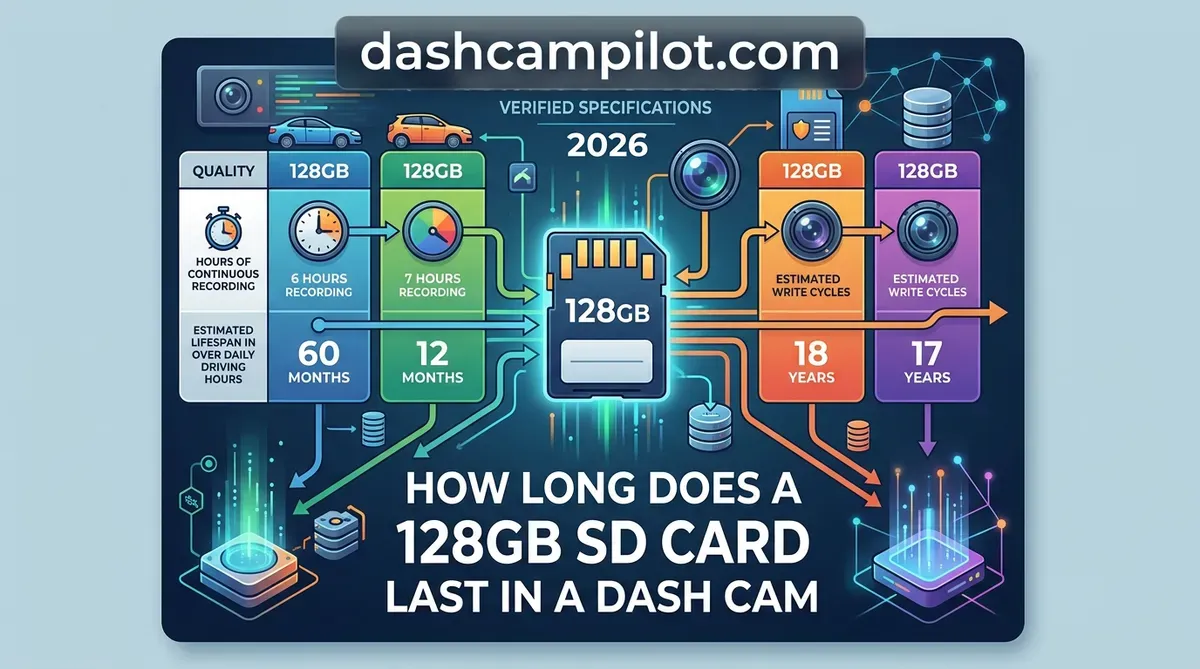
A 128GB microSD card in a dash cam typically holds between 6 to 20 hours of continuous footage before loop-overwriting, depending on resolution, bitrate, and camera configuration. In terms of physical lifespan, a high-endurance 128GB card lasts approximately 2 to 3 years (10,000 to 20,000 write hours) under standard daily driving conditions before NAND flash degradation occurs.
A 128GB microSD card in a dash cam provides between 6 and 25 hours of continuous video recording before loop overwrite, while physically enduring 1 to 5 years of operational service before hardware wear-out. The exact duration depends heavily on your hardware configuration: video resolution (1080p Full HD vs. 4K UHD), video compression bitrates, single vs. dual-channel camera operation, and the silicon endurance rating of the NAND flash memory. Crucially, extreme automotive thermal cycling inside windshield environments can degrade lower-tier consumer storage cards in under twelve months.
This reference guide covers dash cam architectures across model years 2020 through 2026, tracking optical sensor engines (e.g., Sony STARVIS and STARVIS 2), single- to triple-channel configurations, and controller wear profiles. Formatted binary capacities reflect standard exFAT and FAT32 file system allocations. Field data assumes average passenger vehicle driving patterns (1.5 to 2.5 hours daily) and normal operating temperatures (-10°C to 65°C / 14°F to 149°F). Always confirm the maximum storage capacity range and recommended memory class in your dash cam manufacturer manual. Last reviewed: October 2026.
How Long Does a 128GB SD Card Last in a Dash Cam: Hours vs Lifespan
📤 Share Image
When vehicle owners ask how long a 128GB card lasts, they are typically seeking one of two distinct metrics: video retention time (how long footage stays on the card before being overwritten) or hardware operating lifespan (how long the physical silicon functions before failing permanently). Conflating these two concepts is the primary reason motorists discover their dash cam failed to record an accident or critical vandalism event.

Footage Recording Capacity: Hours Before Overwrite
Footage recording capacity refers to the rolling buffer of recorded video stored on the card at any given moment. A 128GB card advertised by storage manufacturers uses the decimal system (128,000,000,000 bytes). Once formatted in exFAT or FAT32 with master boot records and bad block table provisions, the usable formatted capacity sits between 116 GiB and 120 GiB.
Dash cams rely on loop recording. Video streams are cut into continuous 1-, 3-, or 5-minute segmented container files (.MP4 or .TS). Once the formatted volume reaches maximum capacity, the camera's system firmware automatically writes over the oldest non-protected file. For an everyday commuter driving one hour per day using a single-channel 1080p setup at standard bitrates, a 128GB card retains two to three weeks of driving history before cycling over past trips.
Hardware Operating Lifespan: Physical Endurance in Years
Physical lifespan measures the mechanical and electrical integrity of the silicon gate array. Unlike standard digital cameras that write photos periodically, a dash camera functions under continuous heavy write cycles. The internal flash memory controller directs continuous data streams onto microscopic floating-gate or charge-trap transistors. Physical operational lifespan ranges from 1 to 5 years, heavily governed by whether the card is built with standard consumer memory or dedicated High Endurance NAND architecture.
128GB Dash Cam SD Card Specification Chart by Year and Setup
The baseline performance and recording life of a 128GB microSD card varies depending on optical processor generations and camera channel configurations. The reference table below details verified recording times, cumulative bandwidth loads, and hardware endurance milestones tracked across dash cam model years from 2020 through 2026.
How to read this chart:
Identify your camera's architecture by Model Year and Optical / Processor Engine tier. Cross-reference the Specification column to observe total bitrates, loop durations before overwrite, and total hardware write endurance ratings based on factory testing standards.
| Year | Model / Engine | Specification | Value | Notes |
|---|---|---|---|---|
| 2020-2021 | Legacy 1-CH 1080p (Novatek 96655 Engine) | Loop Retention (H.264 @ 12 Mbps) | 23.5 - 25.0 Hours | Single channel; generous storage buffer for basic daily commuting. |
| 2021-2022 | Dual-CH 1080p Front/Rear (Sony STARVIS IMX291) | Loop Retention (Combined 22 Mbps) | 12.5 - 13.5 Hours | Dual write channels halve available overwrite retention window. |
| 2022-2023 | Single 1440p 2K QHD (Ambarella A12 Platform) | Loop Retention (H.264 @ 18 Mbps) | 15.0 - 16.5 Hours | Balanced sweet spot between license plate clarity and buffer window. |
| 2023-2024 | Single 4K UHD 30fps (Sony STARVIS 2 IMX678) | Loop Retention (H.265 @ 30 Mbps) | 9.0 - 10.0 Hours | H.265 compression mitigates high pixel array throughput. |
| 2024-2025 | Dual 4K Front + 1080p Rear (High-Bitrate Tier) | Loop Retention (Combined 42 Mbps) | 6.5 - 7.5 Hours | Generates roughly 18 GB/hour. Overwrites in less than one full workday. |
| 2025-2026 | Triple 4K + 2K + 1080p Fleet Architecture | Loop Retention (Combined 55 Mbps) | 5.0 - 6.0 Hours | Front, cabin, and rear simultaneous write streams. |
| All Models | Standard TLC/QLC Consumer Flash Card | Operational Hardware Lifespan | 500 - 1,500 Hours (6-12 Mo.) | Not designed for continuous dash cam loop writing. High failure rate. |
| 2026 Verified | Specialized High Endurance (pSLC / 3D TLC) | Operational Hardware Lifespan | 10,000 - 20,000 Hours (3-5 Yrs) | Factory specification rating: 60-120 TBW (Terabytes Written). |
Footnote: Recording capacity assumes continuous write mode with default emergency G-sensor partition sizes (15% reserved buffer). Operational endurance is based on a daily commute of 2 hours at ambient automotive operating ranges.
Verified Recording Hours and Resolution Benchmarks
The continuous write time before looping is directly governed by total video stream bandwidth. The chart below illustrates how recording buffer hours decline rapidly as you step up through standard resolution presets on a 128GB capacity drive:
Card Endurance and Write Cycle Ratings Through 2026
Memory card longevity is formally measured in TBW (Terabytes Written) or guaranteed recording hours before block exhaustion. Manufacturers such as SanDisk (High Endurance / Max Endurance), Samsung (PRO Endurance), and Transcend publish verified continuous ratings. A 128GB High Endurance card provides between 10,000 and 20,000 certified continuous write hours. At two hours of vehicular driving per day, 10,000 hours equates to more than 13 years of raw write life—meaning extreme cabin heat and seasonal thermal shock will almost certainly destroy the card's electronic packaging long before write-cycle exhaustion occurs.
How Resolution and Dual-Channel Setups Impact Recording Hours
The speed at which a 128GB card fills up and loops over older video is determined by raw data generation throughput. Many drivers make the mistake of assuming card capacity is fixed strictly by time, without calculating the bitrate demands of their camera setup.
Single 1080p vs 4K Ultra HD Bitrate Overhead
Video bitrate represents the volume of digital bits encoded per second of video. The mathematical formula to calculate hourly storage consumption is straightforward:
Hourly Storage (GB) = [Bitrate in Mbps × 3600 seconds] ÷ [8 bits per byte × 1024 Megabytes]
- 1080p Full HD (12 Mbps H.264): Consumes ~5.27 GB per hour. A usable 118 GiB card retains ~22.4 hours of continuous footage.
- 1440p 2K QHD (18 Mbps H.264): Consumes ~7.91 GB per hour. A 118 GiB card yields ~14.9 hours.
- 4K Ultra HD (30 Mbps H.265 / HEVC): Consumes ~13.18 GB per hour. A 118 GiB card loops after ~8.9 hours.
- 4K Ultra HD Uncompressed Preset (45 Mbps H.264): Consumes ~19.77 GB per hour. Overwrite starts after just ~5.9 hours.
Modern dash cams allow toggling between legacy AVC/H.264 and efficient HEVC/H.265 compression algorithms. H.265 delivers identical visual fidelity and license plate readability at roughly 30% lower bitrates. Switching your dash cam engine to H.265 can increase your 128GB card's recording window before overwrite by 3 to 4 hours without sacrificing optical quality.
Dual-Channel and Multi-Camera Storage Demands
Adding a rear camera or an infrared interior cabin camera significantly increases storage consumption. In a dual-channel configuration, the dash cam's system processor writes two separate video files simultaneously to the 128GB card:
- Front 4K (30 Mbps) + Rear 1080p (10 Mbps): Combined throughput equals 40 Mbps (17.58 GB per hour). Total loop time drops to approximately 6.7 hours.
- Triple Setup (Front 4K + Interior 1080p + Rear 1080p): Combined throughput reaches 52 Mbps (22.85 GB per hour). Total loop time drops to approximately 5.1 hours.
Furthermore, dash cams partition between 10% and 30% of available card space specifically for "Event" files triggered by the internal G-sensor. Because these emergency files are locked against automatic loop overwriting, the active loop buffer available for normal driving files is compressed further.
Flash Memory Degradation: What Limits 128GB Card Hardware Lifespan
Flash memory is a consumable electronic medium. Every time an electronic charge passes through a silicon floating gate, the micro-thin silicon dioxide insulating layer suffers microscopic physical damage. Over millions of microscopic transactions, this insulation breaks down until individual blocks can no longer hold an electrical charge reliably.
NAND Flash P/E Cycles and Wear Leveling
The durability of flash memory is defined by its Program/Erase (P/E) cycle rating—the number of times an individual storage cell can be written and subsequently cleared. Dash cam write operations are uniquely punishing because video files must clear existing blocks before accepting new data.
To prevent premature sector burnout, the memory card's onboard flash memory controller executes dynamic and static wear-leveling algorithms. Wear leveling dynamically maps inbound data blocks across the entire physical array of NAND cells, ensuring every cell wears down at an even rate rather than burning out the initial blocks of the partition table.
High Endurance vs Standard Consumer MicroSD Cards
The fundamental structural difference between standard memory cards and endurance cards lies in how many data bits are packed into each silicon cell:
✅ High Endurance MicroSD (MLC / 3D TLC)
- Rated for 3,000 to 10,000 P/E cycles per physical cell.
- Specialized controller firmware optimized for constant sequential writes.
- Full manufacturer warranty coverage for dash cam and surveillance duty.
- Operates reliably for 3 to 5 years under normal vehicle operation.
❌ Standard Consumer Cards (QLC / Ultra TLC)
- Rated for only 300 to 500 P/E cycles per physical cell.
- Designed for burst photo/phone storage, not continuous video looping.
- Dash cam usage explicitly voids the factory warranty.
- Commonly suffers silent write-failure within 6 to 9 months.
Windshield Heat and Thermal Fatigue
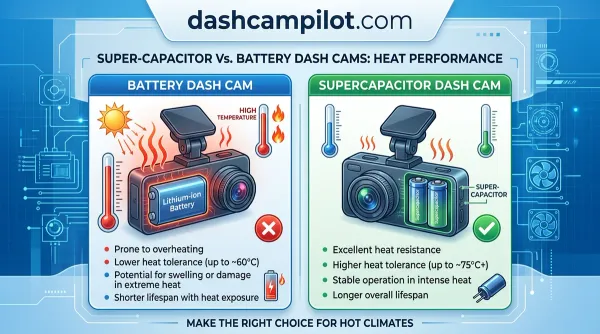
Direct solar radiation compounds mechanical silicon wear. Vehicles parked outdoors on an 85°F (29°C) summer afternoon routinely develop windshield glass temperatures exceeding 140°F to 160°F (60°C to 71°C). The internal flash memory controller generates substantial operating heat of its own during continuous sequential writing. When subjected to intense thermal fatigue, the insulating oxide layers in consumer-grade flash memory deteriorate up to four times faster, causing unexpected file corruption and sudden card lockup.
When an SD card exhausts its spare block reserve, the controller initiates a permanent write-protect lock to preserve existing data. Many basic dash cams fail to chime or notify the driver when this occurs: the camera will display an active recording light, but no new emergency files or loop data can be saved to disk.
Capacity Comparisons: 128GB vs 64GB and 256GB Dash Cam Cards
Card capacity does not just dictate how many hours of footage your dash cam can store before looping—it is also a key factor in hardware longevity. Because wear leveling algorithms distribute writes evenly across the memory array, larger capacity cards experience less frequent cell cycling and hold up substantially longer.
Why 64GB Cards Burn Out Twice as Fast
A 64GB card has half the available physical NAND cells of a 128GB card. In identical driving conditions and video settings, a 64GB card completes a full write-and-erase cycle twice as often. A driver who drives 4 hours daily completes approximately 180 full overwrites per year on a 64GB card, compared to only 90 overwrites on a 128GB card. This doubles the cell degradation rate, cutting physical operational lifespan down to roughly 12 to 18 months even with endurance-grade media.
The Longevity Advantage of 256GB Over 128GB
Upgrading from a 128GB card to a 256GB card doubles both the overwrite retention window and the total wear-leveling surface. In a high-bandwidth dual-channel setup (4K front and 1080p rear), a 128GB card loops in roughly 6.8 hours, whereas a 256GB card stores over 13.5 hours of continuous footage. Crucially, the 256GB card distributes identical write streams across twice as many gates, effectively doubling the card's real-world operational lifespan to 5+ years.
📋 How to Maximize Your 128GB Dash Cam Card Lifespan
Always use the dash cam’s native system settings to format the card rather than a computer. Dash camera operating firmware aligns the allocation cluster size (typically 64KB or 128KB clusters) directly to match the controller block architecture, reducing unnecessary write amplification.
Reformatting every 4 to 8 weeks flushes fragmented files and clears accumulating emergency write locks caused by routine driving jolts. This resets the master file allocation table and restores optimal write-leveling performance.
Avoid consumer-grade "Extreme" cards designed for DSLR burst photography. Insist on models labeled High Endurance or Max Endurance, built specifically with pSLC or premium 3D TLC silicon designed for relentless sequential surveillance writing.
If your dash cam is hardwired for 24/7 parking surveillance using continuous low-bitrate recording, your 128GB card never stops writing. In this operational configuration, write wear triples compared to standard commuting. For hardwired parking mode installations, inspect your memory card integrity every 6 months and upgrade to a 256GB card whenever possible to prolong hardware service life.
Frequently Asked Questions About 128GB Dash Cam SD Cards
Can a 128GB SD card record for a full 24-hour day?
Yes, but only under specific recording conditions. A 128GB card can store 24 continuous hours of video on a single-channel 1080p camera recording at a conservative bitrate of 11 to 12 Mbps using H.264 compression (or up to 14 Mbps with H.265). However, if your dash cam records in 2K, 4K, or utilizes a dual-channel front/rear system, the card will loop over older footage in 6 to 14 hours.
How do I know when my 128GB card has worn out?
Common signs of a degraded memory card include continuous error beeping upon vehicle startup, recurring prompts to format the memory card, unreadable video files with missing playback thumbnails, or unexplained gaps in recording timestamps. Modern endurance cards often switch into a locked "read-only" state when their spare block threshold is exhausted, preventing new recordings from saving.
Why does my dash cam say the 128GB card is full?
A dash cam stating its card is "full" typically indicates that the card's emergency event partition has reached capacity. When the camera encounters potholes, railroad tracks, or aggressive braking, the internal G-sensor automatically flags those files as emergency events and protects them from being overwritten. Over time, these protected files fill the card, leaving no free space for standard loop recording. Formatting the card inside the camera clears these locked files and resolves the issue.
Does a 128GB card need a specific speed rating for 4K dash cams?
Yes. For reliable 4K video recording, your 128GB microSD card must carry a minimum speed rating of UHS Speed Class 3 (U3) or Video Speed Class 30 (V30). These certifications ensure a sustained write speed of at least 30 MB/s. Cards rated only Class 10 or U1 (10 MB/s sustained) cannot keep pace with high-bitrate 4K video streams, causing buffer underruns, dropped frames, and system crashes.
In summary, a 128GB microSD card offers 6 to 10 hours of 4K footage or 18 to 25 hours of 1080p video before loop overwriting. When choosing storage for your dash cam, insist on a High Endurance model to ensure your card physically lasts its expected 3 to 5 years of operational service under demanding cabin temperatures. Take a moment to format your card inside your dash cam system every 4 to 8 weeks—ensuring critical incident footage is always safely preserved when you need it most.