How Long Do Police Keep Dash Cam Footage: 30 Days to Life
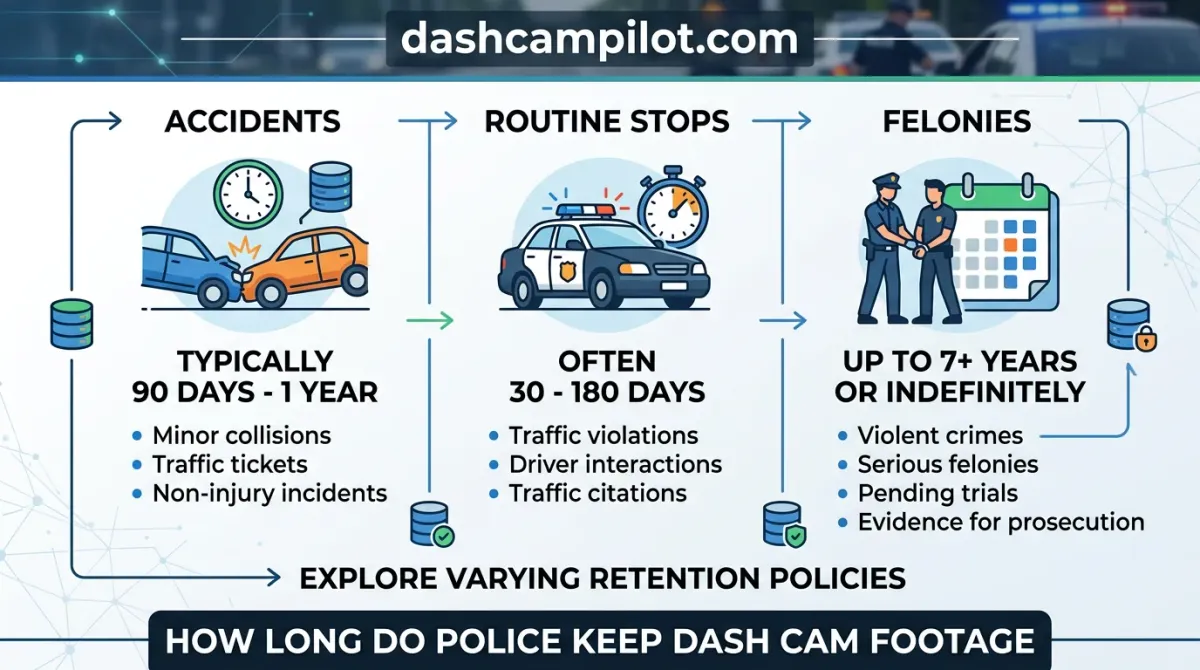
If you were involved in a traffic stop or crash, the clock is already ticking on the recording that could support your claim. Police departments generally retain routine, non-evidentiary dash cam video for only 30 to 90 days before automated systems purge the file. If an encounter involves an arrest, felony, or formal complaint, agencies categorize the recording as evidence, storing it for several years or indefinitely.
Because retention schedules depend heavily on state laws and incident classification, timelines fluctuate sharply. The data below details retention windows across common scenarios and outlines the legal steps needed to preserve vital video before automatic deletion occurs.
How Long Do Police Keep Dash Cam Footage? Quick Overview by Incident
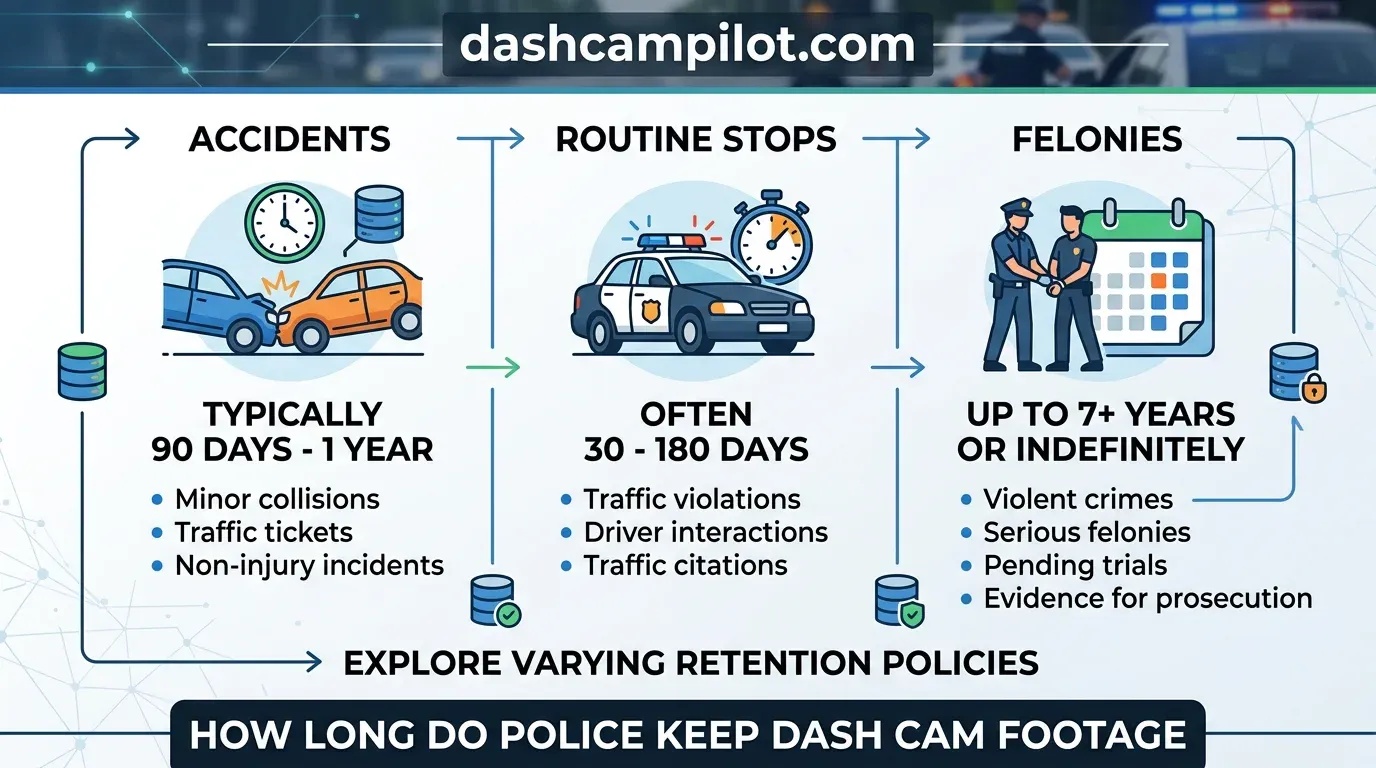
There is no single universal federal standard governing how long police departments must store dash cam video. Instead, retention windows are dictated by incident classification and evidentiary value.
Routine, non-evidentiary patrol footage is typically erased within 30 to 90 days to conserve digital storage capacity. Conversely, any recording tagged during an active enforcement encounter enters a protected evidentiary track.
For example, a routine patrol drive through downtown is wiped in 60 days, whereas a DUI arrest video from the exact same shift is locked in evidence for 3 years or until court resolution.
Standard Retention Schedules Across Law Enforcement Agencies
Retention schedules vary based on whether the recording captures actionable evidence, a formal citation, an arrest, or serious felony conduct.

How to Read This Chart
This table outlines common retention schedules across state, county, and municipal law enforcement agencies. The "Incident Classification" column identifies the legal severity of the contact, which dictates whether an officer or system flags the recording.
The "Typical Retention Window" shows the standard baseline timeframe in days or years before a file becomes eligible for destruction. The "Trigger for Deletion" defines what legal or automated milestone must occur before the purge runs.
Retention categories differentiate between non-evidentiary records—which purge automatically on rolling schedules—and evidentiary files. Evidentiary files require explicit case disposition, judicial dismissal, or prosecutor clearance before permanent removal.
Why State and Local Laws Create Retention Variations
Because there is no single universal federal standard, retention rules vary widely by state statute, county policies, and individual agency guidelines.
State public records laws and criminal discovery mandates establish the baseline minimums. However, municipal police departments often create their own stricter policies based on local litigation risk.
As a result, a brief traffic stop might carry a strict 90-day retention window in one city, while the neighboring county sheriff's office holds the same recording for a full year.
Evidentiary vs. Non-Evidentiary Police Video: Key Classification
Footage categorization (evidentiary vs. non-evidentiary) is the single most critical factor in determining how long a file is saved. This initial classification dictates whether an in-car recording enters a long-term evidence locker or the short-term deletion queue.
Criteria That Define Evidentiary Video Files
Evidentiary video captures any event with potential legal or investigatory relevance. This classification applies to footage documenting arrests, search warrants, field sobriety tests, and high-speed vehicle pursuits.
Files are also marked as evidentiary if an encounter involves a use-of-force incident or prompts an immediate citizen complaint. These records remain locked in storage until all statutory retention requirements or legal proceedings conclude.
What Qualifies as Non-Evidentiary Routine Patrol Footage
Non-evidentiary files cover everyday patrol activity where no enforcement action occurs. This includes general cruising, consensual citizen conversations, routine motorist assistance, and dispatched calls that clear without a citation or police report.
Because these files consume massive server space, they carry short lifespans. For example, an officer initiates a traffic stop that ends with a verbal warning and tags it non-evidentiary, scheduling it for purge in 45 days unless a complaint is filed.
Officer Tagging Protocols and Automated Metadata Logging
Officers tag recordings as evidentiary or non-evidentiary during or immediately following an encounter via in-car computer terminals. Automated systems simultaneously append CAD dispatch codes, timestamps, and GPS metadata to the video profile.
Misclassification risks premature deletion if an incident is not promptly tagged by the responding officer. Untagged recordings typically default to non-evidentiary status, putting vital evidence at risk of automated purging.
How Long Police Keep Dash Cam Footage for Felonies and Critical Events
Homicides, Capital Offenses, and Indefinite Storage Rules
Under state evidence preservation acts, law enforcement agencies must maintain dash cam footage tied to homicides, capital offenses, and severe felonies indefinitely or for multiple decades. Because major capital crimes carry no statute of limitations, these visual recordings are cataloged as permanent, unalterable criminal evidence.
Jurisdictions must retain these files throughout the offender's entire custodial sentence, and frequently until the defendant is deceased. This continuous archival ensures that original, unedited video remains available for state innocence commissions, federal reviews, or future forensic testing.
Use-of-Force Investigations and Internal Affairs Retention
Critical events such as officer-involved shootings and serious use-of-force incidents fall under specialized high-retention policies. Standard departmental deletion schedules are immediately suspended whenever an incident produces severe injury, death, or formal internal scrutiny.
For internal affairs investigations and civil rights complaints, the standard officer use-of-force retention window ranges from 3 to 10+ years. Municipalities enforce these extended timelines to maintain necessary evidentiary defenses against municipal liability lawsuits and federal civil rights claims.
Statute of Limitations and Post-Conviction Appeal Windows
Felony cases require evidence preservation that spans the entire statutory limitations period alongside all direct post-conviction appeal windows. Law enforcement custodians cannot purge digital media simply because a local trial court reaches a verdict or accepts a plea.
For example, a high-speed pursuit resulting in aggravated vehicular assault is retained for 7 years post-sentencing to protect against federal habeas corpus claims. Maintaining the recording through these prolonged appellate cycles prevents allegations of evidence spoliation while convictions remain contested.
Storage Constraints and Cloud Costs: Why Departments Purge Routine
A common public misunderstanding assumes law enforcement agencies possess infinite cloud storage capacity to preserve every recorded shift indefinitely. In reality, storage constraints—both physical on-premises servers and recurring cloud fees—are primary drivers behind short non-evidentiary retention limits.
On-Premises Servers vs. Secure Law Enforcement Cloud Platforms
Cruisers recording in 1080p or 4K produce gigabytes of video per shift across dozens or hundreds of squad cars. For example, a 200-officer municipal department generates over 15 terabytes of raw squad car footage each month, requiring aggressive lifecycle rules to avoid budget shortfalls.
Local agencies must choose between maintaining costly on-premises server racks or contracting with specialized CJIS-compliant GovCloud platforms. Both options carry severe financial trade-offs, as on-premise hardware maintenance and GovCloud hosting fees escalate into millions annually for medium-to-large departments.
How Automated Lifecycle Rules Execute Routine File Purges
To keep operating budgets sustainable, Digital Evidence Management Systems (DEMS) enforce strict data lifespans. Non-evidentiary routine footage is routinely purged after a short window (typically 30 to 90 days) to manage digital storage capacity and cloud costs.
Automated purge algorithms execute unflagged deletions precisely when retention windows lapse. Unless a recording receives an investigative tag, collision marker, or formal preservation hold, the software permanently overwrites the files without requiring manual officer intervention.
Police Dash Cam vs. Body-Worn Camera Footage: Retention Comparison
Dash Cameras vs. Body-Worn Cameras (BWC)
Cruiser dash cams primarily document public roadways, traffic stops, and vehicle transport cages. Because these cameras monitor public thoroughfares and standard enforcement positions, baseline privacy concerns remain relatively low.
Body-worn cameras (BWCs) travel with the officer into private residences, medical facilities, and vulnerable interpersonal encounters. These environments capture sensitive personal data, triggering rigorous statutory redaction requirements and specialized handling under public record statutes.
Police Video Systems vs. Fleet and Consumer Dashcams
Fleet and commercial dash cams prioritize driver safety metrics and telematics. They upload flagged telematics events to proprietary servers while quickly purging routine driving data to manage private bandwidth.
Consumer devices typically overwrite footage via continuous loop recording within hours or days unless manually saved or locked by an internal impact sensor. They lack evidentiary chain-of-custody protections and automated department classifications.
How to Read the Recording Systems Comparison
This table outlines the mechanical triggers, legal redaction requirements, and operational lifespans of law enforcement and private recording hardware. "Primary Recording Trigger" specifies what initiates footage capture, distinguishing automated law enforcement vehicle sensors from continuous vehicle loop recorders.
"Privacy Redaction Demand" indicates the administrative threshold required prior to public release under freedom-of-information laws. "Standard Retention Window" establishes baseline holding timelines for unflagged, routine files before system purges occur.
Retention durations represent general statutory baselines across state jurisdictions. Exact intervals fluctuate depending on municipal code, specific department policy, and total server capacity. For consumer hardware, retention relies entirely on micro-SD card storage volume and video resolution settings.
Dispatch Audio and CAD Log Timelines
Computer-Aided Dispatch (CAD) log entries and 911 dispatch audio follow statutory tracks distinct from mobile camera files. These records operate under state telecommunications retention rules rather than law enforcement video policies.
911 audio dispatch recordings: Usually kept under broader communications retention schedules, typically 30 to 365 days depending on state telecommunications rules. Text-based CAD logs and dispatch dispatch event histories often persist in administrative databases for three to ten years.
How to Halt Video Purges: Evidence Preservation Letter Guide
Automated server scripts continuously erase police video once standard retention timers expire. Filing a formal evidence preservation letter or public records request legally pauses the automated deletion cycle and protects critical evidentiary files.
Believing a phone call to the precinct constitutes a legally binding litigation hold is a critical error. Informal phone calls or desk inquiries do not establish a binding hold or create spoliation exposure; formal written notices are required to freeze automated file destruction cycles.
What a Formal Litigation Hold Must Contain
A generic demand to save all footage is routinely challenged for overbreadth. Preservation notices must specify the exact date, time window, street location, involved officer names, patrol car numbers, and Computer-Aided Dispatch (CAD) incident IDs.
For example, an attorney sends a formal spoliation notice 14 days after an intersection collision, legally compelling the department's records supervisor to manually lock Cruiser #14's forward-facing dash cam footage from the automated 30-day purge queue.
Who to Serve: Chief of Police, City Attorney, and Records Custodian
Deliver the written demand via certified mail with return receipt requested to three specific administrative targets to ensure absolute legal accountability:
Manually tags, isolates, and exports the raw video file within the digital evidence management system.
Puts municipal legal counsel on notice of impending civil litigation and triggers formal internal litigation holds.
Notifies executive department leadership to establish command-level accountability over chain-of-custody protocols.
Legal Consequences of Spoliation of Evidence
Failure to preserve after receiving formal notice opens the agency to spoliation of evidence sanctions in civil court.
If an agency permits video destruction after receiving a valid hold, trial judges can issue adverse inference jury instructions, strike defense pleadings, or impose severe monetary penalties against the municipality.
How Long Do Police Keep Dash Cam Footage After a Car Accident?
Why Accident Footage Is Often Purged Within 60 to 90 Days
When an auto collision does not involve felony charges, reckless driving, or severe injuries, police departments typically classify the recording as non-evidentiary. Because the crash is deemed a routine civil dispute rather than a criminal matter, the files fall under standard municipal schedules, frequently triggering automated system purges within 60 to 90 days.
Waiting until civil litigation begins months or years later almost guarantees the loss of liability proof. For example, a driver injured in an accident waits five months for the insurance settlement to stall before requesting footage, only to discover the city legally and permanently cleared the non-evidentiary file at day 90.
Using State Public Records Laws (FOIA / Sunshine Laws)
Filing state Sunshine Law or Freedom of Information Act (FOIA) requests promptly is critical when dealing with two-vehicle crashes. However, standard public records processing wait times can easily exceed the short retention window if an initial preservation request or public records claim is not filed immediately with the department's records custodian.
Claimants must also prepare for administrative expenses. Law enforcement agencies routinely charge processing or redaction fees before releasing traffic stop or crash video. These statutory fees cover officer or technician hours spent blurring bystander faces, juvenile passengers, and displayed personal data.
Navigating Active Criminal Investigation Exemptions
Assuming public records laws guarantee immediate and unredacted release of active criminal investigation video is a common mistake. If a crash involves cited criminal violations—such as driving under the influence or reckless vehicular assault—agencies can legally withhold the video under active investigatory exemptions until prosecutors resolve the charges in court.
Chain of Custody and Common Pitfalls That Risk Lost Video Evidence
How Digital Audit Logs Verify File Integrity and Chain of Custody
Modern Digital Evidence Management Systems (DEMS) generate detailed, tamper-evident audit logs. These automated systems record every view, export, tag change, and redaction, establishing the verifiable chain of custody required for court admissibility.
Proactively requesting the full audit trail ensures the footage hasn't been improperly modified or truncated before trial. For example, a defense attorney challenges a missing 3-minute gap in cruiser footage by subpoenaing the DEMS chain of custody metadata log, proving an officer manually altered the tag.
Top Assumptions That Lead to Lost Cruiser Footage
Assuming all police cruiser video is automatically stored forever in the cloud is the most dangerous assumption a litigant can make. Unindexed or routine files are systematically queued for automated server deletion.
Another frequent error involves confusing private dashboard camera overwrite cycles with law enforcement records retention schedules. Consumer dash cams rely on rolling SD card overwrite loops of several hours, whereas departmental servers manage deletions using rigid administrative retention categories.
Confusing private dashboard loop recordings with police departmental retention standards causes costly legal delays and missed discovery windows. Counsel must evaluate municipal timelines immediately rather than relying on commercial video standards.
- ✓ Retention schedules divide recordings into non-evidentiary video (deleted after 30 to 90 days) and evidentiary files (kept years or indefinitely).
- ✓ Car accident recordings without criminal charges or disputed liability are routinely purged within 60 to 180 days across most municipal departments.
- ✓ Felony investigations, officer-involved shootings, and critical incidents require retention until statutes of limitations expire or cases close permanently.
- ✓ High digital cloud storage expenses and strict municipal server quotas force law enforcement agencies to automate regular footage purges.
- ✓ Sending a formal spoliation or evidence preservation letter within days halts routine automated deletion cycles before vital video is overwritten.
❓ Frequently Asked Questions
1 How long do police keep dash cam footage after a minor car accident?
For minor traffic accidents without criminal citations, departments generally classify dash cam files as non-evidentiary or routine records. These files are typically held between 60 and 180 days. Securing insurance or legal representation early ensures you request critical video information before scheduled digital storage overwrites permanently delete it.
2 What is the difference between evidentiary and non-evidentiary police dash cam footage?
Non-evidentiary video covers routine patrols, casual public interactions, and uneventful traffic stops, resulting in swift deletion within 30 to 90 days. Evidentiary footage documents arrests, use-of-force incidents, felonies, or contested citations. Departments archive evidentiary files under rigid chain-of-custody rules for three to seven years, or indefinitely.
3 Can police delete dash cam footage if an active investigation or lawsuit is pending?
Police departments are legally prohibited from deleting dash cam footage tied to active criminal prosecutions, tort claims, or civil lawsuits. When a department receives a formal evidence preservation letter or litigation hold, automated purge schedules must cease immediately. Destroying flagged footage exposes law enforcement agencies to severe spoliation sanctions.
4 How can citizens request police dash cam footage before it gets deleted?
Citizens can obtain video information and records by filing a state open records or federal FOIA request directly with the law enforcement agency. You must provide specific incident details, including date, time, location, and case numbers. Expediting your request ensures processing occurs before automated retention clocks run out.
5 Why do police departments purge routine dash cam footage so quickly?
Law enforcement departments generate petabytes of high-definition video weekly across cruiser cameras and body devices. Substantial cloud storage expenses and stringent local budget caps compel administrators to enforce swift deletion policies. Key facts show that archiving non-evidentiary files indefinitely would cost mid-sized agencies millions in software licensing annually.
6 How long do police keep dash cam footage if no citation or arrest occurs?
Explain that routine stops without enforcement are classified as non-evidentiary and are automatically deleted within 30 to 90 days depending on local department policy.