Dash Cam Privacy for Rideshare Passengers: Audio & App Laws
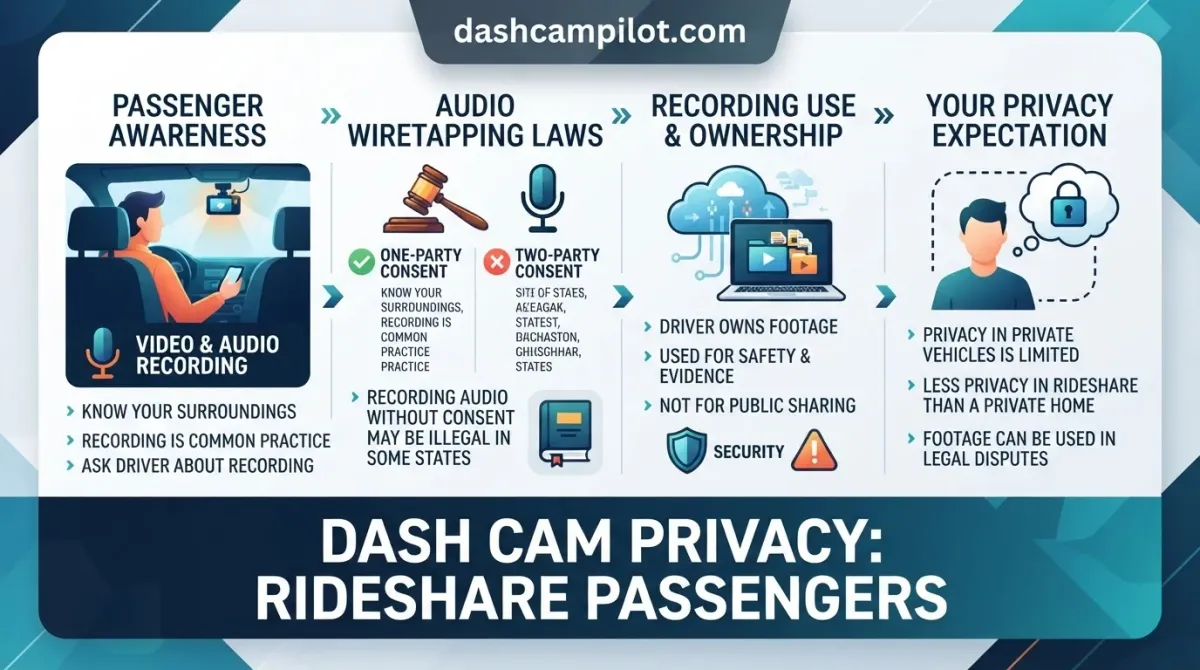
Stepping into an Uber or Lyft and seeing a dash cam pointed right at your seat can feel unsettling.
As a passenger, your legal privacy is limited. Drivers generally have the right to record video for safety, but capturing cabin audio and posting clips online trigger strict legal restrictions and platform penalties.
Here is how state consent laws, rideshare policies, and cabin camera technology affect your privacy on every ride.
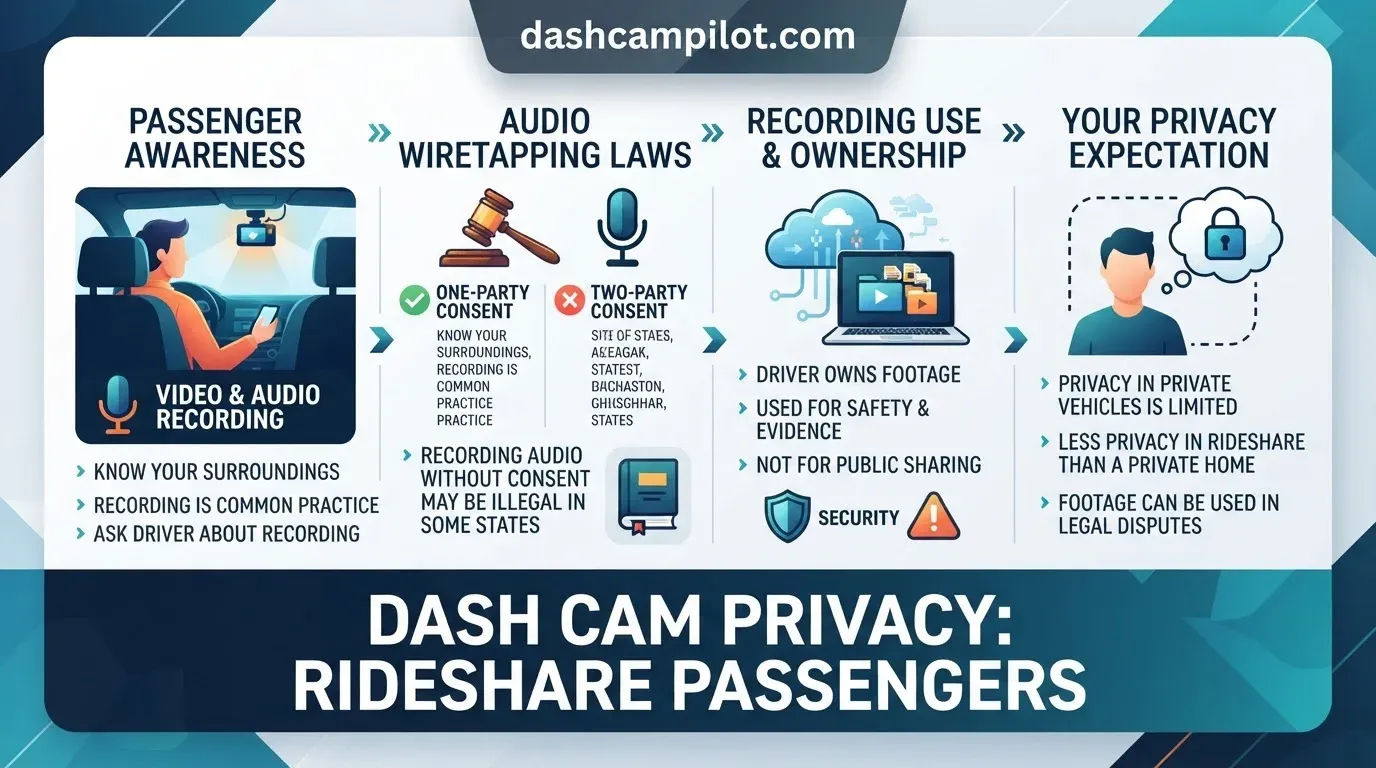
Dash Cam Privacy for Rideshare Passengers: Legal Rights Overview
The legal framework governing rideshare cabin surveillance balances driver workplace security against rider civil liberties. While commercial transportation occurs within personal automobiles, privacy legislation clearly differentiates between what a camera sees and what a microphone hears.
The Baseline Rule for TNC Vehicles
Drivers possess legal rights to equip their personal vehicles with surveillance gear for security, fraud defense, and liability documentation. Because the vehicle remains private property deployed as a commercial conveyance, drivers retain broad legal authority to monitor physical spaces inside and around the car.

Passengers do not have a general legal expectation of visual privacy inside another person's private vehicle used for commercial rideshare service. Major platforms like Uber and Lyft permit dual-facing dash cams for incident investigation, yet both place strict contractual limits on footage distribution to prevent unauthorized data sharing.
Visual Surveillance vs Audio Interception
Visual recording in a commercial conveyance is generally permissible across jurisdictions because public passenger cabins offer a diminished expectation of privacy. For example, a rider entering an Uber vehicle in New York sees a dual-facing camera mounted beside the rearview mirror; this silent optical capture complies fully with federal surveillance doctrines.
In sharp contrast, audio recording creates severe legal liability depending on local wiretapping frameworks. While a driver may freely film physical cabin activity, recording sound intercepts oral communications. Capturing spoken words without mandated participant awareness elevates standard vehicular monitoring into potential electronic eavesdropping.
Federal law permits single-party audio capture, but individual state eavesdropping statutes impose distinct, rigorous compliance burdens. When drivers record cabin sound without statutory consent, they risk civil lawsuits and regulatory penalties that never apply to standard, visual-only dash camera systems.
Video vs. Audio Recording: Legal Facts on Wiretapping and Consent
While visual surveillance inside a vehicle is largely governed by private property rights, cabin audio recording falls under strict state and federal wiretapping statutes. Capturing passenger voices without proper authorization creates severe criminal eavesdropping risks that do not apply to silent video footage.
One-Party vs All-Party Consent Jurisdictions
Under federal law and statutes in roughly 35 states, only one-party consent is required to record oral communications. In these regions, a rideshare driver can legally record in-cabin conversation because the driver is a recognized participant in the ongoing interaction.
For example, in a one-party state like Texas, a driver needs no permission from riders to capture audio. Conversely, in all-party consent jurisdictions like California, recording passenger dialogue without the knowledge and explicit or implied consent of everyone in the car violates criminal eavesdropping laws.
Wiretapping statutes treat voice capture far more strictly than visual capture. While a driver can visually record cabin events openly, active audio capture in an all-party state can expose the operator to felony wiretap charges and statutory civil damages.
When Recording Becomes an Illegal Wiretap
Even within one-party consent states, legal protection disappears the moment the driver leaves the vehicle. If a driver steps out to help with luggage or handle an errand while leaving interior audio recording running, any continuing voice capture becomes an illegal interception.
Because the driver is no longer physically present or part of the discussion, nobody left in the cabin has consented to the recording. This transforms passive dash cam audio into an unlawful third-party wiretap, stripping away any legal shield regardless of state consent laws.
Interior Dash Cam Privacy for Rideshare Passengers: Hardware Insights
Cabin Lenses and Night-Vision Infrared LEDs
Cabin-facing dash cams utilize specialized wide-angle optics, typically ranging between 140 and 180 degrees. This ultra-wide focal length allows a single windshield-mounted unit to capture the entirety of the back seat, interior door frames, and passenger positions without requiring motorized panning.
To maintain clear visibility after dark, interior lenses integrate light sensors paired with infrared (IR) LEDs. When interior illumination drops, these LEDs emit invisible light wavelengths, enabling the sensor to film sharp, high-contrast monochrome passenger footage in complete darkness without alerting vehicle occupants.
MicroSD Storage vs Cellular Cloud Uploads
Most commercial-use dash cams record directly to onboard flash storage using continuous loop architecture. For example, a 128GB MicroSD card cycling footage on a 3-minute continuous loop saves video into individual file chunks, systematically overwriting the oldest unsecured video blocks once capacity fills.
Because of this continuous overwrite cycle, the typical footage retention window lasts between 24 to 168 hours. The exact lifespan of cabin clips varies based on SD card capacity, video resolution, compression codecs, and whether a physical g-sensor trigger locks a specific event file.
Conversely, enterprise-level cameras incorporate 4G or 5G connectivity. Instead of relying solely on local storage cards, an LTE dash cam transmitting collision telemetry to AWS can instantly upload passenger-cabin incident clips to remote cloud servers, establishing an off-site archive that bypasses standard local loop overwrites.
Expectation of Privacy: Passenger Rights in a Commercial Vehicle
The legal doctrine of a "reasonable expectation of privacy" distinguishes sharply between private residences and automobile cabins. While people enjoy robust privacy protections inside their homes, vehicles operating on public roads offer significantly reduced safeguards under the law.
Fourth Amendment protections against unreasonable searches primarily constrain government actors and law enforcement, not private independent contractors operating rideshare vehicles. Passengers cannot legally demand visual privacy inside a driver's vehicle during a paid fare.
Why Rideshares Are Not Private Sanctuaries
To establish a common law privacy tort against an individual, a plaintiff must prove an objectively reasonable expectation of privacy. Courts rarely grant this status inside vehicles open to the paying public.
Numerous court rulings establish that taxicabs and rideshare cars constitute public commercial conveyances. Because the vehicle interior is visible through transparent windows from public streets, visible passenger conduct enjoys no protected zone of seclusion.
Consequently, cabin video recording maintains a "generally legal with low expectation of privacy" status. While specific rules vary based on local surveillance statutes, passengers have virtually no legal grounds to prevent passive optical recording while in transit.
Constructive Notice and Implied Rider Consent
Any lingering expectation of privacy dissolves once a passenger receives constructive notice of active monitoring. In-app safety notifications and physical warnings clearly inform riders that the passenger cabin is under surveillance.
Visible exterior and interior window decals noting audio and video recording are frequently used by drivers to establish legal constructive consent before passengers enter the car. By choosing to step inside the vehicle after viewing these warnings, the passenger gives implied consent to being filmed.
Uber and Lyft Camera Rules: Official Details for Rideshare Passengers
Uber and Lyft terms of service explicitly permit drivers to install and operate dash cams. Under platform policies, these recording devices protect driver safety, deter bad behavior, and provide objective evidence to help customer support agents resolve safety disputes or cleanup fee claims.
However, rideshare contracts restrict how drivers handle passenger footage. Platforms prohibit sharing rider video online or with third parties, excluding law enforcement, insurance carriers, or official platform support. Using cabin recordings for commercial gain, promotional material, or personal exploitation constitutes a direct violation of community guidelines and leads to account deactivation.
In-App Dash Cam Registration and Rider Push Alerts
To improve cabin transparency, Uber provides an official dash cam registration feature inside the driver app. Drivers submit their device details, prompting the dispatch system to alert arriving passengers before they open the car door.
When an equipped driver accepts a dispatch request, the rider receives an automated push notification. The app alert screen reads: "Your driver has a dashcam that records video and/or audio inside the vehicle." This automated system ensures passengers receive clear notice of active recording hardware before entering the car.
Mandatory Signage and Local TNC Compliance
Independent of company guidelines, both platforms require drivers to obey local municipal transportation network company (TNC) regulations. Regulatory status varies based on state wiretap statutes and municipal taxi rules, creating differing legal thresholds across regional service areas.
Physical notification signage is mandatory in several states and cities, while platforms classify it as strongly recommended everywhere else. In jurisdictions requiring physical notice, drivers must display clear window decals or headrest placards informing riders that cameras record inside the passenger compartment.
Posting Passenger Footage Online: Social Media Rules and Laws
TOS Violations vs Criminal Acts
Many riders confuse platform Terms of Service (TOS) violations with criminal statutes. Uploading dash cam clips of riders to TikTok or YouTube is primarily a breach of contract with the rideshare company, not an automatic criminal offense.
Both Uber and Lyft enforce strict Community Guidelines that prohibit sharing rider images or personal data online. A verified report of unauthorized posting will result in immediate and permanent account deactivation for the driver.
However, an act does not cross into criminal law unless it breaches statutory thresholds. For instance, posting video only becomes a potential criminal matter if it includes illicitly intercepted audio in an all-party consent state or constitutes criminal harassment.
Civil Torts for Unauthorized Online Broadcasts
Real-time livestreaming on platforms like Twitch exposes drivers to significant liability. Broadcasting unconsented passenger interactions infringes on common-law privacy principles and platform safety agreements.
In one prominent incident, a driver livestreaming drunk passengers on Twitch was permanently banned from Lyft after an affected passenger identified the stream and filed an official complaint.
Beyond deactivation, passengers can pursue civil litigation. Potential causes of action include invasion of privacy, public disclosure of embarrassing private facts, and intentional infliction of emotional distress.
Furthermore, if a driver monetizes clips on social channels using a passenger's recognizable likeness, the rider may sue under right of publicity statutes for unauthorized commercial appropriation.
Rideshare Passenger Dash Cam Privacy Guide: What You Can Do
Can You Request the Driver Turn Off the Camera?
A passenger has the legal right to cancel the ride and exit the vehicle if they do not want to be recorded, but cannot legally force the driver to disable their safety equipment. Drivers operate their personal vehicles as independent contractors, meaning riders cannot compel them to unplug, power down, or tape over dash cam lenses.
You can, however, politely inquire whether the interior cabin camera records audio. In all-party consent states, you can ask the driver to mute the microphone for the duration of the trip. If the driver declines and you feel uncomfortable, ask to pull over in a safe location, end the trip in the app, and exit.
How to Report Privacy Breaches to Rideshare Support
If a driver misuses interior footage, streams your conversation online, or violates platform policies, follow these reporting steps immediately:
Open the Uber app, tap the blue shield icon (Safety Toolkit), and select "Report Safety Incident" to file a report regarding an unauthorized livestream. On Lyft, open Ride History, select the ride, and tap "Get Help."
Notify the support agent that the driver used an active cabin recording for non-safety purposes. Explicitly request an immediate account unpair so you are never matched with that vehicle or driver again.
If your image or private conversation was published without consent, file a formal complaint with your local municipal taxi commission or state Public Utilities Commission (PUC) against the driver's operating license.
Dash Cams vs In-App Recording: Cabin Privacy Comparison Summary
Raw Local Storage vs Platform-Encrypted Audio
Consumer dash cams save video and audio directly to removable hardware. For example, a driver-owned camera writes raw MP4 files onto a standard SanDisk MicroSD card. Because the media is unencrypted, the driver can remove the card, browse recordings, edit clips, or transfer files directly to personal storage devices.
Platform-integrated tools operate under a fundamentally different technical structure. Uber's in-app audio recording feature generates a localized file protected by device-level AES encryption. The driver cannot play the audio, view file contents, or export the clip to social media.
Decryption keys for in-app files remain exclusively with platform customer safety agents. The audio is uploaded and analyzed only if a rider or driver submits an incident report. In contrast, exterior-only dash cams bypass interior data collection entirely, focusing strictly on the roadway while eliminating cabin surveillance risks.
Surveillance Architecture Breakdown
Unlike personal rideshare cameras, municipal taxi CCTV systems fall under strict city taxi commission mandates. These configurations mount the recording unit inside locked, tamper-evident physical enclosures, blocking drivers from accessing SD cards or extracting footage to personal devices.
How to Read the Surveillance Architecture Breakdown
This comparison matrix classifies vehicle recording technologies by data exposure risks and physical custody. The "Data Storage Location" column identifies where media settles immediately upon capture, ranging from unsecured consumer-grade MicroSD cards to sandboxed app directories and locked vehicle housings.
"Driver Data Access" assesses whether the vehicle operator has permission or technical capability to view, download, modify, or distribute captured records. "Encryption Protocol Status" details whether media files are stored as plain text or scrambled via secure algorithmic standards before transmission.
Technical specifications for municipal taxi CCTV vary across regulatory bodies. For instance, specific encryption ciphers depend on municipal vehicle standards set by individual transport commissions; riders must verify local municipal licensing guidelines for exact configuration parameters.
- ✓ Commercial vehicles offer no reasonable expectation of privacy, making visual recording legally permissible in public transit and rideshares.
- ✓ State wiretapping facts dictate audio consent: twelve two-party consent states require drivers to inform passengers before audio recording begins.
- ✓ Uber and Lyft platform details strictly ban drivers from publishing passenger footage or audio to social media and public platforms.
- ✓ Look for notification stickers on vehicle windows providing clear info that interior dash cam surveillance hardware is active.
- ✓ Passengers uncomfortable with cabin cameras have the legal right to cancel the ride immediately and report policy non-compliance.
❓ Frequently Asked Questions
1 Can rideshare drivers record passengers with dash cams?
Yes, rideshare drivers can legally install dual-facing dash cams for safety. Because rideshare vehicles are considered commercial spaces open to the public, passengers do not maintain a reasonable expectation of privacy regarding video. However, drivers must comply with local jurisdiction rules regarding camera registration and passenger notification stickers.
2 Is audio recording inside an Uber or Lyft legal?
Audio recording legality depends entirely on local wiretapping statutes. In one-party consent states, drivers can record audio without informing riders. In two-party consent states, drivers must provide advance information and obtain passenger consent before capturing cabin conversations, making unannounced audio recording a potential criminal wiretapping offense.
3 Can a driver post dash cam footage of passengers online?
No, both Uber and Lyft explicitly prohibit drivers from publishing passenger images, video, or audio recordings online or on social media. Sharing footage publicly violates platform privacy terms and can result in immediate, permanent driver deactivation, alongside potential civil liability for invasion of privacy or defamation.
4 How do I know if my rideshare driver has a dash cam?
In-app ride confirmation details often notify passengers if a driver has registered a dash cam with Uber or Lyft. Additionally, state regulations and rideshare company policies frequently mandate visible window decals indicating that recording devices are active before you enter the passenger cabin.
5 What should I do if an interior dash cam makes me uncomfortable?
If a camera makes you uncomfortable, you have the right to decline entry or cancel the trip immediately and request another ride. If you discover an undisclosed camera in a two-party consent state, document the vehicle details and report the privacy violation directly to the platform support team.
6 Can an Uber or Lyft driver legally record me without my permission?
Video recording inside a rideshare is generally legal because passenger cabins are commercial conveyances lacking a high expectation of privacy. Audio recording, however, requires all-party consent in roughly a dozen states.