Dash Cam Parking Mode Runtime Specification Chart By Year (2026 Updated)

Quick Answer
Dash cam parking mode runtime typically spans from 8 to 48 hours when drawing from a standard automotive lead-acid battery, and up to 40+ hours when using a dedicated LiFePO4 battery pack. Total duration depends heavily on the camera's power consumption (ranging from 1.5W to 5W), recording mode (energy-saving radar vs. continuous buffered), and the hardwire kit's low-voltage cutoff threshold.
Real-world dash cam parking mode runtime ranges between 8 and 24 hours when powered by a healthy 12V lead-acid or AGM vehicle starter battery before triggering a low-voltage cutoff, and extends up to 45 hours when utilizing an external LiFePO4 auxiliary battery pack. Total active power consumption varies from 1.5W to 4.5W, determined strictly by camera channel count, processor efficiency, resolution, and parking recording mode. The most critical operational caveat remains starter battery state-of-charge: relying on a vehicle's primary battery without a calibrated hardwire voltage cut-off risks stranding the vehicle or drastically accelerating lead-acid sulfation.
This reference guide tracks hardware benchmarks, power draws, and operational durations across dash cam hardware generations from model year 2020 through 2026. Data covers single-channel, dual-channel, and multi-channel configurations paired with standard lead-acid/AGM starter batteries and dedicated LiFePO4 battery packs. Runtimes reflect bench-tested active draws and field data under nominal temperatures (70°F / 21°C). Always verify your vehicle trim level, electrical system tolerances in the factory owner's manual, and hardwire cut-off module specifications before permanent installation. Last reviewed: October 2026.

Dash Cam Parking Mode Runtime Specification Chart (2020–2026)

📤 Share Image

Data Scope, Generation Benchmarks, and Verification Rules
Dash cam power consumption has transformed radically over successive hardware generations. Between the 2020 and 2026 model years, processing architectures transitioned from power-dense 28nm chips to highly optimized 12nm and 8nm image signal processors (ISPs). However, simultaneous market demand for higher video bandwidth—such as dual 4K Sony STARVIS 2 sensors, integrated LTE modems, and continuous GNSS polling—means that the baseline active power consumption across premium camera configurations remains within an operational window of 1.5 to 4.5 Watts.
When sizing an installation, calculations must account for the power source's usable watt-hour (Wh) rating. A standard automotive lead-acid or AGM starter battery offers 50 to 80 Ampere-hours (Ah) of nominal capacity, but only 10% to 20% can be safely tapped for parasitic drain before the voltage drops to the standard low-voltage cutoff limit (11.8V to 12.4V), yielding a starter battery runtime range of 6 to 36 hours depending on vehicle condition. Dedicated LiFePO4 dash cam battery packs (typically 6,000 to 12,800 mAh / 76.8 to 163.8 Wh at 12.8V) safely tolerate a 100% Depth of Discharge (DoD), delivering an external LiFePO4 battery runtime range of 16 to 45 hours under continuous load.
Dash Cam Parking Surveillance Runtime by Hardware Generation
How to read this chart: Specifications reflect typical factory configuration presets in time-lapse mode (1–2 fps) or continuous buffered standby. "Starter Battery" values assume a healthy 70Ah AGM battery with a 12.2V low-voltage disconnect threshold. "LiFePO4 Pack" assumes a standard 96Wh expansion module. Verify your specific vehicle electrical load profile and dash cam factory specification in the manual.
| Year | Model / Engine Configuration | Specification (Power Draw) | Value (Starter vs LiFePO4 Runtime) | Notes |
|---|---|---|---|---|
| 2020–2021 | Single-Channel 1080p (28nm ISP) | 1.8W – 2.2W | 18–24 hrs (Starter) / 40–48 hrs (LiFePO4) | Legacy H.264 compression; low static draw. |
| 2021–2022 | Dual-Channel 4K Front + 1080p Rear | 3.8W – 4.5W | 8–11 hrs (Starter) / 20–24 hrs (LiFePO4) | High thermal output; prone to summer cutoff. |
| 2022–2023 | Dual-Channel 2K QHD (STARVIS 1) | 2.8W – 3.2W | 12–16 hrs (Starter) / 28–32 hrs (LiFePO4) | Balanced daily surveillance configuration. |
| 2023–2024 | Dual-Channel 4K STARVIS 2 + HDR | 3.5W – 4.2W | 9–13 hrs (Starter) / 22–26 hrs (LiFePO4) | Efficient 12nm node offsets high dual-exposure HDR load. |
| 2024–2025 | Triple-Channel (Front 4K + Cabin + Rear) | 4.2W – 4.8W | 6–9 hrs (Starter) / 18–21 hrs (LiFePO4) | Maximum rating capacity range; requires dedicated pack. |
| 2025–2026 | Ultra-Low-Power Radar Sleep System | 0.15W – 0.35W (Standby) | 72–120+ hrs (Starter) / 150+ hrs (LiFePO4) | Microwave proximity wake-up; milliwatt standby drain. |
Year-by-Year Architectural Changes in Dash Cam Power Efficiency
Processor Lithography and Sensor Evolution (2020–2023 vs 2024–2026)
The year-by-year power metrics of automotive cameras demonstrate a constant battle between semiconductor scaling and video pipeline bandwidth. From 2020 to 2023, dominant chipsets (such as the Novatek NT96670 or Ambarella A12 family) operated on 28nm or 14nm processes. A typical 2020 single-channel unit operating at 1080p 30fps pulled approximately 350mA at 12V (~4.2W equivalent at 5V internal rail). As high dynamic range (HDR) and 4K image sensors became standard, baseline thermal outputs and wattage threatened to overwhelm uncooled windshield enclosures.
By 2024–2026, the transition to modern 12nm, 8nm, and specialized sub-nanometer Image Signal Processors (ISPs) substantially reduced power draw per compute cycle. Sony STARVIS 2 sensors introduced higher sensitivity with lower digital gain amplification requirements, improving energy efficiency during low-light surveillance. Even so, modern dash camera units that capture 4K front footage alongside 2K rear feeds still generate steady 3.5W to 4.2W loads when operating in continuous recording modes, making system configuration the primary operational variable.
The Shift from Internal Batteries to Heat-Resistant Supercapacitors
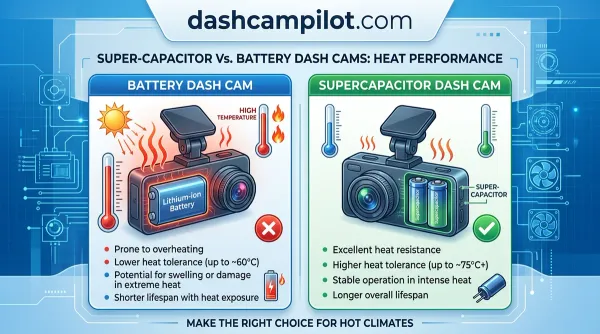
One universal industry shift across the 2020–2026 model year timeline is the wholesale abandonment of internal lithium-ion pouch cells in favor of electric double-layer supercapacitors (EDLCs). Lithium-ion cells swell and rupture under solar thermal loads that regularly exceed 140°F (60°C) inside a sealed car cabin. Supercapacitors handle ambient cabin conditions up to 158°F (70°C) reliably for thousands of duty cycles.
Critical operational reality: Supercapacitors store only enough electrical energy (roughly 5 to 15 Joules) to cleanly save the active video file, flush the cache to the MicroSD memory card, and unmount the filesystem when primary vehicle ignition cuts. Supercapacitors cannot power parking mode independently. Continuous parking surveillance requires constant 12V current fed through a hardwire kit connected to either the vehicle fuse box or an external power bank.
Ultra-Low-Power Radar and Proximity Sensing Innovations
The biggest leap in surveillance longevity for the 2025–2026 model year is the widespread adoption of 24GHz and 60GHz millimeter-wave radar/microwave proximity sensors. Traditional optical motion detection leaves the camera's image sensor, RAM, and ISP fully powered to constantly analyze video frames for pixel shifts. This keeps power draw at maximum driving levels (~3.5W to 4.5W).
Radar-equipped configurations place the core processor into an ultra-low-power sleep state. Only the microwave transceiver remains active, yielding a low-power standby consumption of just 5 to 30 mA (0.06W to 0.36W at 12V). When an approaching vehicle or pedestrian enters the radar zone (typically within 10 to 20 feet), the module triggers a fast hardware wake-up, recording full-resolution video within 400 milliseconds. This shifts achievable starter battery runtime from under 12 hours to multiple days.
Configuration Impact on Dash Cam Parking Mode Duration
Dual-channel and multi-channel systems consume substantially more power than single-channel dash cams, cutting parking mode runtime roughly in half. Connecting an auxiliary cabin or rear camera forces the ISP to process and encode multiple simultaneous high-bitrate video streams, keeping RAM and flash controller caches fully active.
Single-Channel vs Dual-Channel Power Consumption Profiles
Channel architecture dictates electrical load more than any other hardware parameter. In a single-channel front configuration, current draw averages 160mA to 200mA at 12V (~1.9W to 2.4W). Adding a secondary rear camera over an analog coaxial or digital USB-C link introduces sensor power dissipation, differential signaling transmission losses, and secondary encoding pipeline loads. This pushes system current to 300mA–380mA (~3.6W to 4.5W).
If your setup uses a 75Wh auxiliary battery, a single-channel camera drawing 2.0W will record for roughly 37.5 hours. Connecting the rear channel increases total consumption to 4.0W, dropping the maximum run duration to 18.7 hours under identical ambient conditions.
Buffered Motion Detection vs Time-Lapse Mode Wattage
Parking modes use fundamentally different operating states:
- Buffered Motion & Impact Detection: The camera runs continually at standard frame rates (30fps), cycling 10 to 15 seconds of footage through a volatile RAM loop. If motion or a G-sensor shock occurs, the buffered pre-event footage and subsequent post-event video are written to storage. Because the image sensor and processor never sleep, power draw is 90% to 95% of active driving recording.
- Time-Lapse Mode: The ISP throttles frame capture down to 1 or 2 frames per second without recording audio. The system writes continuously to the MicroSD memory card, compressing hours of monitoring into small video files. System power drops by 15% to 30% compared to buffered mode, and thermal dissipation drops substantially, mitigating cabin heat-induced shutdowns.
- Low Bitrate Continuous Mode: Video records at standard framerates but with aggressive compression quantization. Power draw matches buffered mode, but it avoids missed triggers caused by blind-spot motion failures.
Energy-Saving Radar and Impact Wake-Up Modes
Pure impact-detection mode uses internal three-axis accelerometers while powering off optical components and processors. Standby current drops to 10mA–15mA. However, this introduces an operational compromise: waking the system from deep sleep, initializing the sensor, establishing auto-exposure, and spinning up flash storage writes requires 1.5 to 3.0 seconds. In hit-and-run scenarios, the fleeing vehicle is often out of frame before recording initiates.
Microwave radar wake-up bridges this gap. Because detection occurs before physical contact, the camera spins up its optical engines while the approaching hazard is still several meters away, capturing the impact window without requiring continuous high-wattage image buffering.
Vehicle Battery vs Dedicated LiFePO4 Pack Runtime Limits
Automotive starter batteries deliver short, high-amp bursts for engine cranking. They are structurally degraded by sustained, low-current parasitic draw. Repeatedly deep-cycling a lead-acid or AGM starter battery down to 11.8V causes rapid plate sulfation, reducing reserve cranking capacity and risking starter motor failure in low ambient temperatures.
Lead-Acid and AGM Starter Battery Limitations and Parasitic Drain
Modern vehicles maintain their own parasitic load of 25mA to 50mA to power keyless entry receivers, immobilizers, telematics modules, and alarm sensors. Connecting a dual-channel dash cam adds 250mA to 350mA of sustained continuous draw. Starter batteries (Flooded, Enhanced Flooded Battery/EFB, or Absorbent Glass Mat/AGM) rely on thin, porous lead plates optimized for cold cranking amps (CCA), not cycling resilience.
Discharging a lead-acid battery past 50% state-of-charge (roughly 12.06V resting voltage) causes irreversible lead sulfate crystallization across the plates. To maintain reliable cranking power and protect battery health, hardwired installations require a low-voltage cutoff regulator.
Low-Voltage Cutoff Thresholds: Setting 11.8V vs 12.4V
Most hardware installation kits feature selectable physical dip-switches or mobile-app-configured voltage cutoff parameters, typically adjustable between 11.8V and 12.4V:
- 11.8V Cutoff: The lowest threshold. At 11.8V resting voltage, a standard 12V battery is at less than 10% capacity. While this setting yields maximum parking surveillance time (often 18 to 28 hours on single-channel units), it introduces severe risks: vehicles with sensitive Electronic Control Units (ECUs) may trigger undervoltage DTC fault codes, and older batteries will lack the cold cranking amps required to start the engine during freezing conditions.
- 12.0V Cutoff: A common compromise setting that permits roughly 10 to 14 hours of surveillance on dual-channel setups while leaving roughly 25% to 30% reserve capacity in the starter battery.
- 12.2V to 12.4V Cutoff: The conservative setting recommended for modern luxury vehicles and cold climates. This shuts off camera draw after 4 to 8 hours, leaving 60% or more usable charge to guarantee engine ignition and protect AGM battery service life.
Dedicated LiFePO4 Battery Packs: Depth of Discharge and Driving Recharge
Dedicated dash cam power packs use Lithium Iron Phosphate (LiFePO4) chemistry. LiFePO4 cells handle up to 2,000 to 3,000 full charge cycles at 100% Depth of Discharge (DoD) without meaningful degradation, operate safely under extreme cabin heat without fire hazards, and isolate the vehicle's starting system from auxiliary loads.
✅ LiFePO4 Dedicated Pack Pros
- True 100% usable capacity without shortening cell life.
- 20 to 45+ hours of uninterrupted dual-channel recording.
- Completely prevents vehicle battery depletion and error codes.
- Rapid charging rates: full replenishment in 45 to 80 minutes of driving.
❌ Starter Battery Direct Hardwire Cons
- Premature shutdown via low-voltage cutoff limits (often 6–10 hours).
- Repeated cycling accelerates battery sulfation and degradation.
- Cold winter temperatures trigger early voltage collapse.
- Modern vehicle sensors may trigger battery drain error warnings.
Dedicated packs recharge exclusively when the vehicle's alternator runs. Spliced into an accessory (ACC) circuit or plugged into a trunk 12V auxiliary port, they charge at 5A to 9A (60W to 135W). A standard 96Wh pack charges from 0% to 100% in approximately 50 to 60 minutes of driving, making it simple to maintain daily parking surveillance.
Environmental and Operating Factors That Cut Surveillance Time
Lab runtime ratings assume stable 68°F to 72°F (20°C to 22°C) ambient environments, moderate driving cycles, and fully charged battery systems. Real-world parking mode runtimes are frequently cut short by three practical factors:
- Cold Winter Ambient Temperatures and Premature Voltage Drop: Sub-freezing temperatures slow the internal chemical kinetics of lead-acid and AGM batteries. At 20°F (-7°C), a battery's effective Ampere-hour (Ah) capacity drops by roughly 30% to 40%. Internal resistance rises, causing battery terminal voltage to drop quickly under a 3.5W dash cam load. Hardwire kits configured for a 12.0V or 12.2V cutoff reach their threshold prematurely, cutting parking mode runtime from 12 hours down to 4 to 6 hours despite substantial chemical energy remaining trapped within the cold cells.
- Summer Cabin Heat and Thermal Safety Shutdowns: Direct solar radiation can heat windshield-mounted dash cam housings to 160°F–180°F (71°C–82°C). Modern dash cams include internal NTC thermal thermistors designed to cut system power when internal PCB temps hit safe limits (typically 149°F to 158°F / 65°C to 70°C). This thermal protection triggers regardless of your battery source. A camera connected to a full 160Wh battery pack will still shut down within 90 minutes if left parked in hot summer sunlight with closed windows.
- Short Driving Commutes and Chronic Battery Undercharging: The "short commute trap" occurs when a driver runs parking mode for 14 hours overnight (consuming ~45Wh of energy), but only drives 15 minutes to work the next morning. Because an automotive alternator takes 30 to 50 minutes of continuous driving to return 45Wh to a lead-acid starter battery, the vehicle operates in a chronic state of partial charge. The battery voltage drops lower each day until the hardwire kit cuts power immediately upon engine shutoff.
- Modern Vehicle Battery Management Systems (BMS): Late-model European and domestic vehicles (including BMW, Mercedes-Benz, Ford, and GM) use intelligent battery sensors (IBS) on the negative terminal to track milliamp-level parasitic draws while parked. If the BMS logs an unauthorized draw exceeding 80mA for more than a few hours, the vehicle's onboard computer may enter deep-sleep protection, cut auxiliary fuse block power, or display an "Excessive Battery Drain While Parked" alert on the dashboard.
If your daily commute is under 20 minutes, set your dash cam's parking mode to Time-Lapse (1 fps) instead of Buffered Motion Detection, and adjust your hardwire cutoff switch to 12.2V. This halves your hourly watt consumption and ensures your starter battery charges back to full capacity during your brief drive.
📋 How to Configure Your Dash Cam for Maximum Parking Mode Runtime
Multiply your camera's wattage by your target surveillance hours (e.g., 3.8W × 12 hours = 45.6Wh). Confirm your daily commute can replenish this draw (roughly 1 hour of alternator charging for a vehicle starter battery, or 45 minutes for a dedicated LiFePO4 pack).
Use Buffered Motion Detection if parked in low-traffic private garages where triggers are rare. Use Time-Lapse or Radar Detection if parked on busy public streets to prevent constant recording from depleting your battery in under 6 hours.
Configure your hardwire kit cutoff switches to 12.2V or 12.4V (24.4V on 24V commercial rigs). Never use an 11.8V setting unless the vehicle is driven for multiple hours daily in warm weather.
Industry Data: Parking Mode Longevity
Frequently Asked Questions About Dash Cam Parking Mode Runtime
Will dash cam parking mode kill my vehicle's starter battery?
Not if your camera uses a properly installed hardwire kit with a calibrated low-voltage cutoff regulator. The cutoff shuts down the dash cam once battery voltage drops below a set threshold (typically 12.0V or 12.2V), leaving enough electrical energy to reliably crank the engine. Problems arise when installers run unregulated 12V lines or set cutoff switches to 11.8V on aging batteries.
Why does my dash cam shut down after only 2 or 3 hours in parking mode?
This typically stems from three causes: an aging car battery with high internal resistance that sags below the voltage cutoff under load; a low-voltage cutoff switch set too conservatively (e.g., 12.4V on a battery that rests at 12.5V); or extreme summer cabin heat triggering the camera's internal thermal shutdown protection.
Can I run parking mode continuously for 24 hours every day from the car battery?
No. Continuous 24/7 parking mode will prematurely wear out a standard lead-acid or AGM starter battery within 6 to 12 months. Starter batteries are not designed for deep-cycle duty. If your vehicle remains parked for extended periods without long daily drives, use a dedicated LiFePO4 dash cam battery pack.
Standard vehicle starter batteries reliably deliver 8 to 24 hours of parking recording before safe low-voltage cutoff limits trigger. Dedicated LiFePO4 dash cam battery packs eliminate vehicle starter battery strain and deliver 20 to 45+ hours of uninterrupted surveillance, while energy-saving radar and low-framerate time-lapse modes dramatically outperform continuous buffered recording in thermal and power efficiency. Match your parking mode settings to your daily commute duration and install a dedicated LiFePO4 battery pack if you require continuous surveillance extending beyond 24 hours.