Dash Cam Benefits: Visual Evidence, Fraud Protection, And Financial Security Factors

A single split-second on the road can quickly spiral into months of costly disputes, unfair blame, and higher insurance premiums. Installing a dash cam delivers undeniable video evidence that shields you from false liability and accelerates insurance claim payouts.
Beyond documenting collisions, these devices secure parked vehicles around the clock, expose deliberate road fraud, and promote safer driving habits for families and commercial fleets alike. Below, explore the evidence, financial savings, and key hardware capabilities that make these cameras a vital safeguard for modern drivers.

Core Dash Cam Benefits: Visual Evidence in Accidents
Eliminating Fault Ambiguity with High-Definition Footage
Motor vehicle collisions frequently devolve into conflicting "he-said, she-said" disputes. In these scenarios, insurance adjusters and responding officers must reconstruct dynamic events solely from driver statements, skid marks, and point-of-impact damage.

Dash cams provide objective third-party visual evidence that eliminates this ambiguity entirely. By continuously capturing the roadway environment, optical sensors record critical context such as lane discipline, following distance, signaling, and exact vehicle speeds prior to impact.
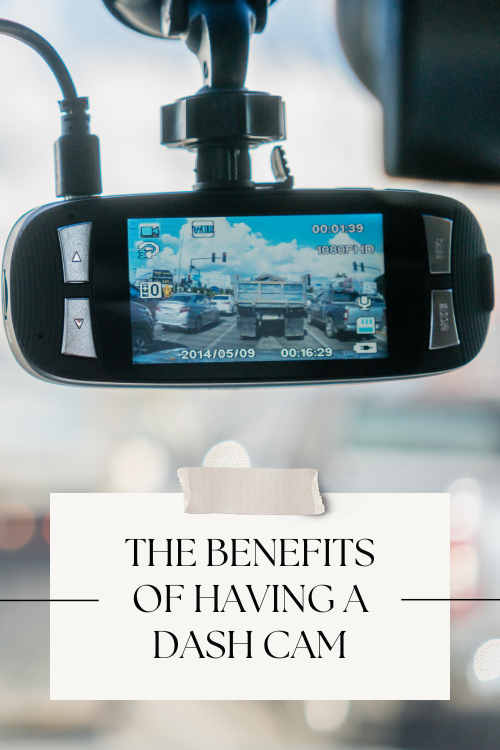
Consider a driver turning left on a green arrow who is suddenly struck by an oncoming vehicle. If the oncoming driver claims their light was green, high-resolution 4K 60fps footage proves the precise signal phase definitively to traffic investigators, resolving liability instantly.
To preserve this timeline without manual intervention, modern cameras rely on loop recording. This firmware architecture ensures continuous operation by automatically overwriting the oldest unlocked footage when storage is full, guaranteeing the camera never stops recording when an unexpected impact occurs.
Legal Admissibility and the Double-Edged Sword of Video Proof
In civil litigation and traffic court, optical recordings are generally admissible as demonstrative evidence, provided the recording party can establish proper chain of custody and verify the footage has not been altered or tampered with.
However, recorded video functions as an absolute double-edged sword. While it can instantly exonerate a driver who obeyed traffic laws, dash cam memory cards can also be formally subpoenaed by opposing counsel or seized as evidence by law enforcement.
If the camera owner was speeding, rolling through a stop sign, or distracted immediately prior to the collision, the device will definitively establish their own civil liability or criminal fault. Dash cams document reality without bias, holding all road users to an unyielding standard of accountability.
Protecting Against Insurance Fraud and Staged Collision Schemes
Organized crime rings frequently target unsuspecting motorists with staged accidents designed to fabricate massive injury and vehicle repair payouts. Without neutral video evidence, victims of these setups are almost always presumed at fault under standard rear-end liability rules.
Neutralizing Staged Crash Rings and Back-Up Scams
Organized rings target vulnerable drivers with 'swoop-and-squat' maneuvers to fabricate massive injury claims. On a multi-lane highway, a lead car deliberately forces a rear-end collision by swerving in front and braking abruptly, while a coordinated accomplice vehicle drives alongside to block escape lanes.
Multi-camera setups eliminate ambiguity by recording the coordinated flow of traffic preceding the event. In addition, interior and rear lenses capture deceptive driver maneuvers inside the target vehicle, such as staged occupant shifting or a driver shifting into reverse at an intersection to fake being hit.
Staged crash rings often recruit multiple "jump-in" passengers to file phantom soft-tissue injury claims. Video evidence proves exact occupant counts and records their genuine physical reactions at the moment of impact.
Automatic Impact Protection via the Internal G-Sensor
During an abrupt confrontation or staged crash, preserving visual data immediately is critical. The internal G-sensor automatically triggers write-protection when sharp deceleration or sudden force is detected across the vehicle's X, Y, and Z axes.
This G-sensor event locking automatically isolates and shields critical impact files from loop overwrite cycles. The camera routes the incident clip into a secure, read-only directory, ensuring the evidentiary footage remains intact and untampered for police investigators and claims adjusters.
Financial Dash Cam Benefits: Insurance Claims and Deductibles
Direct Premium Reductions vs. Indirect Savings
Direct annual insurance discounts for installing a dash cam vary widely by region and carrier. While select insurers in the UK and parts of Europe offer upfront policy discounts between 5% and 15%, most North American carriers do not yet offer guaranteed premium reductions simply for mounting hardware.
Because direct policy credits are limited, the primary financial benefits of a dash cam are indirect. In unwitnessed collisions, adjusters frequently default to shared liability allocations, such as a 50/50 split. This arbitrary assignment exposes non-fault drivers to significant rate hikes and the loss of accumulated no-claims bonuses.
Dash cam footage definitively disproves false liability allocations in disputed crashes. By documenting the exact mechanics of an incident, objective video preserves your no-fault standing and shields you from unmerited premium surcharges that typically linger on your policy for three to five years.
Accelerating Subrogation and Recovering Your Deductible
When you file a repair claim through your collision policy, you must pay your deductible upfront to initiate body work. Your carrier then attempts to recover this expense through subrogation—the formal inter-company process of demanding full reimbursement from the at-fault party's insurer.
Submitting clear video dramatically accelerates subrogation. For example, a driver can secure the return of a $1,000 collision deductible after video confirms an opposing driver merged blindly into their lane. Without visual evidence, that scenario easily stalls as a word-versus-word dispute, risking the loss of your deductible entirely.
Unedited digital proof removes ambiguity and bypasses contentious arbitration. Once the adverse carrier reviews the recording and verifies clear liability, they typically settle immediately, expediting your deductible reimbursement from several months down to a few business days.
Buffered Parking Mode: 24/7 Security Against Hit-and-Runs
Standard dash cams turn off when the vehicle ignition shuts down, leaving parked cars vulnerable to unattended damage. Buffered parking mode extends visual security around the clock, continuously monitoring vehicles parked on city streets, driveways, or commercial parking lots.
How Buffered Parking Surveillance Captures Off-Duty Incidents
Traditional motion detection only powers on the lens after an internal G-sensor registers an impact. This wake-up lag often yields late footage, completely missing critical moments like a perpetrator approaching or an offending car reversing away.
Buffered parking mode resolves this issue by continuously caching video into internal memory, maintaining a rolling 10-to-15-second loop while the vehicle is stationary and turned off.
When the G-sensor detects an impact or the camera detects motion, the camera commits both the pre-incident cache and the post-incident footage onto the permanent microSD card.
This context is vital during parking-lot collisions. For instance, if a delivery van reverses into your parked bumper and flees while you are away, the buffered clip captures the van's approach and license plate before the actual impact occurs.
Preventing Battery Drain with Low-Voltage Cutoff Kits
Parking surveillance modes require a hardwire kit or dedicated auxiliary battery to monitor for vandalism or hit-and-runs without flattening the car's starter battery. Hardwire kits splice into the cabin fuse box, drawing steady, low-amperage power from constant and accessory fuses.
To ensure this continuous monitoring does not deplete the vehicle's primary power source, quality hardwire kits integrate an adjustable low-voltage cutoff switch that measures battery reserves in real time.
Drivers can set cutoffs at specific voltage thresholds, such as 12.0V, 12.2V, or 12.4V on standard 12V automotive systems. The moment battery voltage drops to the predetermined cutoff, the module terminates camera power immediately, preserving adequate charge to crank the engine.
For extended parking durations spanning several days, an auxiliary lithium-iron-phosphate (LiFePO4) dash cam battery pack offers an alternative, completely isolating the camera's power demand from the vehicle's electrical starter system.
Safety Benefits of Dash Cams for Fleets and Teen Drivers
Deploying dash cameras introduces immediate behavioral accountability across commercial fleets and family vehicles. The visible presence of recording hardware discourages risky actions like tailgating, aggressive lane changes, and handheld smartphone use behind the wheel.
GPS Telematics: Validating Speed and Travel Coordinates
Integrated GPS modules synchronously log vehicle travel speed, direction, and precise geographic coordinates alongside the recorded video. This telematics metadata is stamped directly onto each video frame or saved within an accompanying data file for map overlay analysis.
This empirical data provides concrete legal defense during traffic stops. For example, drivers can use timestamped GPS speed logs to disprove an erroneous radar gun reading or contest an unjustified speeding citation issued by patrol officers.
For fleet supervisors and parents, telematics data offers reliable institutional oversight. Fleet managers can audit route efficiency and verify posted speed limit compliance, while parents gain an auditable record to track where teen drivers travel and how fast they drive.
Cabin Monitoring for Rideshare Drivers and Family Safety
Interior-facing lenses offer essential protection for commercial operators, particularly within rideshare and taxi networks. Recording passenger interactions creates an objective record of customer behavior, safeguarding drivers against false misconduct allegations, abusive passenger behavior, and sudden platform deactivation.
Inside family vehicles, cabin cameras establish mutual accountability for novice drivers. Inexperienced teenagers are significantly less likely to engage in distracted driving, passenger horseplay, or smartphone texting when an active interior camera documents their compartment behavior.
Commercial transport fleets also deploy cabin video to identify early indicators of driver fatigue, micro-sleeps, and seatbelt non-compliance. These records allow safety managers to deliver targeted driver coaching before poor habits cause dangerous operational incidents.
Essential Hardware Features That Maximize Dash Camera Benefits
Supercapacitors vs. Lithium-Ion Batteries in Extreme Cabin Heat
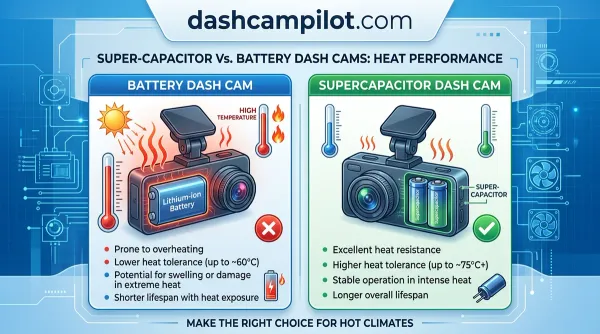
Internal power architecture determines whether a camera survives harsh cabin environments. Supercapacitors handle extreme windshield heat and sub-zero winter temperatures far better than standard lithium-ion batteries, which swell and fail under thermal stress.
Dash cameras powered by a supercapacitor reliably maintain an operating temperature range that spans -20 to 70 degrees Celsius. Unlike chemical battery packs, supercapacitors store energy statically, eliminating explosion risks on hot dashboards.
For example, a swollen lithium-ion battery in a parked car on a 95°F summer afternoon can easily cause unrecoverable corrupted video during an accident. When impact occurs, a degraded battery cuts off abruptly before finalizing the critical video file.
The Necessity of High-Endurance MicroSD Storage
Dash cameras constantly record and overwrite high-bitrate video in uninterrupted loops. This continuous duty cycle quickly exhausts the flash memory cells found inside common flash cards designed only for smartphones or handheld cameras.
Buying a standard consumer MicroSD card instead of a high-endurance card leads to write failure precisely during a crash. When standard flash memory reaches its low write-cycle limit, it defaults to a read-only lock without warning.
High-endurance cards utilize specialized NAND flash memory designed to withstand thousands of continuous overwrite hours. Pairing your device with an endurance-rated card guarantees video sectors save properly during sudden power interruptions.
Legal Mounting Positions and Wiper Sweep Restrictions
Hardware positioning dictates both visual recording clarity and compliance with highway regulations. Windshield mounting laws strictly restrict placing cameras within critical wiper sweep zones to prevent driver sightline obstructions.
The optimal installation point sits directly behind the rearview mirror on the passenger side. This placement hides the unit from the driver's forward field of vision while keeping the lens within the upper boundary of the wiper path.
Placing the lens outside the cleaned glass area leaves your camera blind during heavy rain, snow, or road-spray conditions. Confirming regional windshield tint and obstruction codes ensures your recorded footage remains legally admissible.
Dash Cams vs. Action Cams and Built-in OEM Systems
Purpose-built dashboard cameras address specific automotive demands that improvised alternatives cannot match. Drivers often consider repurposing action cameras or smartphone mounts to capture road footage, but both devices fail in automated operation, storage management, and environmental endurance.
Comparing an aftermarket 2-channel dash cam setup with a GoPro Hero across loop recording, parking mode, and operating heat limits highlights these operational gaps. Action cameras lack ignition-triggered automatic on/off, cyclic loop overwriting, and high cabin-heat tolerance. When an action camera card fills, recording halts manually.
Smartphones present worse operational bottlenecks. A smartphone camera on a windshield mount suffers rapid thermal shutdown under direct sun. Windshield-mounted phones absorb intense radiant heat while processor-heavy 4K encoding runs, simultaneously tying up critical functions like GPS navigation and voice calls.
Factory OEM systems like Tesla Sentry provide clean integration, recording through existing side and front driving-assist cameras. However, these systems remain proprietary. Factory-integrated architectures cannot easily be retrofitted to other makes or older models, making standalone 2-channel systems the standard for universal vehicle coverage.
Feature Comparison Across Video Capture Devices
How to Read This Comparison
This table benchmarks critical functional criteria required for continuous automotive surveillance. "Ignition Triggered" refers to hardware sensors that initiate recording immediately when the vehicle accessory power engages, eliminating user error.
Peak operating temperatures are measured in degrees Celsius (°C). Dash cams utilize supercapacitors rather than standard lithium-ion pouches, allowing stable operation up to 70°C inside sun-soaked cabins. Action cams and mobile devices shut down earlier to prevent internal battery combustion.
The "Universal Retrofit" column denotes whether hardware transfers across multiple vehicle brands. While factory installations provide built-in aesthetic integration, verify for exact configuration before assuming OEM-style recording can port to non-supported chassis.
- ✓ Capture undeniable visual evidence to support your claims during insurance disputes.
- ✓ Deter fraudulent staged collisions through active 24/7 parking surveillance.
- ✓ Reduce financial stress by utilizing footage to protect your deductibles and premiums.
- ✓ Improve driver behavior and safety for teen drivers and commercial fleet operations.
- ✓ Analyze high-definition playback to review traffic scenarios and enhance road awareness.
❓ Frequently Asked Questions
1 What is a dash cam?
A dash cam is a specialized digital video recorder mounted inside a vehicle that captures continuous footage of the road and surrounding environment. It serves as an objective observer, providing evidence that aligns with scientific research on accident reconstruction and proving liability in disputed traffic events.
2 How does dash cam technology work?
Dash cams utilize wide-angle lenses and high-resolution sensors to record loops of footage. Modern models incorporate G-sensors to detect impacts, automatically locking that specific clip from being overwritten. This evidence provides a factual record, shielding drivers from the emotional strain and medical uncertainty often associated with post-accident disputes.
3 Why is owning a dash cam important?
Owning a dash cam is important because it provides irrefutable evidence in legal and insurance proceedings. By recording real-time data, it effectively counters fraudulent claims and staged accidents, promoting peace of mind and physical wellness by reducing the intense anxiety caused by unpredictable road occurrences and liability struggles.
4 What are the core benefits of dash cams?
The primary benefits include securing insurance claims, protecting your financial deductibles, and offering 24/7 security through parking modes. These devices provide a verifiable account of incidents, which is essential for insurance investigators and may serve as evidence in medical claims or research-based analysis following a collision.
5 How can I get started with dash cams?
To get started, select a high-definition model with reliable loop recording and parking surveillance features. Install the camera discreetly for an unobstructed view and ensure the memory card is high-endurance. Consult professional installation guides to hardwire the unit, ensuring effective and continuous protection for your vehicle in 2026.
6 Do dash cams lower vehicle insurance premiums?
Some insurers provide modest direct policy discounts (typically 5% to 15%), but the primary financial benefit comes indirectly by protecting your deductible, preserving no-fault status, and shielding you from fraudulent claims.