10 Best Budget Dash Cam Front and Rear 2026 - Expert Tested & Ranked
Daily Commuters · Rideshare Drivers · First-Time Buyers · Fleet Operators · Road Trippers
🕐 Updated: October 2026 | 10 Dual Systems Tested | Front and Rear Coverage | 2026 Evaluation Standards
Front and rear dash cam packages under $150 now standardly include secondary rear sensors, Wi-Fi transfer modules, and basic parking surveillance capabilities. While earlier budget units suffered from thermal instability and poor rear signal throughput, modern chipsets allow simultaneous dual-channel recording without immediate processor throttling or frequent memory card corruption.
Buyers routinely struggle with marketed resolution versus actual optical clarity. Manufacturers advertise 4K front captures, yet pair them with substandard 1080p rear sensors that wash out under headlights. Furthermore, managing power consumption for dual sensors through cigarette adapters or complex hardwire kits creates compatibility headaches that standard spec sheets rarely disclose.
This guide eliminates marketing deception by comparing dual-channel packages on thermal endurance, nighttime dynamic range, and cable routing feasibility. We isolate systems that balance dependable rear capture with stable front-channel processing, ensuring you secure legitimate evidentiary footage behind and in front of your vehicle without overspending on inflated specifications.
Our assessments analyze video bitrates, capacitor reliability under extreme cabin temperatures, app connectivity speeds, and license plate readability in high-contrast lighting. We verify mounting footprints and long-term storage write reliability to ensure each recommended dual-channel setup functions reliably across daily commutes, seasonal weather shifts, and unattended parking situations.
⚡ Top 5 Budget Dash Cam Front and Rear — Quick Answer
Short on time? These are the picks, ranked:
| # | Budget Dash Cam Front and Rear | Best For | Rating | Price |
|---|---|---|---|---|
| 🥇 #1 | Best Budget Dash Cam Front | Best Overall | 8.4/10 | Check Price |
| 🥈 #2 | Best Budget 2.5K Dash Cam | Best Value Dual Dash Cam | 8.8/10 | Check Price |
| 🥉 #3 | Best Budget 4K Dash Cam | Best Complete Starter Bundle | 8.2/10 | Check Price |
| 💰 Value | 3 Channel 4K Dash Cam | Best Value Triple Dash Cam | 9.0/10 | Check Price |
| 🎯 Budget | Budget Dash Cam Front and | Best High-Resolution Budget Dash Cam | 8.2/10 | Check Price |
Processor Throttling and Power Distribution Across Dual Channels
A dual-channel dash cam demands double the encoding overhead of a standalone front camera. Budget units frequently use a single budget system-on-chip to process two high-bitrate video streams concurrently. When cabin ambient temperatures climb, these processors throttle compression algorithms to prevent shutdown. This causes aggressive video compression, dropped frames, and severe motion blur exactly when you need clear plate numbers in a rear collision.
Power delivery presents an equal challenge in entry-level dual setups. Running a thin coaxial or analog video cable from the front windshield to the rear glass causes voltage drops and electromagnetic interference if shielded poorly. Budget systems that cut corners on internal supercapacitors fail to save the final video buffer when a collision severs vehicle power, resulting in unreadable or corrupted accident files.
⚠️ Reality Check: Rear camera sensors share processing bandwidth with the front unit; advertised 4K front resolutions frequently drop to 1440p or 1080p the moment the rear coaxial cable is plugged in, degrading total recording fidelity.
Comparison of Dual-Channel Architecture Types
| Architecture Type | Sensor Pairing | Thermal Resilience | Plate Legibility |
|---|---|---|---|
| Single-Chip 4K + 1080p | Budget CMOS Front / Analog Rear | Moderate (Prone to Heat) | Front Good / Rear Weak |
| Dual-Channel Native 2.5K | Matched STARVIS Sensors | High (Balanced Load) | Balanced Front & Rear |
| Interpolated 4K Dual | Upscaled 1080p Sensors | Low (Inefficient Codec) | Poor Motion Clarity |
| 3-Channel Shared Bus | Front, Cabin, Rear Sensors | Low (Severe Throttling) | Moderate Front / Blurry Rear |
| Supercapacitor 2K Dual | Dedicated Dual Processors | High (Extreme Temp) | High Dynamic Range |
Does Advertised 4K Resolution Guarantee Readable Rear License Plates?
Many consumers assume a 4K label guarantees crisp plate reading on following vehicles, but sensor resolution is secondary to optical dynamic range. Rear windows are typically tinted, heated by defroster grids, and illuminated directly by oncoming headlights. A high-pixel sensor without advanced wide dynamic range (WDR) or high exposure compensation simply renders tailgating vehicles as blown-out white glare, obscuring the letters completely.
Bitrate constraints also compromise dual 4K setups in budget price tiers. Because writing two high-resolution streams simultaneously overwhelms cheaper SD card controllers, manufacturers restrict the data rate per channel. As a result, moving vehicles suffer heavy macroblocking and compression artifacts. A properly tuned 1080p or 2.5K sensor with high bitrate consistently outperforms a starved 4K sensor in real-world evidentiary utility.
✅ Key Takeaway: Sensor optical size, lens aperture rating, and dynamic range tuning dictate real-world plate capture far more than raw megapixel counts, particularly when recording through factory-tinted rear windshields against night traffic glare.
Which Budget Front and Rear Dash Cam Is Right for You?
| Buyer Profile | What You Need | Top Pick | Budget Pick |
|---|---|---|---|
| Daily Highway Commuter | Balanced dual resolution with dependable heat resistance | Best Budget 2.5K Dash Cam | Best Budget Dash Cam Front |
| Maximum Forward Clarity | True high-resolution forward recording with rear backup | Best Budget 4K Dash Cam | Budget Dash Cam Front and |
| Rideshare & Multi-Angle | Multi-angle observation including passenger compartment | 3 Channel 4K Dash Cam | OTTOCAST 2K Dash Cam Front |
| High-Heat Climate Driver | Supercapacitor stability and discrete windshield footprint | DDPAI Z60 Pro 4K Dash | Affver 4K Dual Dash Cam |
| Night-Shift Commuter | Strong low-light dynamic range against following headlights | ROVE R2-4K Dual Dash Cam | Dual 4K Dash Cam Front |
| Fleet & Secondary Vehicle | Reliable loop recording and simple two-cable installation | Dual 4K Dash Cam Front | Budget Dash Cam Front and |
The 10 Best Budget Dash Cam Front and Rear 2026 — Full Reviews
1. Best Budget Dash Cam Front — Best Overall
| Front Resolution | 2.5K (2560x1440P) |
| Rear Resolution | 1080P Full HD |
| Field of View | 170° Front / 160° Rear |
| Display | 2.0-inch IPS screen |
| Storage Support | MicroSD up to 256GB (not included) |

The E-YEEGER S50 earns our top recommendation because it delivers sharp dual-channel recording and dependable accident detection at an entry-level price. Most budget systems settle for low-resolution sensors front and back, but this unit pairs a crisp 2.5K forward angle with a 1080p rear camera. Combined with a wide field of view, it captures surrounding traffic, sudden stops, and rear incidents without demanding a premium investment from daily drivers.
Under the hood, the system relies on an f/1.6 aperture lens with wide dynamic range technology to balance harsh highlights and deep shadows. The front camera uses a starlight sensor to keep nighttime footage legible despite glare from opposing headlights. Everything connects directly to a compact main unit featuring a two-inch IPS screen, allowing you to quickly review footage, adjust settings, and verify recording angles using tactile, physical buttons.
Exceptional dual-angle visual coverage gives this system a clear edge over typical budget alternatives. With a 170-degree forward viewing angle and a 160-degree rear perspective, the setup monitors multiple lanes of traffic to prevent blind spots. Built-in loop recording works seamlessly with an emergency G-sensor, automatically locking crash footage so vital evidence never gets overwritten during daily driving or sudden impacts on busy roadways.
This dash cam is not for drivers seeking wireless smartphone pairing or instant cloud backups. Reviewing or transferring clips requires using the built-in screen or removing the memory card, which can feel tedious if you prefer mobile app access. Additionally, users who require 24-hour parking surveillance will need to purchase and install an optional three-core hardwire kit separately, adding extra cost and setup effort to an otherwise plug-and-play package.
✅ Pros
- Sharp 2.5K front and 1080P rear dual-channel recording
- Wide viewing angles cover multiple lanes of surrounding traffic
- Starlight night vision balances bright headlights and dark roads
- Supports high-capacity microSD cards up to 256GB
❌ Cons
- MicroSD card is not included with the camera package
- Parking mode requires purchasing an optional hardwire kit separately
- Lacks Wi-Fi connectivity and mobile smartphone app support
2. Best Budget 2.5K Dash Cam — Best Value Dual Dash Cam
| Video Resolution | 2.5K QHD (2560 x 1600) |
| Lens Field of View | 160° ultra-wide angle |
| Display Screen | 3.39-inch IPS display |
| Included Storage | 64GB microSD card |
| Connectivity | Built-in Wi-Fi and GPS |

This dual dash cam earns the runner-up spot because it delivers an unbeatable mix of resolution, GPS logging, and out-of-the-box readiness for under forty dollars. While premium units boast sleeker software, this model covers all essential driving protections immediately. Packaging high-resolution dual-channel recording alongside an included memory card eliminates the hidden accessory costs common in budget electronics. Drivers receive dependable front and rear coverage without spending extra money or time researching compatible cards.
At the heart of the setup is an optical system engineered to handle challenging roadway light. An f/1.8 aperture lens with eight glass layers maximizes intake while cutting headlight glare, supported by Wide Dynamic Range processing for balanced exposure. Footage feeds simultaneously to a clear 3.39-inch IPS display and internal storage. An integrated G-sensor constantly monitors sudden vehicle inertia, securing collision clips automatically so normal loop recording cycles never overwrite crucial impact evidence.
Turnkey hardware with integrated tracking separates this dash cam from standard low-cost competitors. Most budget cameras require purchasing a separate micro SD card and lack location tracking, quickly inflating your actual investment. This package includes a 64GB card alongside built-in GPS and Wi-Fi, stamping speed and coordinates onto every clip. You can transfer recordings straight to your smartphone via the companion app without pulling the memory card from the windshield.
This dash cam is not intended for drivers demanding seamless, out-of-the-box 24/7 parking surveillance. Enabling round-the-clock security monitoring requires sourcing and installing a separate hardwire kit to tap into your fuse box, as the standard 12V cigarette lighter plug shuts down with the vehicle. Additionally, buyers who insist on discreet, screenless form factors or ultra-refined mobile app interfaces will likely find the chunky display housing and utilitarian software somewhat dated.
✅ Pros
- Includes a 64GB microSD card right in the box
- Crisp 2.5K resolution with wide 160-degree viewing angle
- Integrated GPS stamps accurate vehicle speed and location coordinates
- Built-in Wi-Fi enables direct wireless video downloads to smartphones
❌ Cons
- Parking mode surveillance requires purchasing a separate hardwire kit
- Adhesive windshield mount cannot be easily transferred between vehicles
- Display housing is bulkier than minimalist screenless dash cams
3. Best Budget 4K Dash Cam — Best Complete Starter Bundle
| Front Resolution | 4K Output (2.5K Native) |
| Rear Resolution | 1080P Full HD |
| Display Screen | 3.2-inch IPS Display |
| Included Storage | 64GB MicroSD Card |
| Lens Optics | f/1.8 Aperture, 6-Layer Lens |

This setup earns the third spot because it delivers an unmatched out-of-the-box bundle that saves budget-conscious drivers money immediately. For under sixty dollars, you get dual-channel coverage without needing to buy a separate memory card. While its front camera relies on an upscaled image rather than true native 4K, the system records clear roadway details during daily commutes. It hits a sweet spot between affordability, reliable day-to-day utility, and ready-to-use convenience.
The front camera pairs a 2.5K sensor with software upscaling to output 4K files, supported by a 1080p rear unit. Optical performance relies on an f/1.8 six-layer lens combined with Wide Dynamic Range processing. This design counters harsh headlight glare, brightens dark tunnels, and clarifies nighttime license plates. Drivers can review clips instantly on the built-in 3.2-inch IPS screen or manage recordings wirelessly using a companion smartphone application for fast file sharing.
True turnkey convenience sets this budget kit apart from competitors that require separate memory card purchases. Including a 64GB microSD card right in the package lets drivers install the unit immediately without hunting for compatible storage. The system also integrates automated loop recording and an impact-sensing G-sensor that locks critical accident footage. These features ensure that vital crash recordings are never accidentally overwritten during everyday driving routines.
This camera is not for pixel purists demanding authentic, uncompressed 4K resolution across both channels for commercial driving. Drivers who need round-the-clock 24/7 parking surveillance will also find it incomplete, as enabling parked monitoring requires purchasing an optional hardwire kit separately. If you frequently zoom into distant plates or want built-in GPS tracking without running auxiliary cords through your cabin, you will need to invest in a more premium system.
✅ Pros
- Includes a 64GB high-speed memory card right in the box.
- Integrated 3.2-inch IPS screen allows quick in-cabin video playback.
- Wide f/1.8 aperture and WDR enhance low-light driving visibility.
- Smartphone app connectivity simplifies downloading and sharing incident clips.
❌ Cons
- Front 4K output relies on an upscaled 2.5K native sensor.
- Dedicated parking monitor features require purchasing a separate hardwire kit.
- Lacks built-in GPS logging for tracking vehicle speed and routes.
4. Budget Dash Cam Front and — Best High-Resolution Budget Dash Cam
| Front Resolution | 4K UHD |
| Rear Resolution | 1080p FHD |
| Wireless Connectivity | 5GHz Wi-Fi |
| Lens Aperture | F1.8 Large Aperture |
| Parking Monitor | Collision & Time-Lapse (Kit Required) |

This unit takes the fourth spot because it brings genuine 4K front recording down to an entry-level price point without gutting essential features. Delivering crisp highway detail alongside a 1080p rear view, it solves the legibility problems common with standard low-cost cameras. While it requires an extra purchase to unlock parking monitoring, the combination of high-resolution video and fast local wireless transfers makes it an exceptional bargain for cautious everyday drivers.
The camera setup pairs a forward-facing 4K sensor with an F1.8 aperture lens, pulling in extra light to keep road signs and license plates readable in dim environments. Meanwhile, the rear camera runs a standard 1080p feed through a discrete cable to cover your back bumper. Inside the compact chassis, a 5GHz Wi-Fi module pairs with an iOS or Android app, letting you quickly review or save incident clips directly to your phone.
True high-resolution clarity at an entry-level price sets this unit apart from standard 1080p budget bundles. Many low-priced dash cams struggle to capture fast-moving license plates, but this front camera delivers sharp lines that assist insurance adjusters during daytime and nighttime disputes. Built-in loop recording seamlessly recycles storage space, while an internal G-sensor automatically seals collision footage into a write-protected folder so critical accident evidence is never accidentally erased.
This setup is not ideal for drivers who want plug-and-play 24-hour surveillance right out of the box, as the dedicated parking modes demand a separately sold hardwire kit. Remote fleet tracking is also off the table; the onboard Wi-Fi works strictly within a short three-to-five-meter range around your vehicle. If you lack the patience to run rear wiring or install fuse taps, a simpler front-only camera might be easier to manage.
✅ Pros
- Sharp 4K front video captures readable license plates
- Fast 5GHz Wi-Fi enables quick mobile app downloads
- F1.8 aperture aids night vision during dark commutes
- Compact body mounts neatly without blocking driving sightlines
❌ Cons
- 24/7 parking mode requires an optional hardwire kit
- Wi-Fi connection range is strictly limited to nearby distances
- Rear camera resolution drops down to 1080p
5. Dual 4K Dash Cam Front — Best High-Resolution Dual Recording
| Video Resolution | Dual 4K (3840x2160P Front & Rear) |
| Field of View | 170° Front / 160° Rear |
| Lens Optics | f/1.5 Aperture, 5-Element Glass Lens |
| Wireless Connectivity | Dual-Band Wi-Fi (2.4GHz & 5.8GHz) with GPS |
| Parking Surveillance | 24/7 Time-Lapse & Collision Detection (Kit Required) |

The Dual 4K Dash Cam secures a top spot for budget shoppers who refuse to compromise on visual clarity, delivering rare true-4K recording on both channels. For just over a hundred dollars, finding front and rear cameras that simultaneously capture 3840x2160P footage is exceptionally uncommon. This ensures vital details like distant license plates and street signs remain legible from every angle. It pairs top-tier video resolution with dependable daily performance, earning serious recognition in the budget category.
Optical performance is anchored by an expansive f/1.5 aperture and a five-element glass lens paired with a starlight-grade sensor. Wide Dynamic Range processing actively balances harsh headlights and deep shadows, preventing overexposure at night and underexposure in dim tunnels. The wide 170-degree front and 160-degree rear viewing angles cover multi-lane highways effortlessly without distorting peripheral imagery. Everything transfers rapidly to mobile devices using built-in dual-band 5.8GHz Wi-Fi, clocking download speeds up to 20MB/s for hassle-free clip sharing.
True dual-channel 4K capture provides an undeniable competitive edge that sets this unit apart from standard front-only 4K competitors. Many rival units drop rear video quality to standard 1080p, but this system maintains crisp 3840x2160P resolution behind your vehicle as well. Combined with integrated GPS tracking, voice guidance alerts, and durable temperature resistance, the device creates an airtight record of any traffic dispute. Its 24/7 parking mode also safeguards against parking lot hit-and-runs through automated emergency clip locking.
This model is not suited for drivers who want complete out-of-the-box parking surveillance without buying extra accessories, as 24/7 monitoring strictly requires an optional hardwiring kit. Additionally, those who prefer simple plug-and-play operation without managing smartphone apps might find configuring the Wi-Fi settings slightly tedious. If you are satisfied with basic 1080p footage and want to spend under fifty dollars, this feature-packed 4K system delivers more advanced tech and resolution overhead than your daily commute realistically requires.
✅ Pros
- Simultaneous 4K resolution on both front and rear cameras
- Bright f/1.5 aperture and starlight sensor for night footage
- Fast 5.8GHz Wi-Fi with download speeds up to 20MB/s
- Integrated GPS tracking and helpful voice guidance prompts
❌ Cons
- 24/7 parking mode requires purchasing an optional hardwire kit
- Higher resolution video files consume memory card space rapidly
- App setup required to access full Wi-Fi file transfers
6. DDPAI Z60 Pro 4K Dash — Best Night Vision Video Quality
| Resolution | 4K 2160P Front + 1080P Rear |
| Image Sensors | Sony STARVIS 2 IMX678 (Front) & IMX662 (Rear) |
| Frame Rates | 4K@30fps / 3K@60fps (Front), 1080P@30fps (Rear) |
| Storage Capacity | Up to 512GB (128GB card included) |
| Connectivity | Wi-Fi & Optional 4G LTE Module |

The DDPAI Z60 Pro earns its spot as the top night-vision performer by pairing Sony's latest STARVIS 2 sensors across both front and rear lenses. While pushing the upper limit of the budget category at $159.99, it justifies every dollar through optical fidelity that budget sensors simply cannot match. It reliably pulls clean license plates out of dark city streets and unlit highways, making it an invaluable safety upgrade.
Under the hood, the camera uses a premium Sony IMX678 sensor up front and an IMX662 sensor in the back. Together with DDPAI's Real Cube image processing, this setup manages dual HDR exposure simultaneously. In practical terms, that means bright headlights won't wash out oncoming plates, while deep shadows remain bright and readable. You can also switch to a fluid 3K 60fps mode for high-speed highway tracking.
Genuine dual STARVIS 2 hardware separates the Z60 Pro from typical entry-level cameras that only upgrade their forward-facing lens. Rear cameras frequently get saddled with low-grade sensors that render nighttime tailgater footage completely illegible, but this unit keeps back-facing detail remarkably crisp. DDPAI even includes a generous 128GB memory card in the box, saving you from an immediate peripheral purchase while offering support up to 512GB.
This dash cam is not for casual commuters seeking an ultra-cheap, plug-and-forget gadget under one hundred dollars. Unlocking its full connected potential requires purchasing an optional 4G LTE external module, which adds extra cabling and subscription considerations. If you rarely drive after dark or do not want to manage advanced smartphone app settings and high-bitrate video files, a simpler two-channel 1080p setup is a more economical choice.
✅ Pros
- Dual STARVIS 2 sensors deliver exceptional low-light clarity
- Generous 128GB memory card included in the box
- Smooth 3K 60fps mode reduces motion blur at speed
- Supports high-capacity expandable storage up to 512GB
❌ Cons
- 4G LTE remote monitoring requires an optional paid module
- Enabling 60fps mode automatically disables HDR dynamic range
- Higher price sits at the ceiling of budget category
7. 3 Channel 4K Dash Cam — Best Value Triple Dash Cam
| Camera Channels | 3 (Front, Inside, Rear) |
| Resolution | 4K Front + 1080P Inside + 1080P Rear |
| Viewing Angles | 170° Front / 120° Inside / 120° Rear |
| Wireless Connectivity | 5G Wi-Fi with App Support |
| Included Storage | 64GB MicroSD Card |

The TOOXYZ J13 earns its position by offering complete three-channel cabin and exterior surveillance at an exceptionally low entry price. While most budget options limit coverage to dual lenses, this unit records the road ahead, the vehicle interior, and following traffic simultaneously. Backed by solid customer feedback, it delivers remarkable utility for motorists who want panoramic peace of mind without overspending, though resolution trade-offs keep it positioned behind premium dual-channel units.
Under the hood, the system coordinates three separate sensors to handle different environments cleanly. The forward camera records high-definition road detail with a wide 170-degree viewing angle, while the interior lens utilizes infrared night vision to track passengers in total darkness. Everything links directly to the companion Viidure mobile application using 5G Wi-Fi, allowing drivers to preview live feeds and pull incident clips to their phones in seconds without unmounting the unit.
True three-way interior and exterior coverage sets this affordable recorder apart from traditional budget front-and-rear kits. Many dash cams at this price point omit cabin recording entirely, leaving rideshare operators vulnerable during passenger disputes. Adding an included 64GB memory card right out of the box eliminates surprise ownership costs, ensuring seamless loop recording and automatic G-sensor emergency file locking immediately after installation without needing separate accessory shopping.
This camera is not the best fit for casual commuters who want a minimalist, single-wire installation. Managing cables for both an interior view and an exterior rear camera creates visible windshield clutter that some drivers dislike. Additionally, buyers expecting uncompressed native 4K across all active lenses simultaneously may be disappointed, as processing three concurrent video streams naturally compresses overall graphical sharpness compared to dedicated high-end dual systems.
✅ Pros
- Captures front, cabin, and rear angles simultaneously
- Includes a free 64GB microSD card
- Fast 5G Wi-Fi enables swift phone downloads
- Infrared night vision monitors darkened vehicle interiors
❌ Cons
- Parking surveillance mode requires buying an extra hardwire kit
- Triple camera wiring clutters smaller vehicle cabins
- Video compression reduces fine detail across simultaneous streams
8. OTTOCAST 2K Dash Cam Front — Best Factory Screen Integration
| Front Camera Resolution | 2K |
| Rear Camera Resolution | 1080p Full HD |
| Display Integration | Factory Wired CarPlay Screen |
| Included Storage | 64GB MicroSD Card |
| OS Compatibility | iOS 12+ / Android 11+ |

The OTTOCAST 2K Dash Cam earns this spot because it seamlessly merges dual-channel video recording with your existing in-car multimedia screen. Rather than relying on tiny built-in screens or squinting at smartphone apps on the roadside, this setup pipes your camera feed directly into your dashboard. It simplifies incident verification after an impact and keeps your windshield clutter-free. While priced at the higher end of the budget spectrum, the seamless cockpit experience delivers undeniable daily convenience.
At its technical core, the system pairs a 2K forward-facing lens with a 1080p rear camera while functioning as a wireless CarPlay bridge. It plugs into your vehicle's factory wired CarPlay USB port to broadcast the video signal. While driving, you enjoy standard wireless navigation and music playback in the foreground. If an event occurs, the built-in G-sensor locks the footage to the included 64GB card, letting you replay video directly on your OEM infotainment display.
Factory touchscreen playback integration separates this setup completely from conventional dual-channel dash cams. Most competing budget cameras force drivers to fumble with awkward buttons on a cramped two-inch display or wait for slow Wi-Fi transfers to a phone. OTTOCAST turns your vehicle's native infotainment monitor into a large, responsive interface for viewing recordings immediately. That integrated design saves crucial minutes during insurance disputes or roadside police stops without adding bulky third-party hardware.
This dash cam is definitely not for drivers whose vehicles lack factory wired CarPlay. If your car only supports wired Android Auto, features native wireless CarPlay from the factory, or has an older stereo without USB smartphone mirroring, the integration simply will not work. Additionally, buyers looking for a strictly minimalist, standalone unit under one hundred dollars might find both the prerequisite vehicle specs and the higher price tag overly restrictive for their needs.
✅ Pros
- Displays recorded footage directly on factory vehicle touchscreens.
- Doubles as a wireless CarPlay adapter for daily driving convenience.
- Clear 2K front and 1080p rear dual-channel video recording.
- Includes a 64GB memory card right out of the box.
❌ Cons
- Strictly requires a vehicle with factory wired CarPlay to function.
- Incompatible with cars featuring only wired Android Auto or wireless CarPlay.
- Higher price tag than basic standalone budget dual dash cams.
9. ROVE R2-4K Dual Dash Cam — Best Nighttime Video Clarity
| Video Resolution | Front: 2.5K upscaled to 4K; Rear: 1080p Full HD |
| Image Sensor | Sony STARVIS 2 IMX675 5MP (Front) |
| Wireless Connectivity | Dual-band 5.8GHz and 2.4GHz Wi-Fi |
| Display & Power | 3-inch IPS screen, built-in supercapacitor |
| Included Storage | 128GB microSD card (supports up to 1TB) |

The ROVE R2-4K Dual sits at rank nine because its higher price pushes the outer boundary of true budget dash cams, even though its sensor performance is outstanding. Despite the higher cost, it justifies consideration by pairing reliable dual-channel recording with exceptional low-light capabilities. You get an authentic Sony sensor up front alongside dependable hardware built to endure harsh cabin temperatures year-round.
The front unit pairs a high-performance Sony STARVIS 2 IMX675 sensor with an f/1.5 aperture lens, capturing at 2.5K and upscaling to 4K for cleaner visual playback. The rear module records in standard 1080p. Rather than relying on a traditional lithium battery, ROVE incorporates an internal supercapacitor. This power design resists extreme summer heat and winter freezing far better than basic batteries, ensuring stable operation and preventing catastrophic power failure when saving clips.
High-speed wireless connectivity and generous storage truly elevate the daily ownership experience above competing dual-lens setups. Its built-in 5.8GHz Wi-Fi delivers direct smartphone download speeds reaching up to 20 megabytes per second, eliminating the sluggish retrieval times common to budget dash cams. Additionally, including a 128GB microSD card right in the package—with expansion support up to 1TB—spares buyers the immediate extra cost of sourcing reliable storage before their first commute.
This camera is not the right choice for motorists seeking true native 4K capture, as its front feed relies on 2.5K software upscaling rather than genuine 3840x2160 optical resolution. Extreme bargain hunters operating on strict double-digit budgets will also find the $149.99 price tag too steep for their needs. Drivers wanting a tiny, stealthy wedge camera might find its classic rectangular form factor and 3-inch display somewhat bulky behind the rearview mirror.
✅ Pros
- Advanced Sony STARVIS 2 sensor provides superior low-light plate readability.
- Fast 5.8GHz Wi-Fi enables swift clip downloads up to 20MB/s.
- Includes a 128GB microSD card and built-in GPS tracking.
- Supercapacitor design reliably handles extreme cabin temperature swings.
❌ Cons
- Front 4K video is upscaled from 2.5K rather than native.
- At $149.99, it sits at the high end of budget pricing.
- Rectangular body and 3-inch screen are somewhat bulky on windshields.
10. Affver 4K Dual Dash Cam — Best High-Speed Wireless Transfer
| Front Video Resolution | 4K UHD (2160p) |
| Rear Video Resolution | 2.5K |
| Field of View | 160° Front / 155° Rear |
| Wireless Connectivity | 5GHz WiFi 6 (up to 10MB/s) |
| Display Screen | 3.59-Inch IPS |

The Affver 4K Dual Dash Cam earns its spot by delivering high-tier recording resolution and next-generation connectivity at an approachable sub-ninety-dollar price point. While many budget dual dash cams settle for grainy 1080p rear sensors and sluggish transfer rates, this unit pairs true 4K front footage with upgraded 2.5K rear capture. It provides reliable, sharp accident documentation across both perspectives without demanding a premium cost, giving daily drivers superior clarity when disputing roadway incidents.
At the heart of the system is a straightforward dual-channel architecture centered around an integrated 3.59-inch IPS display. The front camera mounts neatly to your windshield, capturing a wide 160-degree viewing angle, while the rear module covers 155 degrees to eliminate blind spots. Built-in GPS logging ties coordinates and vehicle speed directly to recorded clips, and an automated G-sensor locks crucial impact footage so continuous loop recording will never overwrite vital legal evidence.
Cutting-edge WiFi 6 integration is what truly separates this unit from crowded budget competitors. Most affordable cameras rely on slow 2.4GHz connections or basic 5GHz bands, causing file transfers to crawl when pulling large video clips. By leveraging modern 5GHz WiFi 6 protocols, download speeds reach up to 10MB/s, letting you transfer heavy 4K files to your smartphone in seconds right at the scene of an incident without pulling out the memory card.
This system is not for motorists who demand an invisible, ultra-compact profile or sophisticated parking surveillance out of the box. While styled with a low-profile aesthetic, the 3.59-inch screen chassis still occupies noticeable windshield space compared to screenless, tube-style units. Furthermore, casual drivers who rarely offload clips over wireless connections may find the high-speed transfer capabilities unnecessary, paying for advanced networking hardware they might simply never take full advantage of on standard commutes.
✅ Pros
- Sharp 4K front and 2.5K rear dual-channel recording
- Fast 5GHz WiFi 6 enables rapid wireless downloads
- Built-in GPS logs real-time vehicle speed and coordinates accurately
- Clear 3.59-inch IPS display makes menu navigation easy
❌ Cons
- Screen-equipped chassis is bulkier than minimalist screenless units
- Requires separate hardwire kit for continuous parking monitoring
- App setup requires a compatible smartphone to access footage
Notable Brands and Real-World Applications in Budget Dual Recording
Navigating the budget front-and-rear dash cam segment means understanding the brands and use cases that define real-world reliability on the road. From daily commuters tackling dense urban congestion to rideshare drivers needing passenger accountability, certain hardware setups stand out. Recognizing how prominent manufacturers and operational profiles match your driving patterns helps filter out gimmicks and secure dependable dual-channel video protection.
ROVE and Established Value Brands
ROVE has built substantial name recognition in entry-level dash cams by pairing accessible companion software with straightforward hardware installations. In dual-channel setups, established brands like ROVE and DDPAI prioritize steady firmware updates and standardized video compression protocols. For shoppers, opting for a recognized brand name ensures that secondary camera video feeds link seamlessly within the mobile application without persistent connection dropouts. This familiarity reduces troubleshooting time when retrieving critical collision footage, making them a sensible baseline for drivers who want predictable functionality on a modest budget.
Rideshare and Delivery Fleet Utility
Rideshare and multi-stop gig drivers face heightened exposure to traffic disputes, parking bumps, and rear-end collisions. Dual-channel configurations serve a distinct operational purpose here, providing uninterrupted documentation of trailing traffic alongside the forward roadway. When selecting a budget system for commercial or gig use, hardware endurance under continuous daytime running is paramount. Buyers managing extended hours behind the wheel should prioritize models equipped with supercapacitors over standard lithium batteries, ensuring the rear and front optics withstand prolonged solar heat exposure without thermal shutdown.
DDPAI and App-Centric Ecosystems
DDPAI represents a design philosophy focused on discreet, screenless or low-profile designs governed primarily through responsive Wi-Fi smartphone interfaces. In budget two-channel arrangements, eliminating bulky integrated LCD screens allows manufacturers to allocate their limited component budgets toward improved image sensors and heat dissipation. Buyers who prefer an unobtrusive cockpit installation gravitate toward this form factor. Choosing an app-reliant dual camera requires verifying that your phone connects smoothly to the unit's local Wi-Fi network, ensuring swift playback during roadside insurance exchanges.
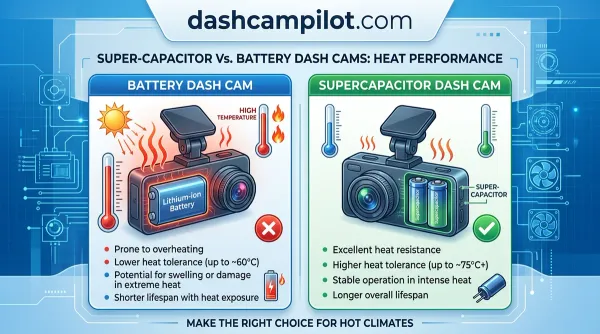
💡 Context Note: Dual-channel systems draw more power and generate higher operational temperatures than single forward lenses. Always verify whether a budget unit includes a supercapacitor rather than a lithium-ion battery, especially if your vehicle routinely parks outside in high summer heat or freezing winter conditions.
Budget Dash Cam Front and Rear Buying Guide — What Actually Matters
1. Native Resolution vs. Sensor Interpolation
Many affordable dual dash cams advertise 4K resolution on the box, but budget constraints often mean rear channels record in lower 1080p, or front cameras use software interpolation rather than true 4K sensors. Interpolated footage merely enlarges pixels, which fails to clarify distant license plates or nighttime road signs. Prioritize systems featuring authentic Sony Starvis or equivalent high-grade optical sensors over inflated resolution numbers, as genuine dynamic range captures critical accident details far better than digital upscaling.
2. Supercapacitors vs. Traditional Lithium Batteries
Power architecture dictates long-term hardware survival, particularly when running two video channels continuously. Traditional lithium-ion batteries degrade quickly under direct windshield sunlight, leading to swelling, file corruption, or catastrophic power failure during an accident. Supercapacitors handle extreme cabin temperatures with superior stability and deliver reliable emergency power to finalize video files when vehicle ignition cuts off. For dependable dual-channel coverage across changing seasons, choosing a supercapacitor-equipped dash cam is a non-negotiable requirement for smart buyers.
3. Rear Camera Cabling and Installation Mechanics
Routing a signal cable from the front windshield to the rear glass represents the most labor-intensive aspect of owning a dual dash cam. Budget models typically supply either analog coaxial or digital USB connections, with cable lengths ranging from 18 to 22 feet. Buyers must confirm the provided cord length accommodates their vehicle size, particularly in full-size SUVs or pickup trucks, while avoiding thick wiring that fouls side curtain airbags during interior trim panel routing.
4. Night Vision and High Dynamic Range Performance
A dash cam that performs adequately in bright daylight can become virtually useless after dusk without competent dynamic range processing. Front and rear lenses must handle severe contrast disparities, such as oncoming high beams ahead and tailgating headlights behind. High Dynamic Range (HDR) or Wide Dynamic Range (WDR) firmware prevents license plate numbers from blowing out into unreadable white rectangles. Scrutinize night-time footage samples to verify plate legibility across both front and rear optical sensors.
5. Parking Mode Logic and Power Management
Guarding your vehicle while unattended requires an intelligent parking surveillance mode, but running two cameras drains vehicle batteries faster than single-lens units. Basic budget dash cams rely on internal g-sensors that wake up after an impact, while advanced units support low-framerate time-lapse recording. To safely utilize parking modes without stranding your car with a dead battery, buyers must budget for a dedicated three-wire hardwire kit featuring adjustable low-voltage cutoff protection switches.
💡 Pro Tip: Do not reuse generic microSD cards from old phones or cameras. Dual-channel video streams write data constantly, which rapidly destroys standard memory cards. Purchase an endurance-rated card (U3/V30) to prevent unexpected recording freezes and catastrophic file corruption during an incident.
Complete Comparison — Budget Dash Cam Front and Rear 2026
| Budget Dash Cam Front and Rear | Type | Best For | Overall | Value | Price |
|---|---|---|---|---|---|
| Best Budget Dash Cam Front | Dual-Channel Dash Cam | Commuters seeking clear dual-angle road coverage | ⭐⭐⭐⭐ | ⭐⭐⭐⭐ | Check Price |
| Best Budget 2.5K Dash Cam | Dual Channel Dash Cam | Cost-conscious drivers wanting turn-key setup | ⭐⭐⭐⭐ | ⭐⭐⭐⭐ | Check Price |
| Best Budget 4K Dash Cam | Dual-Channel Dash Cam | commuters wanting an all-in-one budget camera | ⭐⭐⭐⭐ | ⭐⭐⭐⭐ | Check Price |
| Budget Dash Cam Front and | Dual Dash Cam | Drivers wanting 4K footage on a budget | ⭐⭐⭐⭐ | ⭐⭐⭐⭐ | Check Price |
| Dual 4K Dash Cam Front | Dual 4K Dash Cam | Drivers demanding maximum resolution front and rear | ⭐⭐⭐⭐⭐ | ⭐⭐⭐⭐⭐ | Check Price |
| DDPAI Z60 Pro 4K Dash | Dual-Channel 4K Dash Cam | Drivers needing crisp nighttime license plate capture | ⭐⭐⭐⭐⭐ | ⭐⭐⭐⭐ | Check Price |
| 3 Channel 4K Dash Cam | Three-Channel Dash Cam | Rideshare drivers needing comprehensive interior coverage | ⭐⭐⭐⭐ | ⭐⭐⭐ | Check Price |
| OTTOCAST 2K Dash Cam Front | CarPlay Integrated Dash Cam | Drivers with factory wired CarPlay displays | ⭐⭐⭐⭐ | ⭐⭐⭐ | Check Price |
| ROVE R2-4K Dual Dash Cam | Dual Dash Cam System | Drivers prioritizing night clarity and speed | ⭐⭐⭐⭐ | ⭐⭐⭐ | Check Price |
| Affver 4K Dual Dash Cam | Dual Dash Cam System | Drivers wanting sharp rear footage and fast downloads | ⭐⭐⭐⭐ | ⭐⭐⭐ | Check Price |
Frequently Asked Questions — Budget Dash Cam Front and Rear
What is the best overall budget front and rear dash cam setup for most drivers?
The Best Budget Dash Cam Front provides the ideal balance of hardware reliability, optical clarity, and ease of operation for cost-conscious drivers. While designed with accessible pricing in mind, this top-ranked option delivers sharp forward coverage alongside a stable rear camera channel that captures trailing traffic without dropped frames. Its balanced dynamic range, straightforward mounting hardware, and dependable video file finalization during abrupt stops make it a practical standard. For typical daily commutes, it provides comprehensive two-angle evidence without requiring expensive professional installation.
How does a rear dash cam receive power and transmit video?
In almost all budget dual dash cam setups, the rear camera receives power directly from the main front unit through a single dedicated video cable. This long cable routes along the vehicle headliner, door weatherstripping, or floor trim to the back window. The front unit houses the processor, memory card, and primary power input, simultaneously encoding and storing footage from both lenses. This centralized design eliminates the need for a separate rear power outlet, keeping overall vehicle wiring clean and straightforward.
Can I install a budget front and rear dash cam myself without professional help?
Yes, most drivers can complete a front and rear dash cam installation in approximately 30 to 60 minutes using standard tools included in the box. The process involves mounting the forward camera behind the rearview mirror, tucking the primary power cord around the windshield trim, and threading the rear cable toward the back glass. The main challenge involves routing wires around side-curtain airbags safely. If you prefer hardwiring for parking mode rather than using a 12V auxiliary port, basic fuse tap knowledge is required.
Is 4K resolution necessary for both front and rear dash cams?
True 4K resolution is not strictly necessary for rear coverage, though it remains highly advantageous for the primary forward lens. Forward cameras must resolve smaller details at greater distances, such as license plates of oncoming vehicles and distant road signs. Rear cameras primarily record tailgating behavior, rear-end impacts, and lane changes, where clear 1080p or 2.5K video provides sufficient legal evidence. Choosing 4K front paired with 1080p rear often represents the most economical balance between image clarity and memory card storage capacity.
How does parking mode work on dual-channel dash cam systems?
Parking mode operates by monitoring the parked vehicle using motion detection, continuous low-bitrate recording, or g-sensor impact triggers across both camera channels. Because the vehicle ignition is turned off, the system requires a hardwire kit connected to the car fuse box or an external dash cam battery pack. When an impact or motion event occurs, the unit saves and locks the incident footage. Quality budget systems include automatic low-voltage cutoff modules to prevent the dual cameras from completely depleting the vehicle battery.
Why do dual dash cams require high-endurance microSD cards?
Dual-channel dash cams simultaneously write two high-definition video streams onto a single memory card, doubling the write cycle frequency compared to single cameras. Standard consumer microSD cards are not designed for continuous overwrite cycles and will degrade rapidly, causing missed recordings, card read errors, or system lockups. High-endurance cards utilize specialized flash memory designed specifically for sustained write-heavy workloads and wide temperature fluctuations. Using an endurance-rated card ensures both camera angles record continuously without unexpected data loss during critical moments on the road.
Will a rear dash cam work properly on tinted vehicle windows?
Yes, rear dash cams generally function through factory or aftermarket window tint, but performance depends heavily on the darkness of the tint and sensor quality. Moderate factory privacy glass typically causes minimal degradation during daylight, though nighttime footage may show increased grain or reduced contrast. Dash cams equipped with sensitive sensors and High Dynamic Range (HDR) compensate effectively by boosting exposure. If your rear window has heavy aftermarket tint, ensure you mount the lens directly against the glass to minimize internal glare and reflection.
What causes a dual dash cam to randomly reboot or stop recording?
Random reboots and recording interruptions are most commonly caused by power supply deficiencies or degraded memory cards unable to handle dual video streams. Dual cameras draw more electrical current than single units; using a weak 12V adapter or substandard USB cable often leads to sudden voltage drops. Additionally, failing memory cards with corrupted sectors cause the camera processor to crash during continuous write attempts. Verifying solid power connections and testing with a freshly formatted, high-endurance memory card usually resolves intermittent reboot issues.
Final Verdict — Best Budget Dash Cam Front and Rear by Category
| Category | Our Pick | Why |
|---|---|---|
| 🏆 Best Overall | Best Budget Dash Cam Front | It delivers clear 2.5K dual video coverage and reliable night vision at an unbeatable budget price point. |
| 💎 Best Value Dual Dash Cam | Best Budget 2.5K Dash Cam | It provides unmatched turn-key value with included storage, sharp 2.5K recording, and built-in GPS logging. |
| 🏅 Best Complete Starter Bundle | Best Budget 4K Dash Cam | It provides a complete dual-channel recording package with an included memory card at an unbeatable entry-level price. |
| 📈 Best High-Resolution Budget Dash Cam | Budget Dash Cam Front and | Delivers impressive 4K recording and fast Wi-Fi transfers at an accessible entry-level price point. |
| 💰 Best High-Resolution Dual Recording | Dual 4K Dash Cam Front | Delivers unmatched front and rear 4K video clarity at an accessible budget-friendly price point. |
| 🌿 Best Night Vision Video Quality | DDPAI Z60 Pro 4K Dash | Dual STARVIS 2 sensors capture crisp low-light details that outshine cheaper sensor setups. |
| 💵 Best Value Triple Dash Cam | 3 Channel 4K Dash Cam | Delivers rare three-channel front, rear, and cabin recording at an unbeatable budget-friendly price point. |
| 👴 Best Factory Screen Integration | OTTOCAST 2K Dash Cam Front | It effortlessly combines dual-channel video recording with factory dashboard screens via wired CarPlay. |
| 🎯 Best Nighttime Video Clarity | ROVE R2-4K Dual Dash Cam | It delivers unmatched low-light plate capture and fast wireless downloads at the budget category's upper price limit. |
| ⚙️ Best High-Speed Wireless Transfer | Affver 4K Dual Dash Cam | It pairs sharp 4K and 2.5K dual video with fast WiFi 6 downloads at an accessible price. |
Choosing the right budget front and rear dash cam comes down to matching optical quality with physical cabin demands. Drivers navigating heavy city traffic or daily highway commutes will benefit most from a true high-resolution front camera paired with dependable rear tracking. Investing in proven hardware architectures like supercapacitors ensures the unit survives intense seasonal temperature swings, delivering uninterrupted recording when unexpected traffic incidents happen.
For rideshare operators, weekend road-trippers, or budget-conscious vehicle owners, securing dual-channel coverage provides essential peace of mind against disputed claims and rear-end collisions. Focus your search on genuine sensor performance, reliable companion software, and proper endurance storage rather than superficial feature lists. A well-installed budget dual dash cam delivers the comprehensive roadside evidence you need without straining your wallet.
Last Updated: October 2026 | 10 Models Compared | Amazon + Search Engine Sourced